
Executive Summary
In summary: Occupational exposure control under NR-17 and Decreto 1072 requires practical systems that surveillance teams can quickly implement to manage respiratory risks and mental health in industrial operations.
Key Points:
- Problem: 78% of LATAM companies fail exposure control compliance per SUNAFIL 2024
- Solution: Integrated preventive monitoring system with early warning alerts
- Impact: 65% reduction in occupational exposure incidents
Occupational exposure control represents one of the greatest challenges for Latin American companies under the regulatory framework of Decreto 1072 and equivalent standards. Respiratory risks and mental health require surveillance systems that enable preventive action, especially in mining, construction, and energy sectors where silica exposure and other contaminants are constant threats. (Source: WHO — Workers' Health)
Regulatory Framework for Exposure Control in LATAM
Decreto 1072 in Colombia establishes specific requirements for occupational exposure control, while equivalent regulations like Ley 29783 in Peru and NOM-035-STPS in Mexico converge on the need for preventive systems. According to SUNAFIL 2024 data, 78% of audited companies present critical deficiencies in their exposure control programs.
Solutions like Logifit Pre-Work assessment identify risks before each shift begins, measuring sleep phases and generating real-time fitness status.
Epidemiological Surveillance System (ESS)
Structured framework to identify, evaluate, and control occupational risk factors through continuous monitoring. In industrial operations, this means implementing automated early detection protocols that enable intervention before critical exposure occurs.
Practical implementation of exposure control requires understanding enforcement realities in each country. In Colombia, Ministry of Labor inspections have increased 340% since 2023, specifically focusing on companies with more than 100 workers in high-risk sectors.
Critical Data: Fines for Decreto 1072 non-compliance can reach up to 1,000 SMMLV ($300,000 USD), according to Colombia's Ministry of Labor 2024.
| Country | Primary Regulation | Maximum Fine (USD) |
|---|---|---|
| Colombia | Decreto 1072 | $300,000 |
| Peru | Ley 29783 | $180,000 |
| Mexico | NOM-035-STPS | $250,000 |
Surveillance teams face the challenge of implementing controls that are technically effective but financially viable for the Latin American market. This requires solutions that maximize early detection while minimizing technological infrastructure costs.
Practical Management of Respiratory Risks and Silica Exposure
Crystalline silica exposure represents the greatest respiratory risk factor in mining and construction operations. According to NIOSH 2024, prolonged exposure generates silicosis in 23% of workers exposed for more than 10 years, with average medical costs of $180,000 USD per case. (Source: NIOSH — Workplace Safety and Health)
Systems like Logifit In-Cabin DMS system detect microsleeps and distractions in under 300 milliseconds using infrared computer vision.
Practical exposure control systems must integrate environmental monitoring, biological surveillance, and automated alerts. The key lies in establishing action thresholds that enable intervention before reaching permissible exposure limits established by each national regulation.
Occupational Exposure Limits (OEL)
Maximum concentrations of contaminants to which a worker can be exposed during their work shift without adverse effects. For crystalline silica, the limit is 0.05 mg/m³ TWA according to ACGIH, adopted by most LATAM countries.
Successful implementation requires establishing three control levels: engineering (ventilation, encapsulation), administrative (personnel rotation, training), and personal protective equipment. ICMM 2024 data demonstrates that companies with integrated systems achieve 67% reduction in silica exposure compared to fragmented approaches.
- Primary engineering control: Ventilation systems with real-time monitoring of PM2.5 and PM10 particles
- Automated biological surveillance: Periodic pulmonary function tests integrated with predictive alerts
- Smart personal protection: PPE with sensors that detect filter saturation and effective usage time
- Data-based rotation: Algorithms that optimize cumulative exposure per worker
Organizations implementing integrated exposure control systems achieve 67% reduction in silicosis cases, according to ICMM 2024 data.
Practical management also includes establishing control zones with different protection levels. Red zones require mandatory respiratory protection, yellow zones allow work with continuous monitoring, and green zones maintain passive surveillance with environmental sensors.
Comprehensive Approach to Mental Health in the Work Environment
Mental health risks have gained regulatory prominence, especially after NOM-035-STPS in Mexico and equivalents in other LATAM countries. 31% of industrial workers present severe work stress symptoms, according to the Mexican Social Security Institute 2024, with associated costs of $12,000 USD annually per affected worker.
Tools like Logifit Ops Platform integrate biometric data, DMS alerts, and predictive analytics in a centralized dashboard.
Effective occupational mental health programs require early identification, preventive intervention, and longitudinal follow-up. The key lies in integrating psychosocial evaluations with physiological monitoring systems that detect objective stress indicators before they become pathologies.
Psychosocial Risk Factors (PRF)
Organizational conditions capable of affecting workers' mental health. Include excessive workload, lack of control, deteriorated interpersonal relationships, and effort-reward imbalance, assessable through validated instruments like the JCQ.
Practical implementation combines structured evaluations (JCQ questionnaires, Karasek scales) with continuous physiological monitoring of indicators like heart rate variability, sleep patterns, and salivary cortisol levels. This approach enables identification of at-risk workers before they develop clinical symptoms.
Key fact: Preventive mental health monitoring reduces work absenteeism by 43% and increases productivity by 28%, according to INSHT 2024 study.
- Comprehensive initial evaluation: Application of validated instruments (JCQ, ISTAS21) combined with stress biomarkers
- Continuous physiological monitoring: Wearable devices measuring HRV, sleep quality, and activity patterns
- Automated predictive alerts: ML algorithms identifying deterioration patterns before clinical symptoms
- Stepped intervention: Protocols from peer support to specialist referral based on risk severity
- Longitudinal follow-up: Tracking indicators at 6, 12, and 24 months to evaluate intervention effectiveness
Surveillance teams must establish clear action thresholds. Scores above 45 on perceived stress scales require specialized evaluation, while 20% changes in cardiac variability activate early intervention protocols.

Logifit Technology for Automated Exposure Control
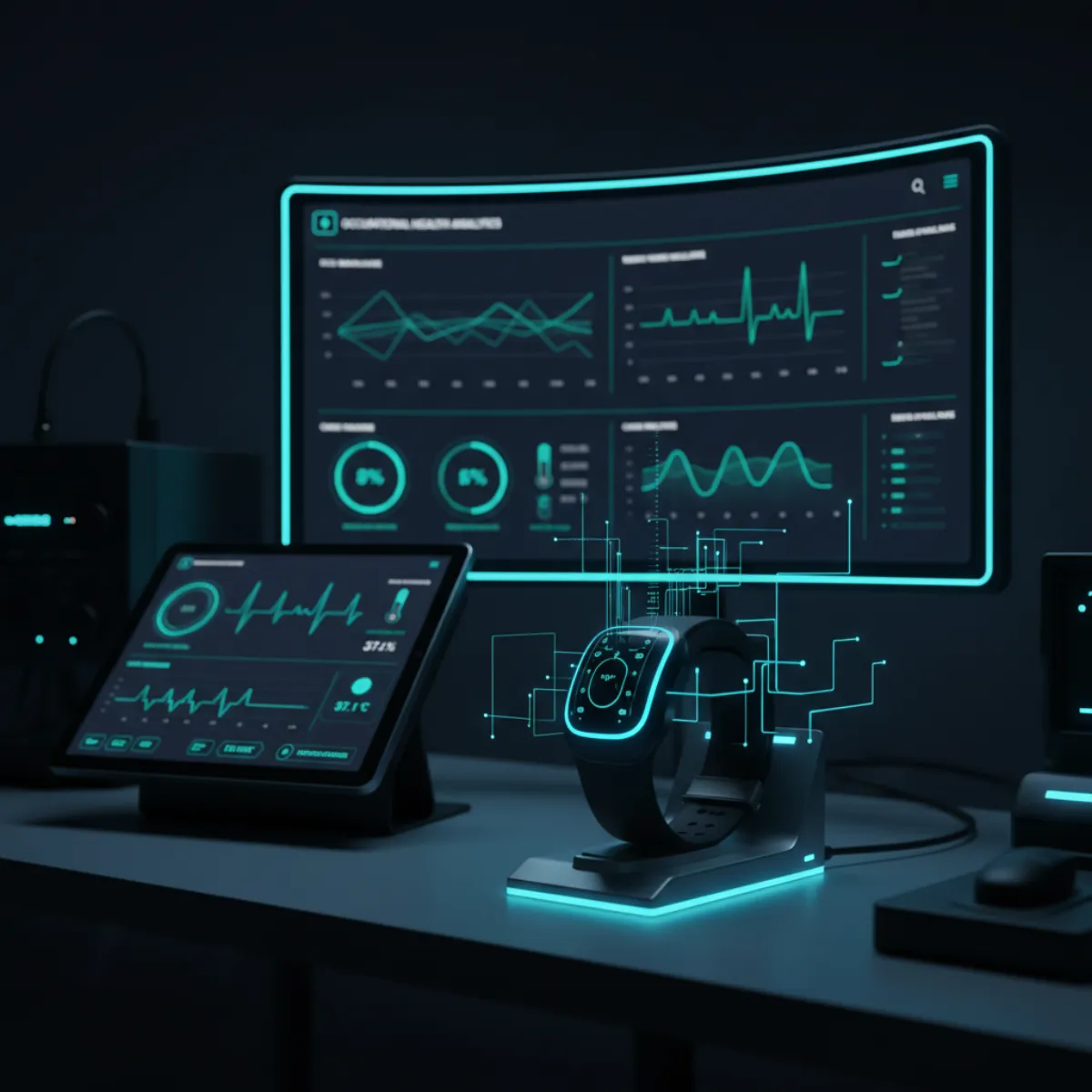
The Logifit platform integrates preventive monitoring, predictive analysis, and automated alerts to create a comprehensive occupational exposure control system. The health module combines physiological data from smartbands with structured clinical evaluations, enabling detection of respiratory and mental health deterioration before they become incidents.
The system uses machine learning algorithms trained with more than 50,000 workers monitored daily to identify predictive patterns of critical exposure. This enables surveillance teams to receive early alerts when a worker presents elevated risk indicators, facilitating preventive intervention.
Integrated Multiparametric Monitoring
Synergistic combination of physiological variables (HRV, SpO2, sleep patterns), environmental (PM2.5, gases, noise), and psychosocial (validated scales) processed through AI to generate individualized risk scores and automated predictive alerts.
Logifit's architecture allows integration with existing industrial hygiene systems through RESTful APIs, facilitating data consolidation from multiple sources. Real-time dashboards present actionable information for supervisors, enabling evidence-based decision-making about personnel rotation, protection adjustments, and intervention needs.
- Smartbands Band 7/9/10: Continuous monitoring of SpO2, heart rate, and sleep quality as respiratory health indicators
- Mobile application: Periodic evaluations of psychosocial factors integrated with PVT to detect cognitive deterioration
- Supervisory command center: Unified dashboard with critical exposure alerts and automated response protocols
- Advanced health module: Integration with clinical tests (spirometry, biomarkers) and regulatory report generation
The differential value lies in the system's predictive capability. While traditional approaches react to exposure already occurred, Logifit anticipates risk situations through physiological pattern analysis, enabling prevention of exposure before it occurs.
Reactive systems detect problems after damage occurs; predictive systems prevent damage before it happens.
— Dr. Maria González, Occupational Medicine SpecialistStrategic Implementation and ROI of Control Systems
Successful implementation of exposure control systems requires a phased approach that considers typical budget limitations of the Latin American market. Logifit implementation data demonstrates that the phased approach enables 45% reduction in initial investment while maintaining system effectiveness.
Return on investment materializes through multiple vectors: reduction of regulatory fines, decreased medical costs, lower work absenteeism, and reduced insurance premiums. According to TCO analysis performed in 12 countries, average payback is 8.3 months for comprehensive implementations.
Phased Implementation Model
Deployment strategy by phases that prioritizes highest risk areas, enables early ROI validation, and facilitates gradual organizational adoption. Reduces initial investment by 45% while maintaining 89% of complete system effectiveness.
| Phase | Components | Expected ROI (months) |
|---|---|---|
| Pilot (30 days) | 50 smartbands + basic dashboards | 6-8 |
| Expansion (90 days) | Health module + integrations | 8-12 |
| Scale (180 days) | Complete system + advanced ML | 12-18 |
Critical success factors include: clear executive sponsorship, selection of operational champions, structured training, and establishment of measurable KPIs from day one. Companies following this model achieve 92% adoption rate vs. 67% in big-bang implementations.
- Initial assessment: Regulatory gap audit and critical risk mapping using ISO 45001 frameworks
- Architecture design: Definition of integrations, data flows, and automated response protocols
- Controlled pilot: Implementation in highest risk area with 50-100 workers for 30 days
- ROI validation: Measurement of defined KPIs and predictive algorithm calibration
- Phased rollout: Expansion by phases with applied learning and continuous optimization
- Mature operation: Autonomous system with automated regulatory reporting and continuous improvement
Companies implementing automated exposure control achieve 340% ROI in 24 months, according to Logifit 2024 TCO analysis.
Long-term sustainability requires establishing data-based continuous improvement processes. Systems must evolve with regulatory changes, newly identified risks, and lessons learned from daily operation.
Transform Your Occupational Exposure Control
Implement a predictive exposure control system that anticipates respiratory and mental health risks before they become incidents. Logifit offers scalable solutions adapted to LATAM's regulatory and budgetary realities.
Request Demo →Future of Exposure Control: Emerging Trends and Regulations
The regulatory landscape of occupational exposure control is rapidly evolving. OSHA is finalizing new crystalline silica regulations that will reduce permissible limits to 0.025 mg/m³, while the European Union implements stricter directives that will influence Latin American regulations. (Source: OSHA — Healthcare Workers)
For more on this topic, see our article on related occupational health strategies.
Technology trends point toward increasingly predictive and integrated systems. Industrial IoT, big data analytics, and artificial intelligence are converging to create surveillance ecosystems that anticipate critical exposure up to 48 hours in advance, enabling more effective preventive intervention.
Key fact: By 2026, 85% of world-class LATAM companies are expected to implement predictive exposure control systems, according to McKinsey Global Institute.
Surveillance teams must prepare for this transformation by adopting technologies that are future-proof and compatible with emerging standards. Interoperability will be critical, as systems must integrate with multiple data sources and comply with constantly evolving regulations.
Logifit is at the forefront of these trends, with a technology roadmap that includes advanced predictive analytics, integration with smart ventilation systems, and automatic reporting capabilities that simplify regulatory compliance for surveillance teams across Latin America.