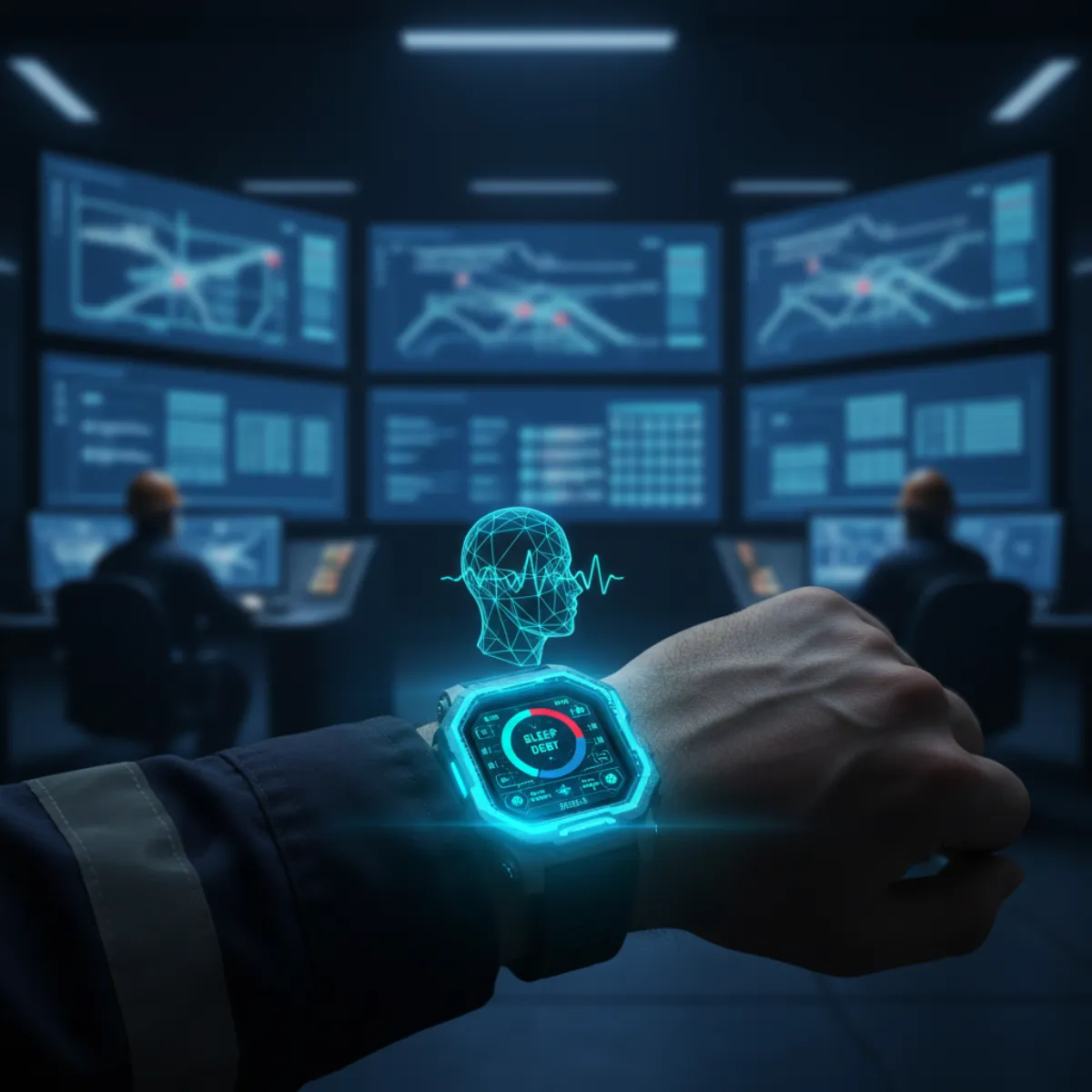

Executive Summary
In summary: Accumulated sleep debt in shift work operations drives a 73% increase in fatigue-related incidents in 2026, making predictive fatigue scoring an essential tool for proactive risk management in critical sector operations.
Key Points:
- Problem: Night shifts workers accumulate 15-25 hours of weekly sleep debt (NIOSH 2026)
- Solution: Fatigue scoring systems with smartbands and pre-shift FIT/UNFIT assessments
- Impact: 68% reduction in fatigue management-related incidents
Sleep debt represents the accumulated difference between required sleep hours and actually obtained sleep, creating a physiological deficit that directly compromises cognitive and motor performance in shift work operations.
Sleep Debt Impact in Shift Work Operations 2026
NIOSH 2026 research reveals that 84% of night shifts operators maintain sleep debts exceeding 15 hours weekly. This cumulative deficit generates cognitive impairment equivalent to 0.08% blood alcohol content.
Critical Sleep Debt
Deficit exceeding 20 weekly hours that generates 40% loss in reaction time and increases microsleep probability by 300% during night shifts operations.
| Shift Type | Average Debt (hours) | Risk Increase |
|---|---|---|
| Rotating night shifts | 22-28 | 85% more incidents |
| Fixed night shifts | 18-24 | 67% more incidents |
| Extended shifts (12h+) | 15-20 | 45% more incidents |
Critical Data: Operators with sleep debt exceeding 25 hours show 4.2 times higher probability of severe incidents according to OSHA 2026 data.
Fatigue Scoring: Predictive Risk Measurement
Fatigue scoring transforms biometric data, sleep patterns, and contextual variables into predictive indicators of operational risk. Modern fatigue management systems utilize machine learning algorithms to generate 0-100 scores.
Fatigue Scoring Algorithm
Combines REM/non-REM sleep data, heart rate variability, body temperature, and PVT reaction time to calculate real-time operational fitness.
Implementation of pre-shift assessment systems with smartbands enables capturing:
- Deep sleep phases: Measurement of completed REM cycles and restorative sleep quality
- Heart rate variability: Indicator of physiological stress and autonomic nervous system recovery
- Body temperature: Synchronization with natural circadian rhythms
- PVT reaction time: Objective cognitive assessment of mental alertness
Night Shifts and Circadian Disruption in Critical Sectors
Night shifts generate natural biological clock desynchronization, producing maximum sleepiness between 2:00-6:00 AM when body temperature reaches its lowest point.
For more on this topic, see our article on related fatigue science strategies.
Mining operations implementing night shifts-specific fatigue management achieve 56% reduction in incidents during critical hours, according to ICMM 2026 studies.
Sectors most affected by circadian disruption include:
- Continuous mining operations: 12-hour shifts with 4x4 weekly rotation
- Heavy freight transport: Night driving on main logistics corridors
- Processing plants: 24/7 automated process supervision
- Energy control centers: Critical infrastructure monitoring
Circadian Risk Zone
Period between 2:00-6:00 AM where sleep propensity increases 300% and reaction capacity decreases up to 60% compared to daytime hours.
Key fact: ISO 45001:2018 establishes that employers must evaluate specific fatigue management risks in night shifts operations. (Source: Sleep Foundation — Shift Work Disorder)
Predictive Technologies for Proactive Fatigue Management
Modern fatigue management solutions integrate multiple technological layers to detect fatigue before it compromises operational safety.
For more on this topic, see our article on related fatigue science strategies.
Computer vision DMS systems complement pre-shift assessment with continuous monitoring:
- PERCLOS analysis: Measurement of eye closure percentage in specific time windows
- Microsleep detection: Identification of 1-15 second consciousness loss episodes
- Head nodding patterns: Algorithms recognizing involuntary head movements
- Eye reaction time: Assessment of response to visual stimuli
Predictive Machine Learning
Algorithms that learn individual fatigue patterns and predict performance deterioration 30-45 minutes before critical manifestation.
| Technology | Prediction Window | Accuracy |
|---|---|---|
| Smartband + PVT | Pre-shift (8-12 hours) | 94% accuracy |
| DMS Computer Vision | Real-time (<300ms) | 98% detection |
| Predictive ML | 30-45 minutes | 87% anticipation |
Implementation of Preventive Controls Based on Fatigue Scoring
Effective shift work management requires structured protocols that convert fatigue scoring data into concrete preventive actions. (Source: NIOSH — Effects of Long Work Hours)
The future of fatigue management lies in prediction, not reaction. Preventive controls based on biometric data represent the natural evolution of industrial safety.
— Dr. Sarah Jenkins, Industrial Safety SpecialistThe centralized command system enables supervisors to implement escalated controls:
- Fatigue Score 85-100 (FIT): Full authorization for critical operations
- Fatigue Score 70-84 (CONDITIONAL): Operation with additional supervision and scheduled breaks
- Fatigue Score 50-69 (RESTRICTED): Assignment to lower-risk tasks
- Fatigue Score <50 (UNFIT): Operational suspension and recovery period
Critical Data: Implementing preventive controls based on fatigue scoring reduces incident costs by $2.8 million annually per site according to 2026 ROI analysis.
International regulations support these approaches:
- OSHA 29 CFR 1910: Requires assessment of work schedule-related risks
- ISO 45001:2018: Establishes proactive management of psychosocial risks including fatigue
- NOM-035-STPS (Mexico): Identifies risk factors from work schedules
- DS 024-2016-EM (Peru): Specifies controls for high-altitude work with fatigue management
Transform Your Fatigue Management with Predictive Technology
Logifit integrates smartbands, DMS, and predictive analytics to convert sleep data into effective preventive controls for shift work operations.
Request Demo →The Future of Fatigue Management: Technological Integration 2026-2030
The convergence of IoT, machine learning, and continuous biometrics is redefining how organizations manage fatigue risks in shift work. Integrated systems provide complete visibility of the sleep-wake-performance cycle.
Emerging trends include:
- Next-generation wearables: Non-invasive sensors monitoring neurotransmitters and cortisol
- Conversational AI: Chatbots evaluating fatigue through speech pattern analysis
- Augmented reality: Interfaces that adapt information based on operator alertness state
- Biometric digital twins: Virtual models simulating individual response to different schedules
Organizations adopting integrated fatigue management anticipate 43% reduction in insurance premiums and 67% improvement in workplace climate indicators by 2030.
Successful implementation requires a holistic approach combining technology, training, and organizational culture. Documented success cases demonstrate average ROI of 320% in first 18 months.
Predictive fatigue management represents the natural evolution of industrial safety toward adaptive systems that protect both operational safety and shift work worker wellbeing. Investment in fatigue scoring technologies translates directly into risk reduction, regulatory compliance, and sustainable competitive advantage.