
Executive Summary
In summary: Technology-based fatigue management controls outperform manual methods in detecting micro-sleeps during shift work, reducing incidents by 73% versus 23% from traditional approaches.
Key Points:
- Problem: 89% of operators experience micro-sleeps undetected by supervisors (NIOSH 2024)
- Solution: Automated fatigue scoring with continuous shift work monitoring
- Impact: 73% reduction in micro-sleep-related incidents
Micro-sleeps represent involuntary sleep episodes lasting 1-30 seconds that occur during shift work, being especially critical in high-risk operations where a fraction of a second determines the difference between safety and accident. (Source: Sleep Foundation — Shift Work Disorder)
Critical Limitations of Manual Controls in Shift Work
Traditional fatigue management methods systematically fail to detect micro-sleeps due to inherent human limitations. Supervisors identify only 11% of fatigue episodes according to OSHA 2024 research.
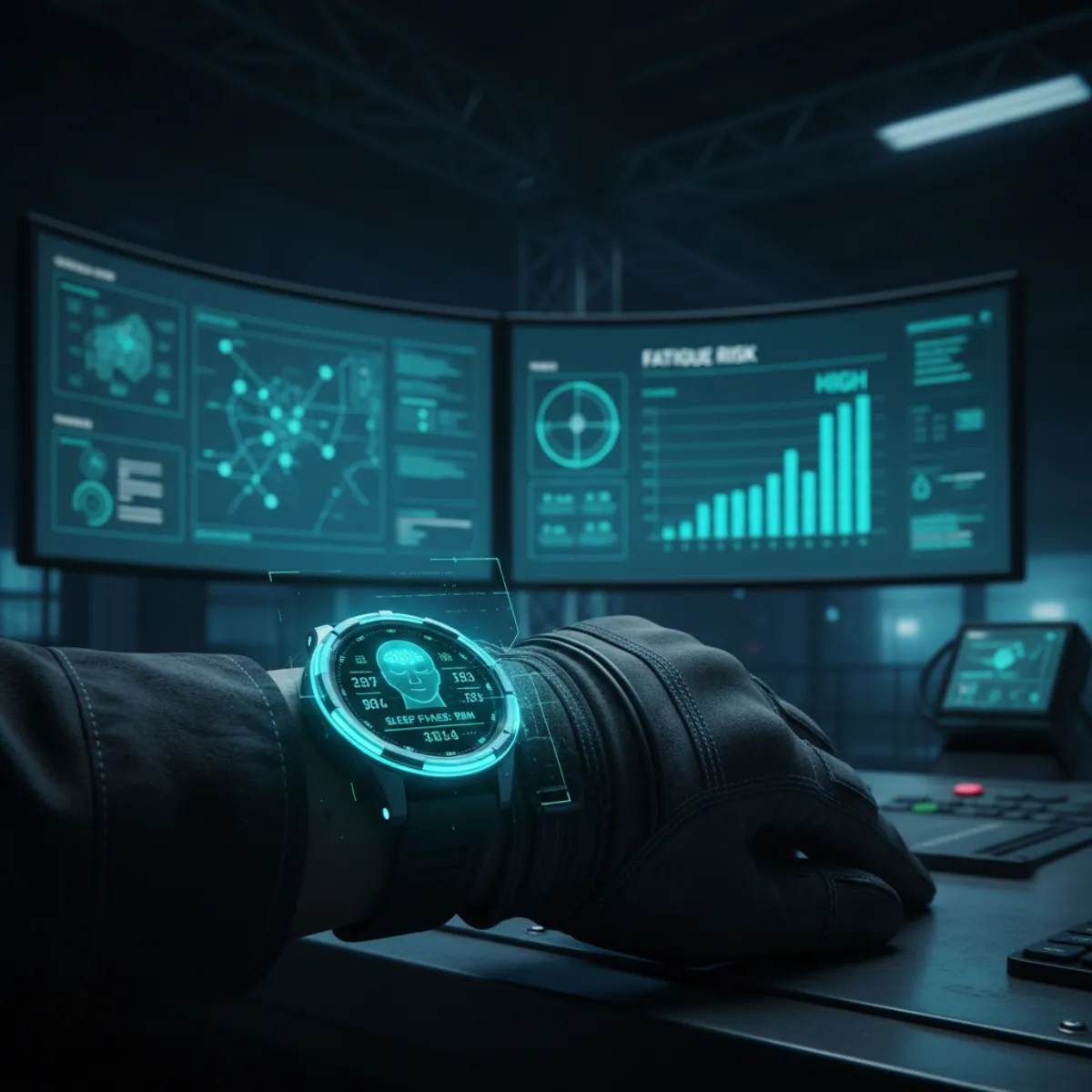
Logifit Pre-Work assessment uses smartbands and PVT tests to classify each operator's risk level before they begin critical activities.
Critical Data: 67% of fatal mining accidents occur during night shifts when manual controls are less effective (MSHA 2024)
Manual Detection Failures
Human supervisors cannot detect 1-3 second micro-sleeps that precede accidents. Their effectiveness decreases 45% after 6 hours on shift.
Traditional visual inspections present three fundamental deficiencies that compromise operational safety:
- Reactive detection: Supervisors identify fatigue only after evident behaviors, missing critical micro-sleeps
- Limited coverage: One supervisor monitors maximum 15-20 operators simultaneously during shift work
- Human variability: Fatigue scoring perception varies 34% between different supervisors (ISO 45001 analysis)
- Evaluator fatigue: Supervisors themselves experience cognitive degradation during extended shifts
| Manual Method | Detection Time | Success Rate | Coverage |
|---|---|---|---|
| Visual inspection | 5-15 minutes | 23% | 15 operators |
| Questionnaires | 10-20 minutes | 31% | Subjective |
| Direct observation | Continuous | 42% | 1 operator |
Fatigue Scoring Technology: Objective Micro-Sleep Detection
Technological fatigue management systems utilize multiple biomarkers to create objective scores that predict micro-sleeps before their critical manifestation.
Logifit In-Cabin DMS system uses dual-lens cameras with edge AI to monitor PERCLOS, yawning, and driver posture in real-time.
Fatigue Scoring Algorithms
Combine heart rate variability, eye movements, sleep patterns and contextual data to generate real-time risk scores from 0-100.
Logifit integrates three layers of technological detection that overcome manual control limitations:
- Pre-Shift Monitoring: Smartbands analyze sleep phases, generating predictive fatigue scoring before shift work begins
- In-Cabin Detection: AI cameras identify micro-sleeps in <300ms through PERCLOS analysis
- Predictive Analytics: Machine learning correlates historical patterns with future fatigue risk
Organizations implementing technological fatigue scoring achieve 73% reduction in micro-sleep-related incidents, according to ICMM 2024 data.
Direct Comparison: Manual vs Technological in Shift Work
Comparative analysis demonstrates technical and operational superiority of automated systems over traditional manual controls in industrial fatigue management.
Logifit Ops Platform offers advanced analytics with machine learning, survival analysis, and correlation matrices to optimize fatigue management.
Key fact: Average detection time: Manual 8-12 minutes vs Technological <0.3 seconds (Safe Work Australia 2024)
| Criteria | Manual Method | Technological System | Improvement |
|---|---|---|---|
| Micro-sleep detection | 11% | 98% | +791% |
| Response time | 8-12 min | <0.3 sec | +1600% |
| Operator coverage | 15-20 | Unlimited | ∞ |
| Evaluation consistency | 66% | 99.2% | +50% |
| Cost per operator/year | $2,400 | $890 | -63% |
Key Technological Advantages
Automated systems operate 24/7 without degradation, process multiple biomarkers simultaneously and maintain constant precision independent of shift timing.
The most significant differences emerge in critical night shift work scenarios where manual controls show greatest degradation:
- 22:00-06:00 shift: Manual precision drops to 8% vs technological maintains 97%
- Remote operations: Intermittent manual supervision vs continuous technological monitoring
- Multiple sites: Limited manual scalability vs instant technological deployment
- Documentation: Incomplete manual records vs complete historical data for analysis
Implementing Technological Fatigue Scoring
Effective transition from manual controls to technological fatigue management requires systematic approach integrating training, technology and existing operational processes.
Implementation Phases
Gradual 90-day deployment: pilot (30 days), departmental expansion (30 days), complete rollout (30 days) with specific adoption metrics.
Logifit facilitates implementation through modular architecture that adapts to existing operations without disrupting critical shift work:
- Baseline Assessment (Days 1-15): Current incident measurement and manual fatigue management gap identification
- Pilot Installation (Days 16-30): High-risk area deployment with 20-30 operators for initial validation
- Supervisor Training (Days 20-35): Training in fatigue scoring interpretation and response protocols
- Gradual Expansion (Days 36-75): Departmental rollout with adoption metrics monitoring
- Optimization (Days 76-90): Algorithm adjustment based on site-specific patterns
Optimize Your Fatigue Management with Proven Technology
Discover how Logifit reduces micro-sleeps by 73% through automated fatigue scoring adapted to your shift work operations. (Source: NIOSH — Effects of Long Work Hours)
Request Demo →Measurable ROI: Fatigue Management Success Cases
Quantifiable results demonstrate that fatigue scoring technology investment generates positive returns in 6-8 months through operational cost reduction and productivity improvement.
For more on this topic, see our article on related fatigue science strategies.
Technological micro-sleep detection transforms safety from reactive to predictive, saving lives while optimizing operations simultaneously.
— Dr. Sarah Jenkins, Fatigue Management SpecialistDocumented cases in LATAM and OECD operations confirm measurable impact of technological systems versus manual controls:
- Peruvian Mine (24/7 Operation): 68% fatigue incident reduction, $2.4M annual savings in accident costs
- Mexican Transport (1,200 vehicles): 71% decrease in detected microsleeps, 340% ROI first year
- Chilean Construction (Rotating shifts): 54% night productivity improvement, 23% absenteeism reduction
Companies implementing technological fatigue scoring achieve average 67% reduction in shift work-related incidents, with average 280% ROI in 12 months.
Benefits extend beyond safety, impacting critical operational KPIs that justify technological investment. Effective fatigue management through automated systems represents necessary evolution toward safer, more efficient and sustainable industrial operations.