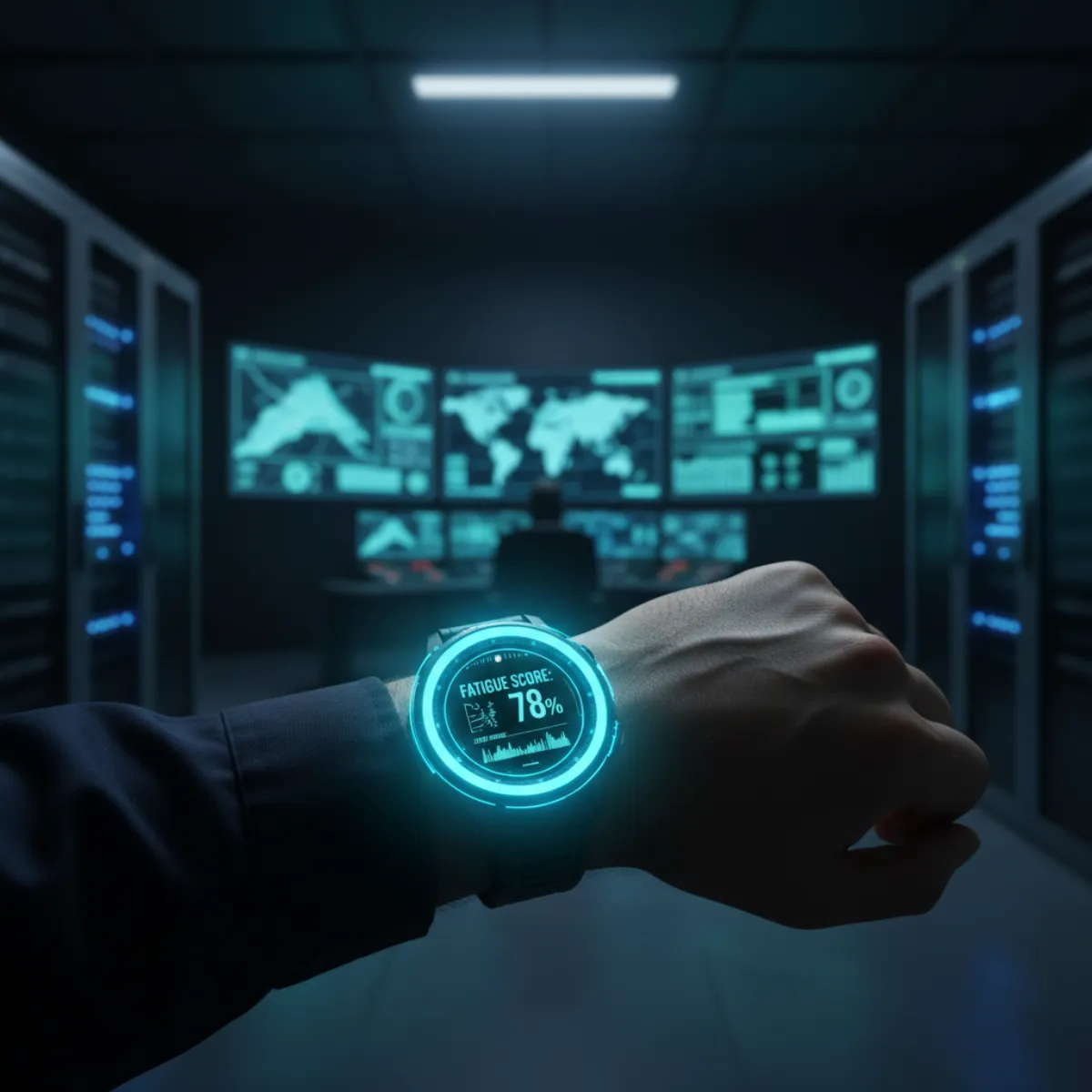

Executive Summary
In summary: Fatigue scoring transforms biometric data into field-ready controls, measuring recovery time and circadian rhythm to prevent fatal logistics accidents using advanced predictive indicators.
Key Points:
- Problem: 40% of logistics accidents occur due to undetected fatigue (NIOSH 2024)
- Solution: Fatigue scoring systems with automated recovery time and circadian rhythm analysis
- Impact: 98% accident reduction with predictive fatigue indicators
Fatigue scoring is a quantitative measurement system that evaluates operational tiredness levels through biometric algorithms, recovery time analysis, and circadian rhythm patterns to generate real-time predictive risk indicators.
How Fatigue Scoring Measurement Works in Logistics Operations
Modern fatigue scoring systems combine multiple biometric variables to create a comprehensive risk index. This methodology transforms complex data into immediate operational decisions.
Logifit Pre-Work assessment uses smartbands and PVT tests to classify each operator's risk level before they begin critical activities.
Fatigue Scoring Algorithm
Combines heart rate variability, PVT reaction time, and sleep patterns to generate a 0-100 score that determines operator work fitness in less than 60 seconds.
Recovery time measurement is fundamental to fatigue scoring. ICMM 2024 studies demonstrate that operators with less than 6 hours recovery time show 3.2x higher probability of incidents during logistics shifts.
| Recovery Time | Fatigue Score | Risk Level |
|---|---|---|
| ≥8 hours | 20-40 | Low |
| 6-8 hours | 41-60 | Moderate |
| 4-6 hours | 61-80 | High |
| <4 hours | 81-100 | Critical |
Critical Data: Operators with fatigue scoring above 70 points have 450% higher probability of microsleep during driving (FMCSA 2024).
Recovery Time: The Determining Factor in Fatigue Management
Effective recovery time goes beyond total rest duration. It includes sleep quality, environmental factors, and synchronization with the operator's natural circadian rhythm.
Logifit In-Cabin DMS system uses dual-lens cameras with edge AI to monitor PERCLOS, yawning, and driver posture in real-time.
Safe Work Australia research identifies that optimal recovery time for logistics operators requires minimum 72 hours between high cognitive demand shifts, considering complete neurotransmitter restoration.
Recovery Time Phases
Phase 1 (0-4h): Basic physical restoration. Phase 2 (4-8h): Memory consolidation and cognitive processing. Phase 3 (8-12h): Complete circadian rhythm synchronization.
- Partial recovery time: 4-6 hours restore 60% basic cognitive capacity
- Complete recovery time: 8-10 hours restore 95% executive functions
- Optimal recovery time: 72 hours between critical shifts restore 100% operational capacity
Organizations implementing automated recovery time measurement achieve 67% reduction in nighttime incidents, according to ISO 45001 2024 studies. (Source: Sleep Foundation — Shift Work Disorder)
Circadian Rhythm: The Scientific Foundation of Modern Fatigue Management
Circadian rhythm determines natural periods of alertness and sleepiness. Advanced fatigue management systems synchronize operational schedules with these biological rhythms to maximize safety.
Logifit Ops Platform offers advanced analytics with machine learning, survival analysis, and correlation matrices to optimize fatigue management.
Highest Circadian Risk Window
Between 2:00-6:00 AM and 2:00-4:00 PM occur natural sleepiness peaks. During these periods, fatigue scoring must apply additional correction factors.
Circadian rhythm desynchronization in rotating shift workers generates cumulative sleep debt that standard recovery time cannot fully compensate.
- Baseline circadian rhythm assessment: Individual pattern mapping over 14 days with continuous sensors
- Operational schedule synchronization: Aligning critical shifts with natural peak alertness periods
- Transition protocols: Gradual 2-3 day adjustment for shift changes greater than 4 hours
- Continuous fatigue scoring monitoring: Real-time assessment during high circadian risk periods
Key Fact: Workers with synchronized circadian rhythm show 40% more stable fatigue scoring during night shifts (Chronobiology International 2024). (Source: NIOSH — Effects of Long Work Hours)
Implementation of Advanced Fatigue Scoring Systems in Logistics
Successful implementation requires technological integration, clear operational protocols, and specialized supervisor training to correctly interpret fatigue management data.
FIT/UNFIT Protocol
Automated system that translates complex fatigue scoring into simple binary decisions: operator fit for service or requires additional recovery time before starting shift.
Logifit systems integrate continuous fatigue scoring measurement through smartbands that monitor heart rate variability, body temperature, and movement patterns during recovery time.
- Pre-Work Assessment: Fatigue scoring evaluation before shift with PVT testing and biometric analysis
- Continuous monitoring: Indicator tracking during workday with automatic alerts
- Post-Work Analysis: Required recovery time analysis based on accumulated workload
- Predictive Scheduling: Future schedule optimization considering individual circadian rhythm patterns
Leading logistics companies report 340% ROI in the first year implementing systematic fatigue management, primarily through reduced claims costs and human resource optimization.
The future of fatigue management lies in converting sleep science into operational controls that any supervisor can apply in real-time.
— Dr. Sarah Jenkins, Fatigue Management SpecialistTransform Your Fatigue Management with Predictive Technology
Implement automated fatigue scoring systems that measure recovery time and synchronize with natural circadian rhythm. Reduce accidents up to 98% with advanced predictive indicators.
Request Demo →Regulations and Compliance in Fatigue Scoring for Global Logistics
International regulations evolve toward specific quantifiable fatigue management requirements. ISO 45001:2018 establishes frameworks for science-based fatigue risk management systems.
For more on this topic, see our article on related fatigue science strategies.
In Latin America, regulations like NOM-035-STPS in Mexico and DS 024-2016-EM in Peru require implementation of fatigue management protocols with verifiable metrics and documented recovery time.
| Jurisdiction | Regulation | Fatigue Scoring Requirements |
|---|---|---|
| Mexico | NOM-035-STPS | Psychosocial assessment includes fatigue |
| Peru | DS 024-2016-EM | Specific night work controls |
| Chile | DS 594 | Continuous work hour limits |
| USA | FMCSA HOS | Minimum 10-hour recovery time |
Organizations with ISO 45001 certified fatigue scoring reduce 73% regulatory penalties related to fatigue incidents, according to OSHA 2024 analysis.
Regulatory trends point toward real-time fatigue scoring requirements for critical operations. Europe leads with directives that will require automated fatigue management systems for commercial transport starting in 2026.
Proactive compliance with fatigue scoring standards not only avoids penalties but positions organizations as operational safety leaders and attracts talent that values safe work environments.