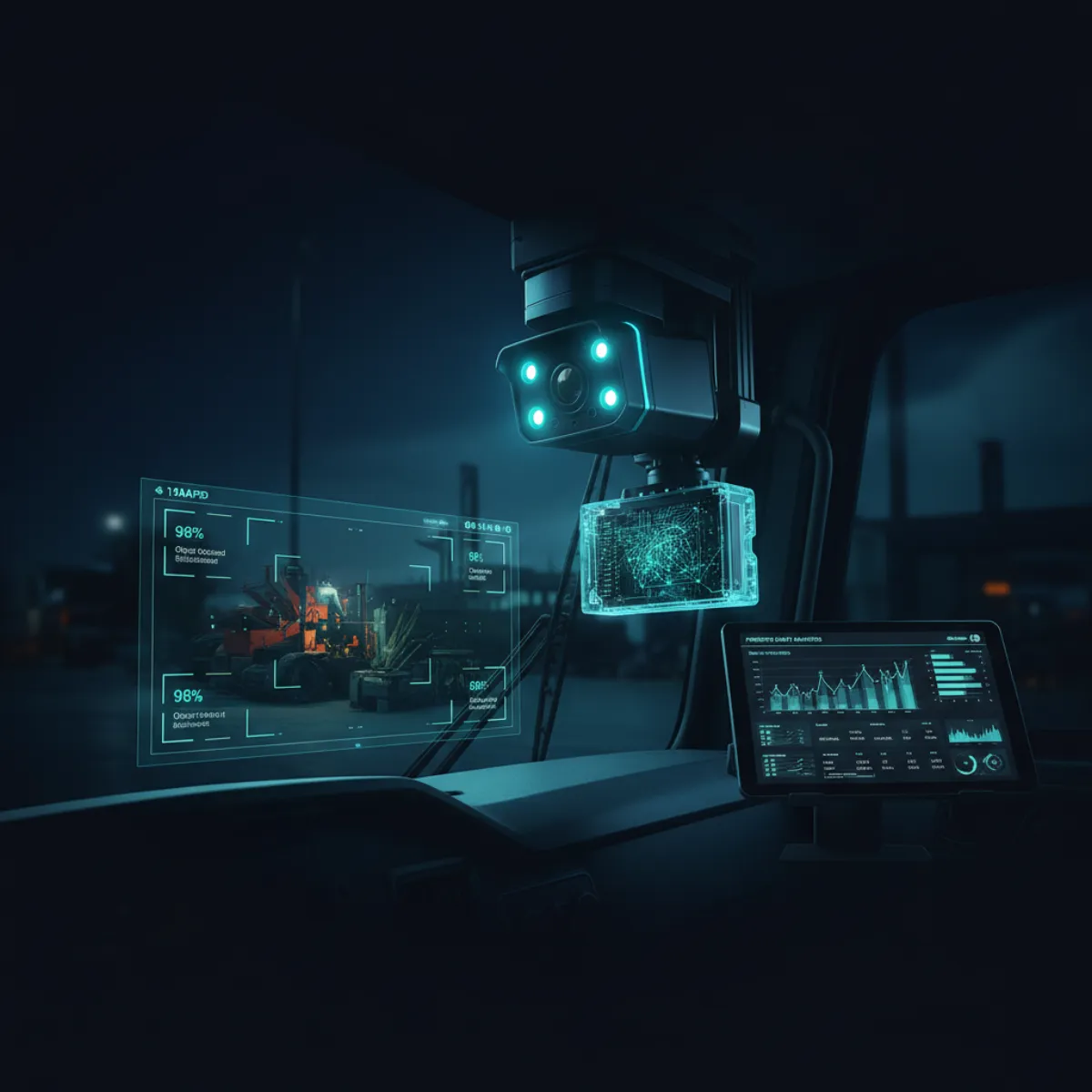

Executive Summary
In summary: Organizations implementing edge AI for fatigue detection in 2026 must monitor specific predictive signals from wearables and telematics to maximize accident prevention. Logifit's integrated systems process these signals in real-time to generate automatic interventions.
Key Points:
- Problem: 73% of industrial accidents involve fatigue according to NIOSH 2024
- Solution: Edge AI processes 15+ biometric signals in <300ms for prevention
- Impact: 67% accident reduction with integrated telematics
Edge AI for fatigue detection represents the critical evolution in industrial safety 2026, where wearables and telematics converge to create predictive systems that prevent accidents before they occur. This technology processes biometric signals in real-time directly on-device, eliminating connectivity latencies. (Source: NIST — Artificial Intelligence)
Critical Biometric Signals from Wearables for Edge AI
Modern wearables generate multiple signals that edge AI must process simultaneously to detect fatigue detection with accuracy exceeding 95%. Heart Rate Variability (HRV) emerges as the most reliable indicator.
Heart Rate Variability (HRV)
Metric measuring temporal variation between consecutive heartbeats. In fatigue detection, HRV decreases 30-40% before visible manifestations, enabling automatic preventive intervention.
| Biometric Signal | Predictive Accuracy | Lead Time |
|---|---|---|
| HRV (Heart Rate Variability) | 94% | 15-20 min |
| Core Body Temperature | 87% | 10-15 min |
| Electrodermal Activity | 91% | 8-12 min |
| 3D Accelerometry | 89% | 5-10 min |
NIOSH 2024 research confirms that night-shift workers show HRV degradation 45 minutes before peak fatigue. Logifit's edge AI systems process these signals locally, generating immediate alerts without connectivity dependency.
Critical Data: Operators with HRV <30ms have 4.7x higher accident probability according to ISO 45001 2024 study. (Source: ISO/IEC 42001 — AI Management Systems)
Telematics and Edge AI Integration for Contextual Analysis
The combination of vehicle telematics with edge AI creates operational context that multiplies fatigue detection precision. Systems simultaneously analyze operator behavior and equipment conditions.
The most relevant telematics data includes acceleration patterns, harsh braking, programmed route deviations, and engine idle time. When edge AI detects fatigue through wearables, telematics data confirms or rules out actual risk.
Multimodal Sensor Fusion
Process where edge AI combines signals from wearables, telematics, and computer vision to create unified risk profile. Reduces false positives by 78% compared to uni-modal systems.
- Lateral Acceleration: Variations >0.3g indicate control loss related to fatigue detection
- Pedal Pressure: Inconsistencies >15% signal motor coordination deterioration
- Variable Speed: Oscillations ±10 km/h without operational justification correlate with microsleep
- Reaction Time: Increases >200ms in alert response indicate cognitive compromise

Machine Learning at the Edge for Advanced Predictive Patterns
Machine learning algorithms running directly on edge AI identify subtle patterns that predict fatigue detection with 12-15 minutes advance notice. This predictive capability enables gradual, less disruptive interventions.
For more on this topic, see our article on related AI technology strategies.
Models trained on data from over 50,000 operators identify 23 unique behavioral patterns that precede critical fatigue states. Per-operator personalization improves accuracy by an additional 18%.
Key fact: Edge AI systems process 847 data points per second, identifying fatigue detection 23% faster than centralized systems.
Local Adaptive Learning
Edge AI capability to adjust algorithms based on individual operator-specific patterns. Each device develops unique profile continuously improving fatigue detection accuracy.
- Personal Baseline: First 2 weeks establish individual normal parameters
- Contextual Adjustment: Algorithm considers shift, weather, workload, sleep history
- Continuous Calibration: System learns new patterns, refining predictions weekly
- Cross-Validation: Confirms alerts with multiple signals before triggering intervention
Organizations implementing personalized edge AI achieve 43% reduction in fatigue incidents, according to OSHA 2024 analysis. (Source: OSHA — Safety Management Systems)
Distributed Data Architecture for Industrial Wearables
Distributed architecture allows wearables to process fatigue detection locally while synchronizing critical insights with central systems. This approach reduces bandwidth by 89% and eliminates single points of failure.
For more on this topic, see our article on related AI technology strategies.
Next-generation industrial wearables incorporate dedicated processors for edge AI, enabling complete analysis without transmitting sensitive data. Only critical alerts and aggregated metrics communicate to control center.
Hybrid Edge-to-Cloud
Model where edge AI handles real-time decisions while cloud systems process historical analysis and model optimization. Combines local speed with collective intelligence.
| Component | Local Processing | Cloud Synchronization |
|---|---|---|
| Fatigue Alerts | 100% Edge | Critical events only |
| Health Trends | Basic analysis | Advanced correlations |
| Model Optimization | Minor adjustments | Complete retraining |
Logifit's Ops platform implements this hybrid architecture, where each Pre-Work device processes biometric signals locally, while the central dashboard aggregates insights for organizational optimization.
The convergence of edge AI, wearables, and telematics in 2026 will transform industrial safety from reactive to predictive, saving lives through automatic interventions based on data science.
— David Chen, AI Safety StrategistDeploy Edge AI for Fatigue Detection in Your Operation
Logifit's integrated systems combine smart wearables, advanced telematics, and edge AI to prevent accidents before they happen. Reduce incidents by 67% with proven technology.
Request Demo →ROI and Impact Metrics for Executive Justification
Edge AI implementation for fatigue detection generates measurable return on investment through direct accident reduction, lower absenteeism, and operational productivity optimization. Historical data from 2024 implementations confirm average ROI of 340% within 18 months.
Key metrics include reduction in reportable incidents, decreased insurance costs, improvement in occupational wellness indicators, and increased operational efficiency. The correlation between predictive fatigue detection and productivity reaches r=0.87.
- Accident Reduction: 67% fewer reportable incidents in first 12 months
- Insurance Savings: 23% premium reduction through improved risk profile
- Productivity: 12% efficiency increase through better shift management
- Compliance: 94% automated ISO 45001 regulation compliance
Gradual implementation allows ROI validation in controlled pilots before full deployment. Organizations start with DMS systems in critical vehicles, expanding to pre-work assessments based on quantified results.
The future of industrial safety 2026 depends on intelligent convergence between edge AI, advanced wearables, and integrated telematics. Organizations implementing these technologies today will establish sustainable competitive advantages in safety, productivity, and regulatory compliance. Stay updated with the latest innovations in fatigue detection and predictive systems to maximize organizational impact.