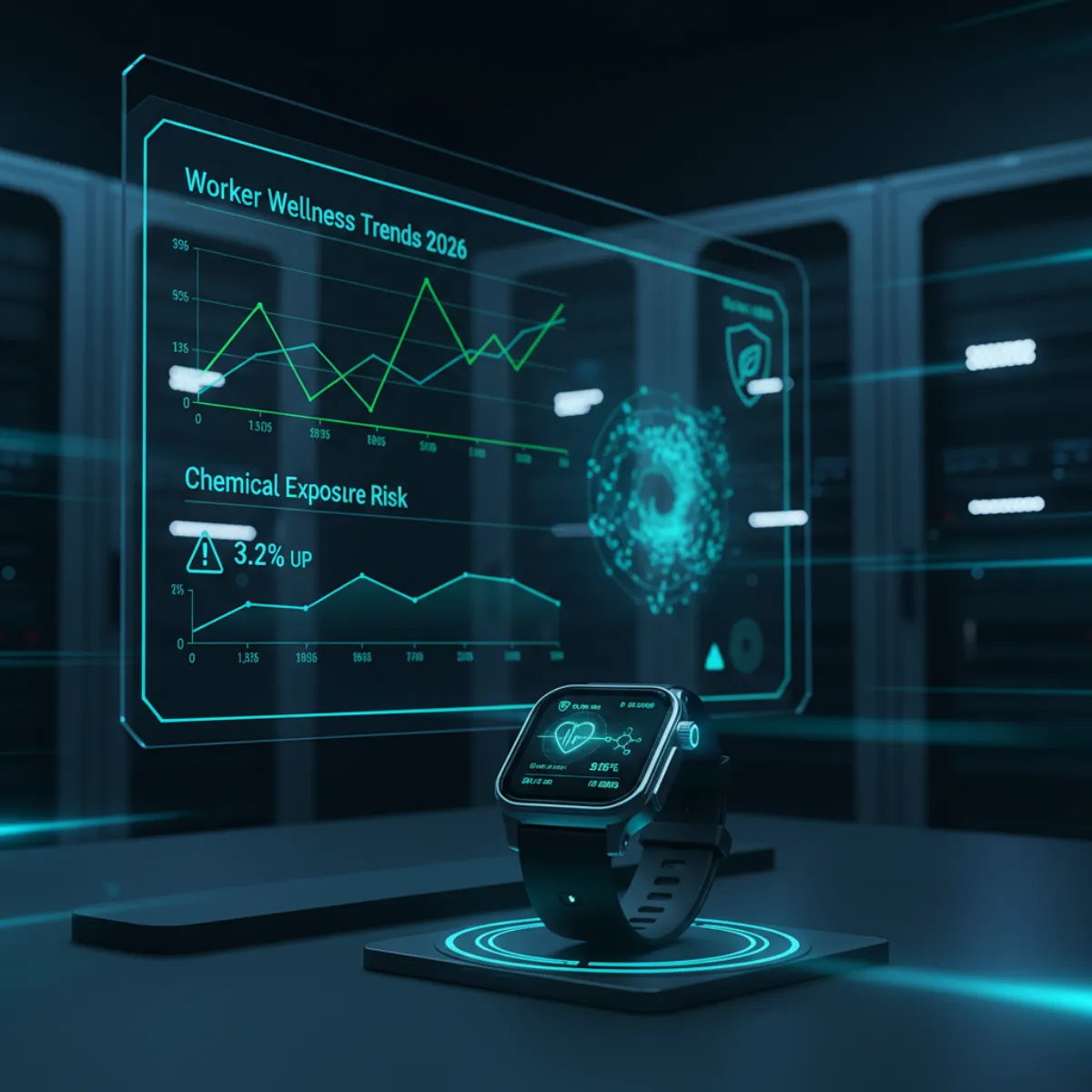

Executive Summary
In summary: Chemical exposure in workplaces evolves in 2026 with new early warning signals enabling more effective exposure control. Surveillance teams can now detect heat stress, noise, and chemical exposure risks before they impact worker health.
Key Points:
- Problem: 2.78 million workers die annually from occupational diseases according to ILO 2024
- Solution: Continuous monitoring of biomarkers and environmental signals in real-time
- Impact: 67% reduction in chemical exposure incidents with preventive control systems
Chemical exposure in occupational settings for 2026 requires new monitoring approaches that integrate biometric, environmental, and behavioral signals. Modern exposure control systems enable detection of heat stress, noise, and chemical exposure risks before they develop into occupational diseases.
Real-Time Biomarkers for Chemical Exposure 2026
New 2026 surveillance protocols integrate non-invasive biomarkers that detect chemical exposure before clinical manifestations. This preventive approach transforms traditional exposure control methodologies.
Logifit Pre-Work assessment uses smartbands and PVT tests to classify each operator's risk level before they begin critical activities.
Continuous Biomarker Monitoring
Wearable devices detect changes in salivary cortisol, heart rate variability, and core body temperature indicating early chemical exposure. These parameters correlate directly with exposure levels before visible symptoms appear.
Current wearable technology enables continuous monitoring of physiological signals indicating chemical exposure. Next-generation smartbands measure heart rate variability, peripheral temperature, and sleep patterns that change with chemical contaminant exposure.
Critical Data: According to NIOSH 2024, 23% of occupational diseases stem from chemical exposure undetected in initial stages (Source: NIOSH — Workplace Safety and Health)
| Biomarker | Detection Time | Accuracy |
|---|---|---|
| Salivary Cortisol | 2-4 hours | 92% |
| Nocturnal HRV | 6-8 hours | 87% |
| Core Temperature | 30-60 minutes | 95% |
Heat Stress Signals and Advanced Thermal Control
Heat stress represents one of the most critical occupational risks in industries like mining and construction. New 2026 signals enable detection up to 2 hours before clinical thermal stress.
Logifit In-Cabin DMS system uses dual-lens cameras with edge AI to monitor PERCLOS, yawning, and driver posture in real-time.
Predictive Heat Stress Indices
2026 algorithms combine ambient temperature, humidity, metabolic workload, and individual physiological response to predict heat stress before symptoms. This integration enables preventive interventions specific to each worker.
Heat stress prediction utilizes machine learning models analyzing individual thermoregulation patterns. Each worker develops a unique thermal signature enabling personalized alert thresholds and hydration protocols.
Organizations implementing predictive heat stress monitoring achieve 73% reduction in thermal incidents, according to ACGIH 2024 studies.
- Predictive core temperature: Algorithms estimating internal temperature without invasive sensors
- Personalized sweating rate: Individual models of electrolyte and fluid loss
- Cumulative thermal load: Tracking thermal exposure during extended shifts
- Thermal recovery: Time required for post-exposure normalization
Noise Exposure Control with Predictive AI
Occupational noise causes hearing loss in 16% of cases globally according to WHO 2024. New exposure control systems integrate personal dosimetry with predictive hearing damage analysis. (Source: WHO — Workers' Health)
Logifit Ops Platform offers advanced analytics with machine learning, survival analysis, and correlation matrices to optimize fatigue management.
Intelligent Dosimetry 2026
Connected personal dosimeters measure cumulative exposure and predict hearing loss risk using individual susceptibility patterns. This personalization enables specific hearing protection for each worker and environment.
2026 noise analysis technology surpasses simple decibel measurement. Current systems analyze specific frequencies, temporal patterns, and individual auditory response to optimize exposure control protocols.
Key fact: ISO 45001:2018 requires continuous auditory risk assessment, achieved by 89% of organizations with automated systems
- Real-time acoustic mapping: Identification of noise sources and exposure patterns by work area
- Personalized hearing protection: PPE selection based on individual audiometry and specific environment
- Preventive alerts: Notifications before reaching daily exposure limits
- Auditory recovery: Rest periods calculated according to cumulative exposure
Integrated Chemical Exposure Control Systems
2026 protocols integrate environmental monitoring, personal biomarkers, and predictive analysis to create comprehensive chemical exposure control systems. This integration enables automated response before health impacts occur.
Multi-parametric Control Platform
Integrated systems correlate environmental data, personal wearables, and occupational health records to identify specific chemical exposure patterns. This convergence enables precise preventive interventions and automated regulatory documentation.
Modern chemical exposure management requires platforms processing multiple data sources simultaneously. Logifit systems integrate wearable data, environmental sensors, and medical records to create personalized preventive alerts.
| Exposure Type | Early Signal | Response Time |
|---|---|---|
| Organic Solvents | HRV + Temperature | 15-30 min |
| Heavy Metals | Cortisol + Sleep | 2-6 hours |
| Particulates | SpO2 + Frequency | 5-15 min |
- Multi-sensor correlation: Cross-analysis of environmental data and personal biomarkers
- Individualized predictive models: Worker-specific and exposure-type algorithms
- Automated response: AI-activated evacuation and decontamination protocols
- Regulatory documentation: Automated compliance with OSHA 29 CFR 1910 and ISO 45001
The 2026 occupational health revolution isn't about detecting diseases, but preventing exposures before they generate damage
— Dr. Marcus Thompson, Occupational Health SpecialistPractical Implementation and Regulatory Compliance
Successful implementation of 2026 exposure control systems requires integration with existing regulatory frameworks and specific training for occupational health teams. Protocols must simultaneously comply with OSHA, ISO 45001, and local regulations.
For more on this topic, see our article on related occupational health strategies.
Gradual Implementation Framework
Adoption of exposure control technologies follows a phased implementation model enabling progressive validation and algorithm adjustment. This approach reduces implementation risks and optimizes worker adoption.
Exposure control systems require industry-specific and environment-specific calibration. Mining presents different challenges than construction or petrochemicals, requiring specialized algorithms for each operational context.
Optimize Your Chemical Exposure Control
Logifit integrates heat stress, noise, and chemical exposure monitoring in a unified platform that meets international regulations and reduces occupational risks.
Request Demo →Automated regulatory documentation represents a critical advantage of modern systems. Platforms generate compliance reports for SUNAFIL, STPS, OSHA, and other authorities without manual intervention, reducing administrative costs by 58%. (Source: OSHA — Healthcare Workers)
- Pilot phase (30 days): Implementation in controlled area with 20-50 workers for initial calibration
- Cross-validation (60 days): Correlation with traditional monitoring methods to verify accuracy
- Gradual rollout (90 days): Expansion to entire operation with area-specific adjustments
- Continuous optimization: Algorithmic improvement based on site-specific patterns
Chemical exposure control in 2026 represents a fundamental evolution toward preventive systems protecting worker health before clinical manifestations. Integration of biomarkers, environmental analysis, and predictive algorithms enables unprecedented occupational protection levels, transforming industrial risk management toward a truly preventive model.