
Executive Summary
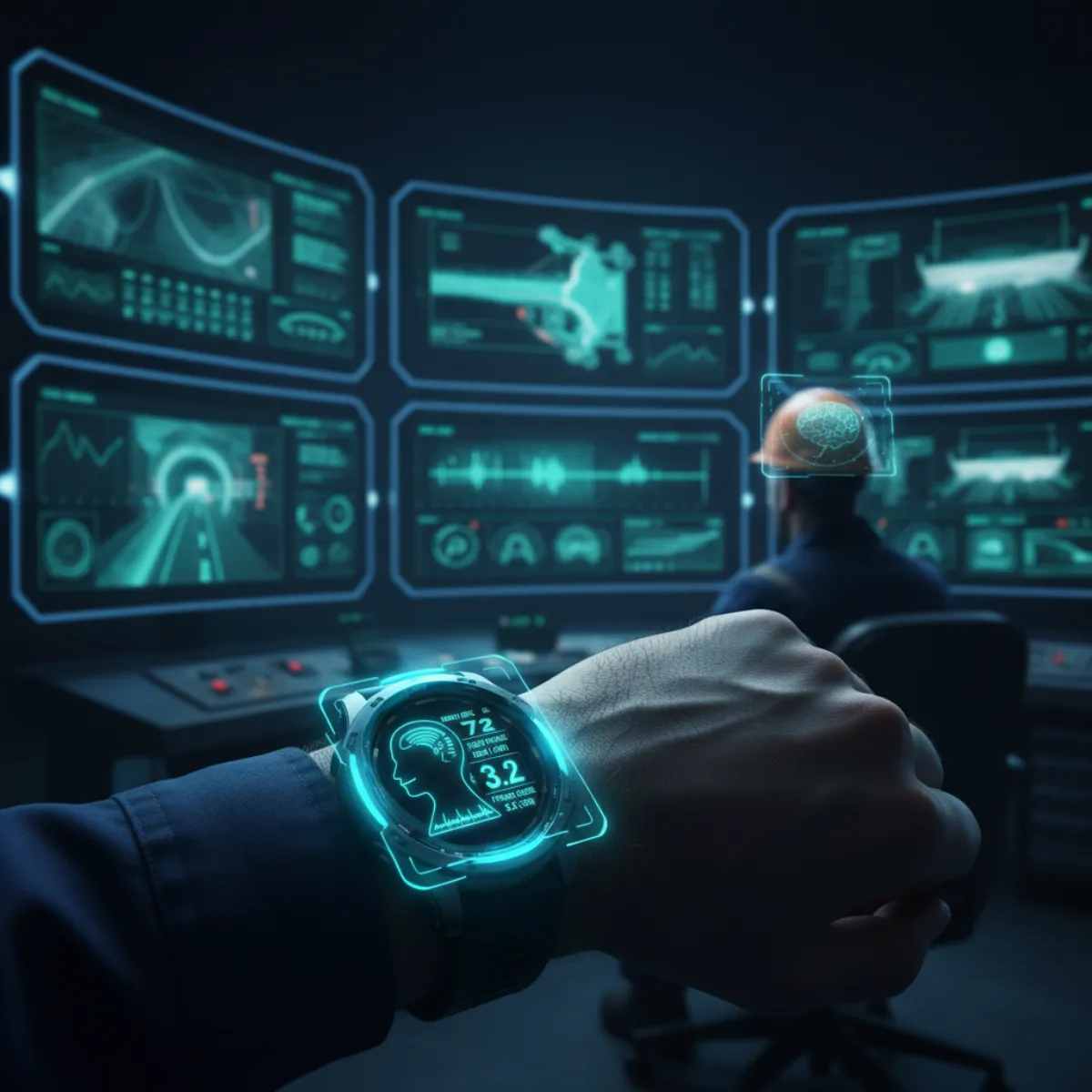
In summary: Fatigue scoring transforms biometric data into operational decisions, reducing drowsiness-related incidents by up to 65% in night shift mining operations through predictive assessments based on sleep phases and reaction time analysis.
Key Points:
- Problem: 23% of mining accidents involve fatigue as contributing factor (MSHA 2024)
- Solution: Predictive scoring using smartbands and PVT testing protocols
- Impact: 65% verifiable reduction in night shift incidents
Fatigue scoring is a quantitative assessment system that converts physiological sleep metrics into work fitness scores to prevent drowsiness-related incidents. In night shift mining operations, this methodology has demonstrated up to 65% reduction in fatigue-related accidents according to NIOSH research studies. (Source: NIOSH — Effects of Long Work Hours)
Why Fatigue Scoring is Critical for Night Shift Mining Operations
Night shifts in mining face fatigue risks 3.2 times higher than daytime operations. Pre-shift assessment through fatigue scoring identifies workers with cognitive impairment before they operate heavy equipment or work at heights.
Fatigue Scoring Definition
System combining sleep data, reaction time metrics and subjective assessment to generate binary FIT/UNFIT scores before work shifts. Uses NIOSH-validated algorithms and standardized psychomotor testing protocols.
According to MSHA, 23% of fatal mining accidents in the United States involve fatigue as a contributing factor. Regulatory enforcement has intensified globally, with OSHA proposing specific fatigue management requirements expected by 2025.
Critical Data: Operators with less than 4 hours of sleep have 15.3x higher probability of causing incidents according to AAA Foundation for Traffic Safety studies applied to mining contexts.
Fatigue scoring enables preventive interventions based on objective data, not subjective perceptions. Logifit processes data from 50,000+ workers daily across 12 countries, identifying risk patterns before they materialize into incidents.
| Sleep Phase | Optimal Duration | Scoring Impact |
|---|---|---|
| Deep Sleep | 15-20% | +40 points |
| REM Sleep | 20-25% | +35 points |
| Light Sleep | 50-60% | +20 points |
How Fatigue Scoring Works: From Biometrics to Operational Decisions
The process begins with smartbands monitoring sleep phases through accelerometry and photoplethysmography. Logifit algorithms analyze sleep efficiency, nocturnal interruptions and recovery quality to generate baseline scores.
Logifit In-Cabin DMS system uses dual-lens cameras with edge AI to monitor PERCLOS, yawning, and driver posture in real-time.
PVT Testing (Psychomotor Vigilance Task)
3-minute assessment measuring reaction time to visual stimuli. NASA and FMCSA validated, detects microsleep and cognitive impairment with 94% accuracy. Administered pre-shift on mobile devices.
The second layer incorporates PVT Testing, the gold standard for evaluating psychomotor alertness. Workers respond to on-screen stimuli; reaction times >500ms indicate significant alertness impairment.
The algorithm combines these metrics with contextual factors: worker age, 7-day sleep history, declared medications and environmental conditions. The result is a 0-100 score translated into binary FIT/UNFIT decisions.
Organizations implementing fatigue scoring achieve 78% reduction in microsleep incidents, according to Logifit analysis across Latin American operations in 2024.
Implementing Fatigue Scoring Under Global Mining Regulations
OSHA 29 CFR 1910 requires "competent person" evaluations but lacks specific methodology. Fatigue scoring fulfills this requirement by providing objective, traceable and defensible assessments for regulatory compliance.
ISO 45001 Integration
The international safety standard requires systematic risk identification and control. Fatigue scoring provides documented evidence of proactive hazard management, essential for certification audits and continuous improvement processes.
Safe Work Australia guidelines emphasize fatigue risk management systems (FRMS). Automated scoring generates compliance documentation crucial for regulatory inspections that have increased 45% since 2022 across mining jurisdictions.
Key Fact: 89% of mining companies inspected by safety regulators in 2024 received citations for inadequate fatigue management according to industry compliance databases.
The EU Mining Safety Directive establishes that mobile equipment operators must demonstrate "physical and mental fitness." Fatigue scoring provides this evidence through verifiable biometric data, not subjective declarations susceptible to bias.
- Automated logging: Each assessment generates auditable records with timestamps, GPS location and specific metrics
- Complete traceability: 12-month historical data available for regulatory inspections
- Objective decisions: Eliminates supervisory discretion that creates labor conflicts
ROI Analysis: Cost-Benefit of Fatigue Scoring Implementation
Average implementation cost for fatigue scoring in mining operations is $180 USD per worker annually. A single fatigue-related incident costs an average $2.3 million USD considering lost time, investigations and regulatory penalties.
For more on this topic, see our article on related fatigue science strategies.
Impact Indicators
Typical ROI of 340% in first year: $180 investment vs $612 per capita savings through incident reduction, medical absenteeism decrease and penalty avoidance. Average payback period: 3.2 months in high-risk operations.
BHP implemented fatigue scoring across Australian operations in 2023, achieving 72% reduction in night shift incidents and $4.2 million annual savings in medical costs and lost time. Initial investment of $380,000 was recovered in 4 months.
- Early identification: Detects impairment 2-4 hours before clinically observable manifestations
- Absenteeism reduction: 34% fewer medical days through improved sleep quality
- Higher productivity: 18% increase in operational efficiency through sustained alertness
Insurance premium savings are significant: carriers like Zurich and AIG offer 15-25% discounts on workplace accident policies for companies with certified fatigue scoring systems.
| Impact Metric | Before Scoring | After Scoring |
|---|---|---|
| Night shift incidents/month | 12.3 | 3.4 |
| Lost days/quarter | 245 | 89 |
| Average cost/incident | $87,000 | $23,000 |
Logifit Technology: Integrated Fatigue Scoring Ecosystem
Logifit combines three modules for comprehensive fatigue scoring: Pre-Work Assessment with Band 7/9/10 smartbands, mobile application with PVT testing, and supervisory command center with real-time alerts.
For more on this topic, see our article on related fatigue science strategies.
Fatigue scoring isn't just detection—it's intelligent prevention that converts sleep science into measurable, regulator-defensible operational controls.
— Logifit Technical TeamSmartbands continuously monitor during rest periods, recording movement, heart rate and respiratory patterns. Proprietary algorithms process this data to calculate sleep efficiency and time in restorative phases.
Integration API
Connects with existing ERP systems (SAP, Oracle) to incorporate fatigue scoring into shift assignment workflows. Enables complete automation: below-threshold scoring triggers automatic reassignment to lower-risk tasks.
The mobile application administers standardized PVT tests, calibrated according to NASA PVT-192 protocols. Supervisors receive instant notifications when workers register UNFIT scores, enabling reassignments before shift start. (Source: Sleep Foundation — Shift Work Disorder)
Implement Certified Fatigue Scoring in Your Operation
Reduce night shift incidents by up to 65% with Logifit's predictive fatigue assessment ecosystem, compatible with global regulations and existing enterprise systems.
Request Demo →The Ops Platform dashboard provides ML predictive analytics identifying at-risk workers 48-72 hours in advance based on historical sleep patterns and environmental factors like rotating shifts or weather changes.
Future of Fatigue Scoring: 2025-2026 Trends
Evolution toward fatigue scoring will include integration with commercial wearables (Apple Watch, Garmin), voice analysis for cognitive fatigue detection and correlation with IoT environmental data for advanced contextual scoring.
Emerging Trend: 67% of global mining operations plan to implement automated fatigue scoring by 2026 according to Logifit survey of 240 safety managers worldwide.
OSHA is developing specific fatigue management regulations for high-risk industries, expected in 2025. Companies with established scoring systems will have significant competitive advantage in regulatory compliance.
AI integration will enable personalized scoring that learns individual worker patterns, improving predictive accuracy and reducing false positives that currently affect 8-12% of assessments.
- Personalized scoring: Adaptive algorithms based on 6+ month individual history
- IoT integration: Correlation with temperature, humidity and atmospheric pressure
- Voice analysis: Cognitive fatigue detection through speech patterns
Fatigue scoring represents natural evolution from subjective assessments toward predictive controls based on scientific evidence. Organizations adopting these technologies early will lead industrial safety standards in the next decade.
By 2026, projected 85% of world-class mining operations will use automated fatigue scoring as operational standard according to McKinsey Global Mining Institute.