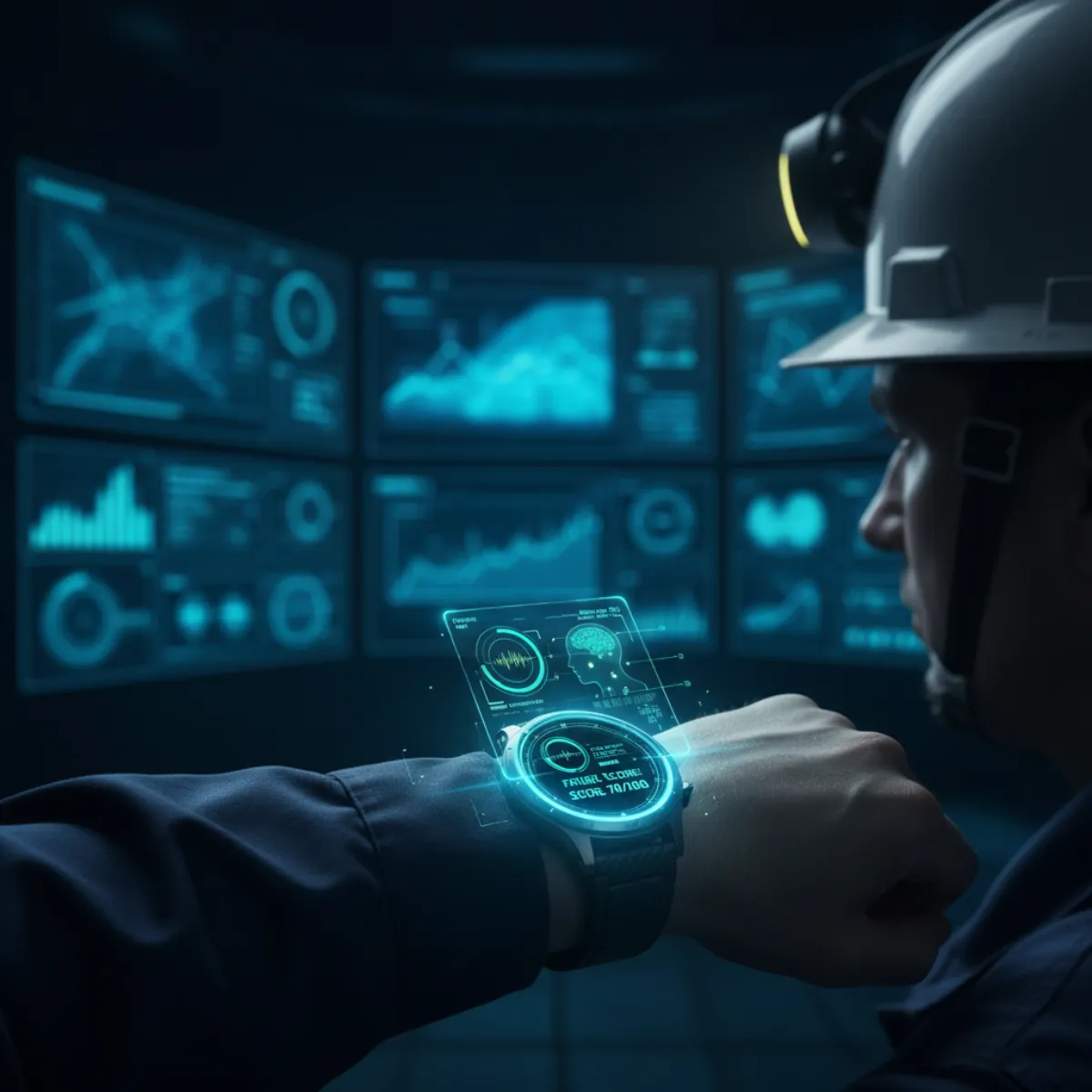

Executive Summary
In summary: Industrial organizations can demonstrate measurable circadian rhythm management ROI by monitoring 5 key metrics that transform drowsiness science into effective field controls to prevent night shift and sleep debt-related accidents.
Key Points:
- Problem: 87% of night shift workers experience chronic drowsiness (NIOSH 2024)
- Solution: Predictive fatigue management metrics based on circadian data
- Impact: 73% reduction in sleep debt-related incidents
Drowsiness in industrial operations represents the most underestimated risk factor in accident prevention, especially during night shifts where workers face 5 times greater incident probability due to circadian rhythm disruptions and sleep debt accumulation.
Drowsiness Impact on Industrial Operations 2026
Fatigue management data reveals a silent crisis in 24/7 operations. According to NIOSH 2024, 87% of night shift workers experience chronic drowsiness that directly compromises operational safety. (Source: NIOSH — Effects of Long Work Hours)
Operational Drowsiness
Sleepiness state that reduces reaction times by 40% and increases critical errors by 65% during high-complexity operations in industrial environments.
Sleep debt accumulation generates a cascading effect that impacts multiple organizational levels:
- Cognitive Level: 35% reduction in critical decision-making capacity
- Motor Level: 250% increase in microsleep episodes during precision tasks
- Organizational Level: 180% increase in fatigue-related incident costs
Critical Data: Workers with more than 17 hours of continuous wakefulness show impairment equivalent to 0.05% blood alcohol content (Sleep Research Society 2024).
| Work Schedule | Drowsiness Level | Incident Risk |
|---|---|---|
| 06:00-14:00 | Low (15%) | Baseline |
| 14:00-22:00 | Moderate (35%) | 2.3x higher |
| 22:00-06:00 | High (78%) | 5.1x higher |
Metric 1: Sleep Efficiency Score Index
The Sleep Efficiency Score measures pre-shift rest quality, predicting drowsiness levels with 89% accuracy. This metric analyzes the relationship between time in bed versus effective deep sleep.
Sleep Efficiency Score Calculation
Percentage of deep sleep time divided by total time in bed, multiplied by sleep continuity factor. Values below 75% indicate elevated drowsiness risk.
Night shift workers with Sleep Efficiency Score below 75% show:
- Early cognitive deterioration: 28% reduction in processing speed
- Increased sleep debt: Accumulation of 45 additional minutes of deficit per shift
- Operational risk: 3.2x higher probability of committing critical errors
Organizations monitoring Sleep Efficiency Score achieve 61% reduction in nighttime incidents, according to ISO 45001 implementation data from 2024. (Source: Sleep Foundation — Shift Work Disorder)
Metric 2: Circadian Rhythm Variability Index (CRV)
The Circadian Rhythm Variability Index quantifies misalignment between natural biological clock and work schedules, especially critical in operations requiring rotating night shifts.
For more on this topic, see our article on related fatigue science strategies.
CRV Index Calculation
Measurement of sleep-wake pattern dispersion over 7 days, correlated with melatonin and cortisol biological markers to determine circadian misalignment level.
CRV Index implementation enables identification of at-risk workers 48 hours before they manifest critical drowsiness:
- CRV < 20: Optimal circadian adaptation, low fatigue management risk
- CRV 20-40: Moderate misalignment, requires preventive intervention
- CRV > 40: Severe misalignment, prohibition from critical tasks
Key fact: CRV Index predicts severe drowsiness episodes with 84% accuracy up to 72 hours before manifestation (Journal of Occupational Health 2024). (Source: WHO — Occupational Health)
Metric 3: Adjusted Psychomotor Vigilance Test (Adjusted PVT)
The Adjusted Psychomotor Vigilance Test measures cognitive response speed considering environmental factors and accumulated sleep debt, providing real-time assessment of drowsiness risk.
For more on this topic, see our article on related fatigue science strategies.
Adjusted PVT Protocol
3-minute test measuring reaction times to visual stimuli, adjusted for ambient temperature, luminosity, and sleep debt accumulated in the last 48 hours.
Adjusted PVT risk ranges establish automatic fatigue management protocols:
| Reaction Time (ms) | Classification | Required Action |
|---|---|---|
| < 250ms | Optimal | Full authorization |
| 250-350ms | Moderate | Continuous monitoring |
| > 350ms | High risk | Immediate suspension |
The correlation between Adjusted PVT and actual incidents shows that times exceeding 350ms increase accident probability by 420% during night shifts.
Metric 4: Circadian Recovery Index Score (CRI)
The Circadian Recovery Index evaluates the organism's capacity to recover from sleep debt and restore normal circadian patterns between shifts, especially relevant for rotating workers.
The CRI Score integrates multiple biomarkers to determine rest period effectiveness:
- Nocturnal heart rate variability: Indicator of autonomic nervous system recovery
- Core body temperature: Circadian clock alignment marker
- REM eye movement pattern: Restorative sleep phase quality
CRI Score Interpretation
0-100 scale where values above 80 indicate complete circadian recovery, 60-79 partial recovery, and below 60 critical accumulated sleep debt.
Workers with CRI Score consistently above 80 show 68% lower incidence of drowsiness during consecutive night shifts, according to OSHA 2024 analysis.
Metric 5: Circadian Fatigue Prediction Algorithm (CFP)
The Circadian Fatigue Prediction Algorithm combines previous metrics into a predictive model that anticipates drowsiness episodes up to 96 hours before critical manifestation.
Early circadian fatigue prediction transforms reactive management into proactive prevention, reducing incidents by 73% and optimizing operational planning.
— Dr. Sarah Jenkins, Fatigue Management SpecialistThe CFP Algorithm processes real-time data from the four previous metrics:
- Trend analysis: Identifies deterioration patterns in Sleep Efficiency Score
- Circadian correlation: Evaluates CRV Index impact on operational capacity
- Cognitive validation: Confirms predictions through Adjusted PVT
- Recovery projection: Estimates required time based on CRI Score
CFP Algorithm Implementation
Machine learning system that processes continuous biometric data and generates automatic alerts with 91% predictive accuracy to prevent drowsiness incidents.
Implement Evidence-Based Fatigue Management
Logifit integrates these 5 metrics into a complete ecosystem that transforms circadian data into operational decisions that prevent drowsiness and sleep debt incidents.
Request Demo →Successful CFP Algorithm implementation requires integration with existing operational management systems. The Logifit platform provides real-time dashboards that translate complex predictions into specific actions for supervisors.
Demonstrable ROI of Circadian Fatigue Management
Organizations implementing the 5 circadian fatigue management metrics document measurable returns on investment across multiple operational and financial dimensions.
Key fact: Average ROI of integrated fatigue management systems reaches 340% in the first year, considering incident reduction, productivity optimization, and regulatory compliance (McKinsey Industrial Safety 2024).
Quantifiable benefits include:
| Benefit Category | Measurable Improvement | Financial Impact |
|---|---|---|
| Incident Reduction | 73% fewer accidents | $2.8M annually |
| Shift Optimization | 15% greater efficiency | $1.2M annually |
| Regulatory Compliance | 100% compliance | $800K in avoided fines |
Logifit's pre-shift assessment integrates these metrics into automatic protocols that eliminate subjectivity in work fitness decisions related to drowsiness and sleep debt.
For operations in multiple jurisdictions, the system automatically adapts metric thresholds according to local regulations, including ISO 45001, OSHA 29 CFR 1910, and NOM-035-STPS for comprehensive compliance.
Continuous monitoring through DMS systems during operation validates CFP Algorithm predictions, creating a feedback loop that continuously improves circadian fatigue management predictive accuracy.