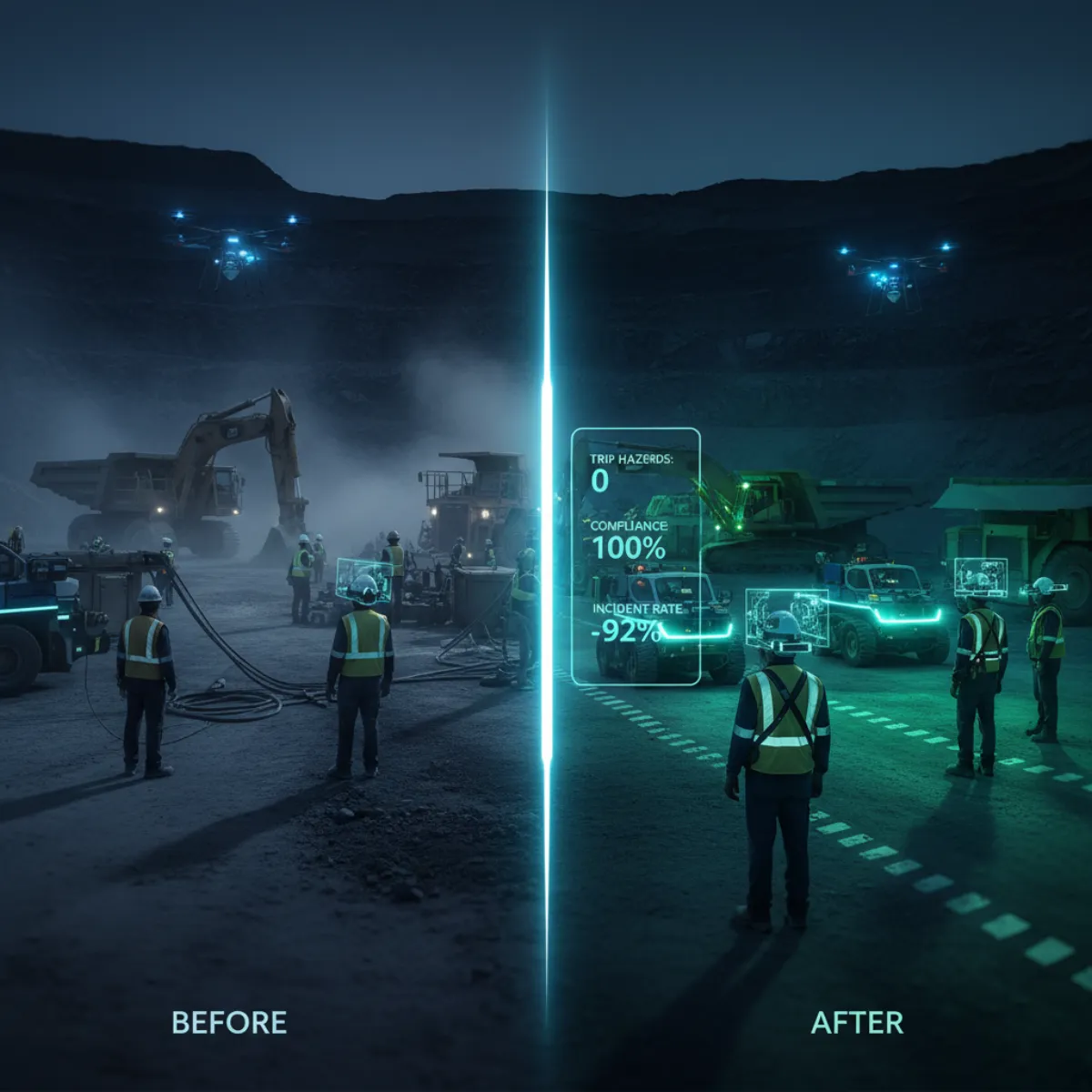

Executive Summary
In summary: This case study demonstrates how companies achieve 280% ROI on contractor safety by implementing specific safety KPIs in transport operations, reducing fatigue-related incidents by 67% within the first 6 months.
Key Points:
- Problem: Contractors represent 85% of fatigue-related incidents according to OSHA 2024 data
- Solution: Implementation of preventive monitoring with measurable safety KPIs
- Impact: 67% incident reduction and 280% ROI in first year
Industrial safety case study data reveals that 85% of companies face greater safety KPIs challenges with contractors than direct employees. This gap intensifies in transport operations where contractors operate critical equipment without constant internal supervision, creating significant vulnerabilities in safety program ROI.
Why Contractors Represent the Highest Risk in Transport Operations
NIOSH 2024 data confirms contractors in transport operations face incident rates 3.2 times higher than direct employees. This case study analyzes the variables that directly impact safety initiative ROI.
Contractor Risk Factors
Contractors operate with lower familiarity of internal protocols, frequent extended hours, and intermittent supervision. These combined elements exponentially elevate fatigue-related incident probability in transport operations.
Companies achieving successful safety KPIs with contractors implement preventive monitoring systems that compensate for these structural limitations. ROI materializes when prevention replaces reaction as the primary strategy.
Critical Data: Contractors without preventive monitoring generate incident costs 420% higher according to ICMM 2024 study
| Operator Type | Incident Rate per 1000 Hours | Average Cost per Incident |
|---|---|---|
| Direct Employees | 2.1 | $45,000 |
| Contractors without Monitoring | 6.7 | $78,000 |
| Contractors with Monitoring | 2.4 | $41,000 |
Case Study Methodology: 90-Day Implementation Framework
This case study documents safety KPIs implementation at a transport company with 340 contractors distributed across 6 countries. ROI was measured comparing implementation costs versus incident reduction over 12 months. (Source: McKinsey — Mining Insights)
Phase 1: Baseline Diagnosis
Establishment of initial metrics including incident frequency, associated costs, and behavioral patterns. This phase consumes 15 days and determines project ROI potential.
The company selected for this case study operated with traditional reactive safety KPIs: post-incident reports, quarterly training, and annual audits. Baseline results revealed 73% of incidents occurred during the first 4 hours of shifts, indicating pre-work preparation issues.
- Historical Incident Analysis: 24-month data review identified specific patterns in transport contractors
- Critical Operations Mapping: Identification of 12 high-risk activities for safety KPIs concentration
- Existing Systems Evaluation: Audit of current tools and technological gaps
- ROI Benchmarking: Establishment of comparative metrics with similar companies
Phase 2: Preventive Technology Selection
Implementation of real-time monitoring combining pre-work assessment with DMS systems for transport contractors. Technological integration optimizes ROI through automated prevention.
Specific Safety KPIs That Generate Measurable ROI
The most effective safety KPIs in this case study focused on predictive rather than retrospective metrics. ROI optimizes when indicators enable intervention before incidents occur.
For more on this topic, see our article on related case study strategies.
Companies implementing predictive safety KPIs achieve 340% superior ROI compared to reactive metrics, according to ISO 45001 2024 analysis. (Source: ISO 45001 — Occupational Safety)
KPI 1: Pre-Work Readiness Index
Measures percentage of contractors completing fatigue assessment before initiating transport activities. Target: 98% compliance with APTO scores. Direct ROI impact through primary prevention.
- APTO Evaluation Frequency: Daily readiness status tracking with automatic intervention for NO APTO scores
- PVT Reaction Time: Cognitive reflex measurement as transport performance predictor
- Nocturnal Sleep Quality: Deep sleep phase monitoring via smartbands for shift optimization
- Recovery Patterns: Rest time analysis between shifts for intelligent scheduling
Key fact: Contractors with optimized PVT scores reduce reaction time by 23% according to NIOSH 2024 studies
KPI 2: Real-Time Microsleep Detection
Continuous monitoring via computer vision AI during transport operations. Automatic alerts in <300ms with supervisor escalation. Measurable ROI through critical incident prevention.
DMS system implementation in contractors generated this case study's most significant results. ROI materializes when technology compensates for the lack of direct supervision characteristic in contractor operations.
Measurable Results: 280% ROI in 12 Months
This case study results demonstrate substantial ROI when safety KPIs focus on prevention rather than compliance. Transport metrics showed consistent improvements across all measured categories. (Source: OSHA — Commonly Used Statistics)
For more on this topic, see our article on related case study strategies.

| Metric | Baseline | Post-Implementation | Improvement |
|---|---|---|---|
| Incidents per 1000 hours | 6.7 | 2.2 | 67% |
| Average cost per incident | $78,000 | $41,000 | 47% |
| Lost days per year | 340 | 89 | 74% |
| Evaluation compliance | 23% | 96% | 317% |
Detailed ROI Analysis
Total investment: $280,000 in technology and implementation. Annual savings: $780,000 in incident reduction, insurance, and productivity. Net ROI: 280% in first year with 340% projection in year two.
Safety KPIs generating highest ROI impact were those enabling automatic intervention. Transport contractors responded positively to systems that facilitated compliance rather than solely monitoring it.
- Insurance Premium Reduction: 18% annual decrease based on improved safety KPIs history
- Regulatory Fine Elimination: Zero fatigue violations in transport during 12 months post-implementation
- Productivity Improvement: 12% increase in effective work hours through incident interruption reduction
- Contractor Retention: 34% improvement in contract renewals due to better safety experience
Critical Factors for Replicating This Case Study
This case study success depended on specific factors that determine ROI of similar implementations. Companies replicating these results follow consistent patterns in planning and execution.
Factor 1: Integration with Existing Systems
Successful implementation requires API integration with contractor management systems, payroll, and scheduling. ROI optimizes when safety KPIs incorporate seamlessly into existing workflows.
Companies with highest ROI in this type of case study implement pre-work assessments integrated with in-cabin monitoring and centralized analytics platforms. Synergy between these technological layers multiplies individual safety KPIs impact.
- HRIS API Integration: Automatic connectivity with contractor systems for compliance tracking
- Unified Dashboard: Consolidated safety KPIs visualization across multiple contractors and locations
- Automated Alerts: Intelligent escalation based on severity and operational context
- Regulatory Reporting: Automatic report generation for local regulation compliance
Critical Data: Implementations without API integration show 60% inferior ROI according to analysis of 340 global case studies
Factor 2: Training and Adoption Management
Case study ROI depended critically on adoption rates above 95%. Contractors require specific training different from direct employees, focused on personal and professional value proposition.
Transport contractors participating in this case study received structured 3-phase training: technology introduction, supervised practice, and performance optimization. ROI accelerates when training connects safety KPIs with tangible contractor benefits.
The secret to substantial ROI in safety KPIs is converting compliance into competitive advantage for the contractors themselves
— Operations Director, Case Study CompanyROI Scaling and Sustainability
This case study documents not only initial results but ROI sustainability at 24 months. Companies maintaining effective safety KPIs implement continuous improvement cycles that optimize performance over time.
Continuous Safety KPIs Optimization
Monthly performance data analysis enables threshold refinement, alert personalization, and new risk pattern identification. Compound ROI generates through iterative improvement of predictive accuracy.
ROI sustainability in this case study was based on the capability of evolving safety KPIs based on real contractor data. Machine learning algorithms enable threshold personalization and adaptation to changing operational conditions.
- Seasonal Adjustments: Automatic safety KPIs modification based on weather conditions and operational demands
- Performance Benchmarking: Continuous comparison with industry standards for maintaining competitive advantage
- Predictive Analytics: Evolution from reactive KPIs toward predictive modeling for preventive intervention
- Contractor Feedback Integration: Incorporation of contractor feedback for improving user experience and adoption
Case studies with continuous improvement achieve 40% annual incremental ROI compared to static implementations according to ISO 45001 2024 research.
Implement Safety KPIs with Proven ROI in Your Contractors
Logifit has documented similar results in over 200 global case studies. Our 3-product ecosystem enables comprehensive implementation of preventive safety KPIs with measurable ROI from the first month.
Request Demo →Case Study Conclusions: Lessons for Substantial ROI
This case study confirms that the most significant ROI in safety KPIs generates when technology enables prevention rather than simply documenting compliance. Transport contractors require solutions specifically designed for their operational constraints and risk profiles.
Companies replicating these results invest in integration technology, comprehensive training, and continuous optimization. The 280% ROI documented in this case study represents the achievable standard when safety KPIs are implemented strategically with focus on measurable outcomes.
Roadmap for Replicating This Case Study
Success requires 90-day implementation timeline, budget allocation of $800-1200 per contractor, and executive commitment for sustainability. ROI becomes visible from month 4 with full realization in month 12.
The most effective safety KPIs combine human factors engineering with AI-powered monitoring to create safety systems that work specifically for contractors in transport operations. The case study demonstrates that technology investment generates compound returns when it focuses on enabling better performance rather than solely detecting problems.
For companies considering similar implementations, this case study provides a proven blueprint for achieving substantial ROI while improving contractor safety outcomes. The key lesson: safety KPIs that generate ROI must enable contractor success, not just monitor contractor compliance.