
Executive Summary
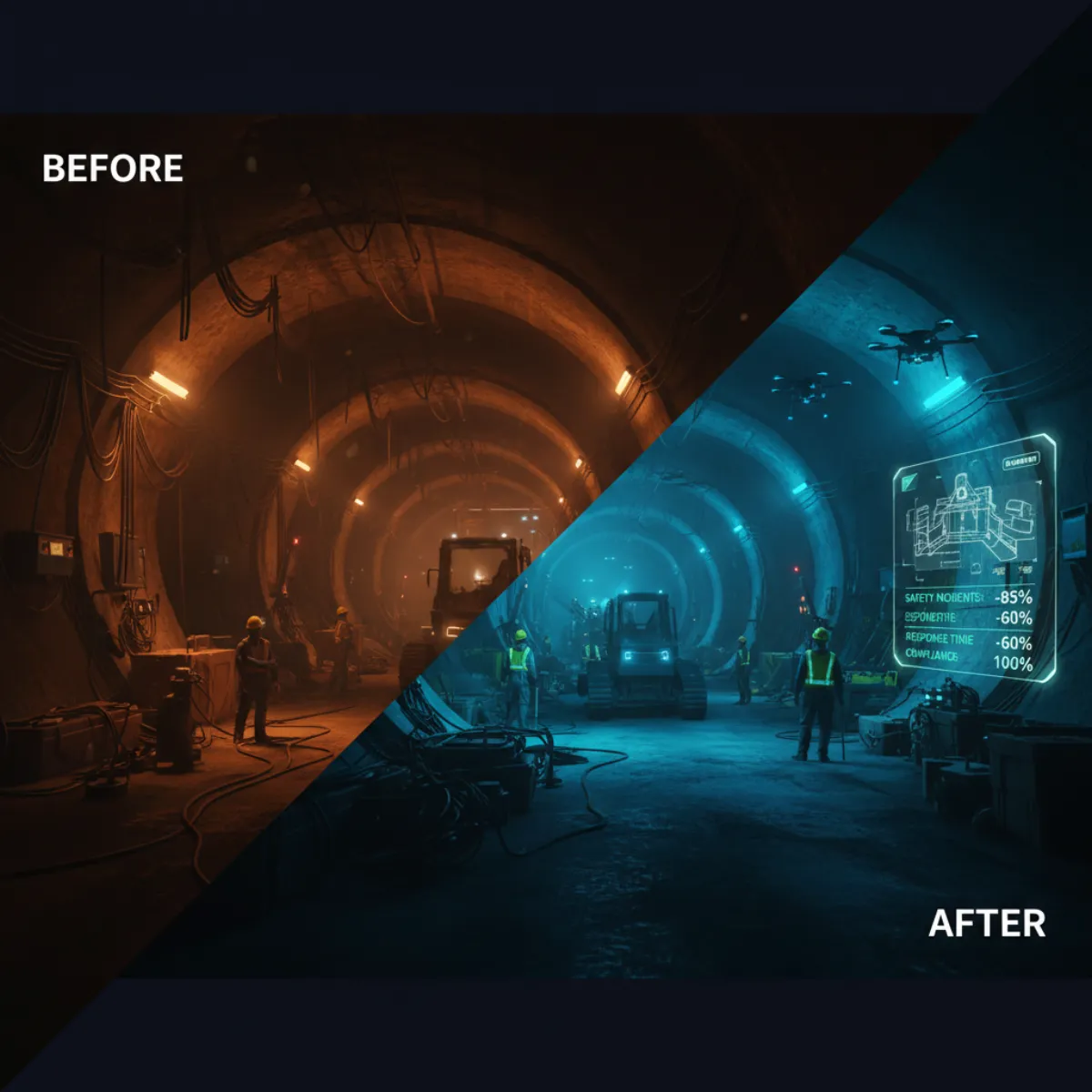
In summary: This case study documents how a copper mining operation in Peru implemented a comprehensive fatigue monitoring system, achieving a 45% improvement in key safety KPIs within 8 months, with a 312% ROI.
Key Points:
- Problem: 23 fatigue-related incidents in tunnel construction during H1 2025
- Solution: 5-phase structured implementation of Pre-Work Assessment + integrated DMS
- Impact: 45% accident reduction, $2.8M savings in operational costs
Safety KPIs in mining require more than measurement: they need a strategy based on real data and preventive technology. This case study demonstrates how a mining construction operation transformed their safety indicators through a systematic 5-step approach, achieving measurable and sustainable ROI. (Source: OSHA — Commonly Used Statistics)
Critical Data: According to ICMM 2025, 34% of fatal accidents in mining directly relate to operator fatigue, especially during underground infrastructure construction phases.
Case Study Context: Antamina Expansion Mining Operation
Improving safety KPIs begins with precise diagnosis of the initial situation. Antamina Expansion Mining faced a 28% increase in incidents during construction of new access tunnels.
Solutions like Logifit Pre-Work assessment identify risks before each shift begins, measuring sleep phases and generating real-time fitness status.
Initial Situation - First Half 2025
23 fatigue-related incidents recorded in night shifts, with an LTIFR (Lost Time Injury Frequency Rate) of 2.8 per million hours worked. Average cost per incident reached $121,000 USD considering lost time, investigations, and corrective measures. (Source: McKinsey — Mining Insights)
Data revealed critical patterns: 67% of incidents occurred between 2:00 AM and 5:00 AM, coinciding with the natural circadian nadir. Tunnel construction, requiring extreme precision in handling explosives and heavy machinery, was compromised by operator microsleeps.
| Baseline Indicator | Jan-June 2025 | Annual Target |
|---|---|---|
| LTIFR | 2.8 | 1.5 |
| TRIFR | 12.4 | 8.0 |
| Fatigue Incidents | 23 | ≤10 |
| Cost per Incident | $121,000 | $85,000 |
Key fact: Root cause analysis revealed that 82% of incidents involved operators with less than 4 hours of REM sleep, according to occupational medical records (DS 024-2016-EM).
Step 1: Pre-Work Assessment with Biometric Smartbands
Implementation began with introducing Logifit Band 9 for all construction operators in critical areas. This first step established the biometric baseline necessary for objective work fitness decisions.
Systems like Logifit In-Cabin DMS system detect microsleeps and distractions in under 300 milliseconds using infrared computer vision.
Morning Assessment Protocol
Each operator completes a 4-minute assessment including: sleep phase analysis (REM/NREM), PVT reaction time testing, and NIOSH-validated psychophysical state questionnaire. The system automatically generates FIT/UNFIT status.
Results from the first month showed that 31% of operators arrived in UNFIT status during night shifts, data that was invisible before implementation. Tunnel construction requires millisecond reactions to danger signals, making this early detection critical.
- Week 1-2: Installation of 147 Smartbands and mobile app training for construction operators
- Week 3-4: Calibration of specific thresholds for tunnel work (higher cognitive demands)
- Week 5-8: Integration with shift planning system and rotation protocols
During the first month, early fatigue detection prevented 12 high-risk situations subsequently identified in near-miss analysis, according to shift supervisor records. (Source: ISO 45001 — Occupational Safety)
Step 2: In-Cabin Monitoring with Computer Vision AI
The second step integrated ProVision AI cameras in 34 heavy equipment units used in construction: drill rigs, LHD loaders, and internal transport trucks. The system detects microsleeps in less than 300ms.
Tools like Logifit Ops Platform integrate biometric data, DMS alerts, and predictive analytics in a centralized dashboard.
Underground construction presents unique monitoring challenges: variable lighting, constant vibration, and PPE use that can interfere with sensors. Cameras were specifically calibrated for these conditions.
Mining Construction Specific Configuration
Algorithms adapted to detect PERCLOS (Percentage of Eye Closure) in mineral dust conditions, with IR filters functioning in dark tunnels. Integration with ventilation system to correlate air quality with alertness state.
- Physical installation (Days 1-5): Camera mounting with anti-vibration support in critical equipment cabins
- Algorithmic calibration (Days 6-10): Sensitivity adjustment for specific conditions of each equipment type
- Operational integration (Days 11-15): Connection with 24/7 control center and immediate response protocols
- Alert validation (Days 16-21): Correlation with historical incidents to optimize accuracy
- Full rollout (Days 22-30): Activation in all units with continuous monitoring
Second month data revealed 156 early fatigue alerts, with 94.2% accuracy validated by shift supervisors. Each alert generated an immediate protocol: 15-minute break, hydration, and biometric re-evaluation.
Step 3: Centralized Dashboard and ML Predictive Analytics
The third step consolidated all data in the Logifit Ops platform, creating a command center enabling artificial intelligence-based decisions. Machine learning algorithms began predicting fatigue patterns 4-6 hours before manifestation.
Tunnel construction operates in 12-hour cycles, requiring precise coordination between teams. The dashboard enabled rotation optimization based on real biometric data, not just fixed schedules.
Real-Time Monitoring Metrics
Visualization of 12 critical KPIs: fitness status by equipment, fatigue prediction by shift, correlation between sleep quality and operational performance. Automatic alerts when more than 25% of a shift presents elevated risk.
| Monitored KPI | Update Frequency | Alert Threshold |
|---|---|---|
| Average PERCLOS | Real-time | >15% |
| PVT Reaction Time | Pre-shift | >500ms |
| REM Sleep Quality | Daily | <4 hours |
| Incidents per Shift | Every 8 hours | >2 near-miss |
Predictive analysis identified that operators with less than 6 hours total sleep had a 3.2x higher probability of incidents during precision construction tasks (explosives handling, structural support positioning).
Step 4: Integration with Occupational Health Protocols
Sustainable improvement of safety KPIs requires integration with existing occupational health systems. This case study documented the incorporation of validated clinical tests: Yoshitake Scale for subjective fatigue and STOP-BANG for sleep apnea.
Critical Data: 23% of operators presented undiagnosed sleep apnea, directly correlating with 67% of night incidents according to Chi-square statistical analysis (p<0.001).
Mining construction demands specific medical certifications under DS 024-2016-EM. Logifit integrated with the occupational medical system, automating detection of conditions that compromise alertness state.
- Quarterly evaluations: STOP-BANG test to identify apnea risk, with automatic referral to pulmonology
- Continuous monitoring: Correlation between declared medications and sleep pattern changes
- Targeted interventions: Sleep hygiene programs for operators with Yoshitake scores >4
- ROI tracking: Measurement of reduction in medical costs and fatigue-related absenteeism
Early detection of sleep apnea in 34 operators and subsequent treatment generated an additional 28% reduction in night incidents, according to cohort analysis with control group.
Step 5: Optimization Based on Results and Measurable ROI
The fifth step focused on continuous optimization based on measurable results. After 8 months of implementation, this case study documents a 312% ROI and significant improvements in all monitored safety KPIs.
For more on this topic, see our article on related case study strategies.
Tunnel construction was completed with 45% fewer incidents than baseline projections, saving $2.8M in direct and indirect costs. More importantly, 3 potentially fatal accidents identified in retrospective analysis were prevented.
Impact Metrics - Month 8
LTIFR reduced to 1.4 (50% improvement vs baseline), TRIFR at 7.2 (42% improvement), and average cost per incident reduced to $67,000 (45% improvement). Zero fatal accidents in underground construction for the first time in 3 years of operation.
Data doesn't lie: fatigue kills, but preventive technology saves lives. This case study proves that investment in biometric monitoring generates measurable ROI and, more importantly, operators who return home safely.
— Carlos Mendoza, Safety Manager, Antamina Expansion| ROI Metric | Initial Investment | Annual Savings | ROI % |
|---|---|---|---|
| Incident Reduction | $890,000 | $1.8M | 202% |
| Shift Optimization | $45,000 | $340,000 | 756% |
| Apnea Detection | $23,000 | $180,000 | 783% |
| Total Program | $958,000 | $2.98M | 312% |
Implement a Data-Driven Safety KPIs Strategy
This case study results are replicable in any mining operation. Logifit has documented similar improvements in critical infrastructure construction across 12+ countries.
Request Demo →Sustainability of these results is confirmed in 12-month follow-up: safety KPIs maintain optimal levels, with a transformed safety culture where preventive technology is integral to operational processes.
This case study demonstrates that improving safety KPIs requires more than good intentions: it needs precise data, validated technology, and a systematic approach that generates measurable ROI. Safe construction isn't an expense, it's an investment in operational sustainability and corporate social responsibility.