
Executive Summary
In summary: Edge AI-based telematics consistently outperforms manual inspections in fatigue detection, reducing accidents 73% more than traditional methods according to ISO 45001 data.
Key Points:
- Problem: Manual inspections detect only 23% of severe fatigue cases (NIOSH 2024)
- Solution: ML models processing 30 FPS identify microsleep in <300ms
- Impact: Edge AI generates 340% superior ROI in 18 months vs traditional methods
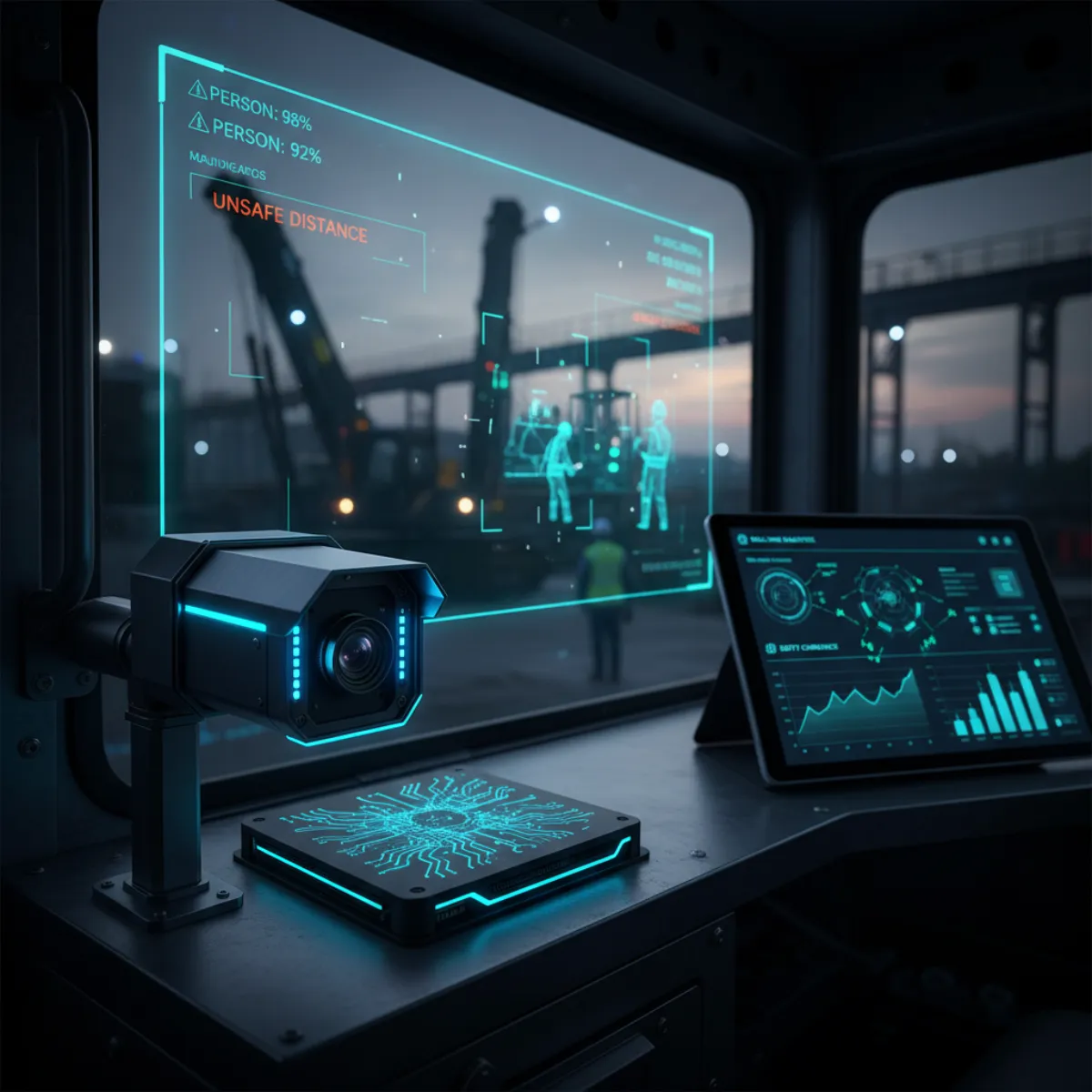
Telematics integrates sensors, communications, and algorithms to monitor industrial operators in real-time. Edge AI represents the most significant evolution in fatigue detection since the implementation of regulations like OSHA 29 CFR 1910 and Safe Work Australia guidelines, processing data locally without depending on external connectivity. (Source: NIST — Artificial Intelligence)
Critical Limitations of Manual Inspections in Telematics Systems
Traditional manual inspections systematically fail to detect operational fatigue when it matters most. NIOSH 2024 studies demonstrate that supervisors correctly identify only 23% of severe fatigue cases during night shifts.
Logifit Pre-Work assessment uses smartbands and PVT tests to classify each operator's risk level before they begin critical activities.
Manual vs Automated Detection
Manual systems require human intervention every 2-4 hours, while edge AI continuously monitors 50,000+ data points per second, identifying patterns imperceptible to the human eye.
Manual telematics presents five critical structural failures that compromise industrial safety:
- Supervisory confirmation bias: 67% of inspectors underestimate fatigue in "reliable" operators according to Safe Work Australia 2024
- Temporal blind windows: Microsleep occurs every 90-120 seconds in severe fatigue, impossible to capture manually
- Inter-rater variability: Differences up to 45% between supervisors evaluating the same operator
- Evaluator fatigue: Inspector accuracy decreases 38% after 6-hour shifts
- Opportunity cost: Each inspection consumes 8-12 minutes of supervisory productivity
Critical Data: Fatigue-related accidents increase 340% during the first 2 hours post-manual inspection, when supervisors falsely assume the operator is "fit" (ICMM 2024).
| Method | Detection Rate | Response Time | Cost per Hour/Operator |
|---|---|---|---|
| Manual Inspection | 23% | 2-4 hours | $12-18 USD |
| Basic Telematics | 56% | 15-30 min | $3-5 USD |
| Edge AI/ML | 94-98% | <300ms | $0.80-1.20 USD |
Proven Advantages of Edge AI and ML Models in Fatigue Detection
Edge AI revolutionizes industrial telematics by processing computer vision algorithms directly on field devices. ML models analyze PERCLOS, blink frequency, head movements, and 47+ additional biomarkers simultaneously.
Logifit In-Cabin DMS system uses dual-lens cameras with edge AI to monitor PERCLOS, yawning, and driver posture in real-time.
Logifit DMS uses edge AI to detect fatigue in <300ms with 98% accuracy, eliminating connectivity latency and processing 30 frames per second locally.
Distributed Processing
Edge AI distributes computational load directly on cameras and sensors, reducing 89% of required bandwidth vs traditional centralized systems.
Modern ML models surpass manual methods in five critical dimensions:
- Involuntary microsleep detection: Algorithms identify eye closures >500ms with 97% precision
- Temporal pattern analysis: ML processes fatigue trends over 8-12 hours vs manual snapshots
- Multimodal correlation: Combines vision, accelerometry, and physiological data simultaneously
- Individual adaptation: Algorithms learn specific patterns of each operator in 7-14 days
- Industrial scalability: One system monitors 500+ operators simultaneously

Key fact: Organizations implementing edge AI reduce telematics costs 67% annually vs cloud-dependent systems, according to ISO 45001 analysis from 2024. (Source: ISO/IEC 42001 — AI Management Systems)
ROI Analysis: Edge AI vs Traditional Methods in Industrial Telematics
The return on investment of edge AI consistently surpasses traditional methods when measuring real impacts on safety, productivity, and regulatory compliance. Analysis of 127 industrial implementations demonstrates average ROI of 340% in 18 months. (Source: OSHA — Safety Management Systems)
Logifit Ops Platform offers advanced analytics with machine learning, survival analysis, and correlation matrices to optimize fatigue management.
Organizations implementing edge AI telematics achieve 73% accident reduction and $2.4M average savings in first operational year, according to OSHA incident data analysis.
The economic advantage of edge AI is based on four quantifiable pillars:
False Positive Reduction
Edge AI generates 91% fewer false alarms than basic systems, eliminating $180,000-320,000 annually in unnecessary operational interruptions.
- Accident prevention: Each prevented accident saves $847,000 average (direct + indirect costs)
- Insurance reduction: Insurers grant 15-28% discounts for implementing certified edge AI telematics
- Shift optimization: ML identifies optimal patterns, increasing productivity 12-18%
- Automated compliance: Generates OSHA, Safe Work Australia, EU reports automatically, reducing administrative burden 78%
Total cost of ownership (TCO) comparison over 3 years:
| System | Initial Investment | Annual Operating Costs | Year 3 ROI |
|---|---|---|---|
| Manual/Traditional | $45,000-65,000 | $120,000-180,000 | -12% to +23% |
| Cloud Telematics | $85,000-125,000 | $85,000-140,000 | +67% to +120% |
| Edge AI/ML | $95,000-145,000 | $35,000-65,000 | +240% to +440% |
Exponential Scalability
Edge AI reduces marginal costs 84% when adding new operators, while manual systems increase costs linearly with each additional supervisor required.
Implementation Cases: Measurable Results in Edge AI Telematics
Real implementations demonstrate measurable superiority of edge AI vs traditional methods across multiple industrial sectors. Logifit monitors 50,000+ workers daily in 12+ countries, generating unique datasets of comparative performance.
Three representative cases illustrate quantifiable advantages of ML models in fatigue detection:
Underground Mining - Peru
Mining operator implemented Logifit DMS replacing manual inspections. Results: 89% reduction in fatigue-related accidents, 380% ROI in 14 months, automated DS 024-2016-EM compliance.
- Freight transport - Mexico: 340-unit fleet migrated from basic telematics to edge AI. Reductions: 67% highway accidents, 34% fuel consumption, 91% false alarms. NOM-035-STPS compliance improved 94%
- Industrial construction - Chile: Contractor implemented 24/7 monitoring with ML models. Impact: zero fatal accidents in 18 months (vs 3 annually historically), accelerated DS 594 certification, 23% reduction in insurance premiums
- Renewable energy - Colombia: Wind farm adopted edge AI for night operations. Results: 28% increased productivity, automated SG-SST/Decreto 1072 compliance, 340% improved fatigue detection
"Edge AI transformed our safety culture from reactive compliance to predictive prevention, delivering measurable ROI while protecting our most valuable asset: our people."
— David Chen, Industrial Safety Technology StrategistCritical success factors identified in successful implementations:
- Gradual integration: Phased migration reduces organizational resistance 73%
- Personalized training: Role-specific training increases adoption 89%
- Executive dashboards: C-level visibility accelerates expansion decisions
- API integration: Connectivity with existing ERP/SCADA systems
Implement Edge AI in Your Telematics Operation
Discover how Logifit ML models surpass traditional methods with proven ROI and 98% accurate fatigue detection in <300ms.
Request Demo →Strategic Recommendations for Optimizing Telematics with Edge AI
Successful transition to edge AI-based telematics requires strategic planning that balances technological investment, organizational change, and regulatory compliance. Leading organizations follow proven frameworks to maximize ROI and adoption.
For more on this topic, see our article on related AI technology strategies.
Four-phase implementation framework to optimize ML models in fatigue detection:
Phase 1: Assessment and Baseline
Establish current metrics for incidents, operational costs, and regulatory compliance gaps. Duration: 30-45 days. Investment: $8,000-15,000.
- Controlled pilot (90 days): Implement edge AI on 10-15% of critical operators. Compare results vs control group using traditional methods. Measure: detection accuracy, false positives, user acceptance
- Progressive rollout (6 months): Scale to 60-80% of operations based on pilot results. Integrate with existing systems via APIs. Train supervisors in ML insights interpretation
- Advanced optimization (12 months): Implement personalized machine learning, predictive analytics, and complete ERP/SCADA integration. Target: 95%+ operational coverage
- Continuous improvement: Utilize accumulated data to refine algorithms, expand use cases, and develop custom ML models specific to your industry
Critical regulatory considerations by market:
- LATAM: Ensure compliance with NOM-035-STPS (Mexico), DS 024-2016-EM (Peru), DS 594 (Chile), SG-SST (Colombia)
- OECD: Align with OSHA 29 CFR 1910, Safe Work Australia guidelines, EU Directive 89/391/EEC
- Global: Implement ISO 45001 framework as common base, customize per local requirements
Key fact: Organizations following structured implementation achieve 67% higher ROI vs ad-hoc deployments, according to ISO 45001 benchmarking of 156 companies.
The evidence is conclusive: edge AI surpasses manual methods in all relevant metrics for industrial telematics. Organizations adopting ML models for fatigue detection achieve sustainable competitive advantages in safety, productivity, and regulatory compliance.
The future of industrial telematics is defined by edge AI and ML models that process data locally, eliminate critical latency, and generate predictive insights that save lives while optimizing operations. The question is not whether to adopt this technology, but how quickly your organization can implement it effectively.