

Executive Summary
In summary: Telematics integrated with computer vision represents the most effective frontier of safety management in energy operations today. This article presents a practical deployment system that directly connects AI deployment choices to measurable safety outcomes and ROI, including LATAM enforcement realities and low-cost rollout options for operations of any size.
Key Points:
- Problem: 23% of energy sector accidents in LATAM involve operator fatigue, according to OISS 2024 data.
- Solution: Integrating telematics, wearables, and predictive analytics with computer vision detects fatigue in under 300ms before an incident occurs.
- Impact: Operations deploying computer vision fatigue detection report a 98% reduction in microsleep-related accidents.
Telematics combined with computer vision AI is the most effective system available today for preventing fatigue-related accidents in the energy sector. Unlike traditional reactive controls, computer vision detects operator state in real time—before an incident, not after—and triggers automatic interventions that no human supervisor can replicate at that speed. In LATAM, where SUNAFIL inspections and STPS audits under NOM-035 demand documentary evidence of preventive controls, this approach simultaneously meets regulatory requirements and reduces accidents with verifiable data.
How Computer Vision Detects Operator Fatigue in Energy Operations
Computer vision safety systems operate through continuous analysis of facial and behavioral parameters during an operator's shift. The central metric is PERCLOS (PERcentage of CLOSure): the proportion of time an operator's eyelids cover more than 80% of the eye during a one-minute interval.
PERCLOS: The Primary Microsleep Indicator
PERCLOS is the most scientifically validated measure for detecting drowsiness in vehicle operators and control room personnel. A PERCLOS above 15% indicates moderate drowsiness; above 25%, microsleep risk is imminent. In energy operations—where an operator controls high-voltage equipment or process valves—these thresholds carry critical consequences.
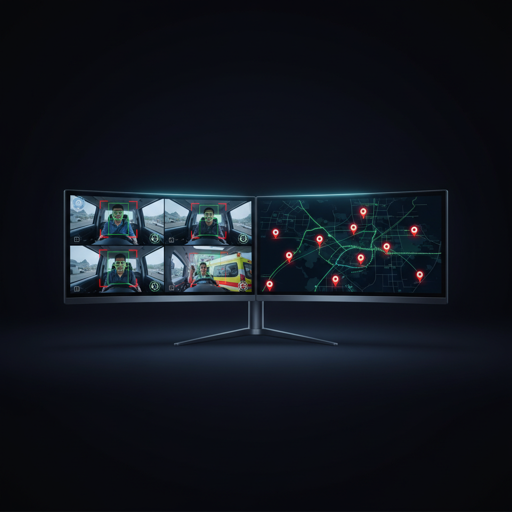
Modern computer vision systems like Logifit's ProVision AI Cam combine dual-lens optics with infrared night vision, enabling precise operation in low-light control rooms and heavy machinery cabins with backlit environments. Processing occurs at the edge via the Compute Module X1, with latency under 300ms from detection to alert.
Critical Data: According to NIOSH (National Institute for Occupational Safety and Health), night shift workers are 2.5 times more likely to suffer a serious accident than day shift workers. In the energy sector, this risk is amplified by the nature of high-voltage work and continuous process operations.
Detection is not limited to fatigue. Current systems simultaneously identify visual distraction (gaze deviation), mobile phone use, and head nodding (pitch/yaw). This multi-event coverage is essential in energy operations where operators must monitor several panels simultaneously.
Why Telematics and Predictive Analytics Change Safety Outcomes
Predictive analytics converts historical telematics data into preventive alerts before risk materializes. This is the qualitative leap that separates reactive systems from next-generation fatigue risk management systems.
The 4-Layer Predictive Analytics Model for Fatigue
Effective predictive analytics in energy safety operates across four layers: (1) biometric data from resting wearables (sleep quality, REM phases), (2) telematics data during commute (speed, braking), (3) real-time computer vision signals during the shift, and (4) historical incident correlation. Each layer feeds a risk score that supervisors can review before an operator takes their post.
Wearables—such as Logifit's Band 7, 9, and 10 smartbands—capture Deep, REM, and Light sleep phases overnight to quantify sleep debt before the shift begins. An operator with less than 6 hours of effective sleep arrives at the plant with a cognitive deficit equivalent to a 0.05% blood alcohol level, according to University of Pennsylvania research (2024).
| Sleep Hours | Pre-Shift Status | Relative Risk | Recommended Action |
|---|---|---|---|
| 7-9 hours | FIT FOR DUTY | Baseline (1.0x) | Normal entry |
| 6-7 hours | FIT WITH OBSERVATIONS | 1.8x higher | Enhanced monitoring |
| 5-6 hours | UNFIT — review required | 3.2x higher | Medical evaluation |
| <5 hours | UNFIT FOR DUTY | 5.1x higher | Shift restriction |
Combining wearable data with predictive analytics enables supervisors to reassign high-risk tasks before the shift starts—not during an emergency. This paradigm shift justifies investment in integrated systems over standalone cameras.
Practical Deployment: Low-Cost Options for LATAM Energy Operations
The entry barrier for computer vision safety has fallen significantly since 2022. Mid-size operations in LATAM—companies with 50 to 500 operators—can implement a functional system with three modular components and manageable initial investment.
Modular Architecture for Constrained Budgets
Phased deployment allows starting with computer vision on the 20% of highest-risk equipment or posts, demonstrating ROI in 6-12 months, and scaling with budget generated by savings. This strategy is especially relevant for Peruvian operations subject to SUNAFIL audits, where demonstrating active controls—not just policies—is required to avoid fines of up to 245 UIT.
- Phase 1 — Pre-Shift Assessment with Wearables: The most accessible starting point. Smartbands and the mobile app generate the FIT/UNFIT status with digital evidence ready for SUNAFIL audits or STPS inspections under NOM-035. Low cost per operator/month.
- Phase 2 — Computer Vision on Critical Equipment: DMS camera installation on equipment with the highest historical incident rate. Telematics integration enables correlation of fatigue events with specific routes, schedules, and operators.
- Phase 3 — Predictive Analytics Platform: The Ops central dashboard integrates data from both sources, activates the clinical health module for recurring UNFIT cases, and feeds the ML forecasting system to anticipate high-risk periods.
- NOM-035 and DS 024 Compliance: Automatic documentation generated by the system directly meets NOM-035-STPS psychosocial risk recording requirements and fatigue controls mandated by DS 024-2016-EM for Peruvian mining and energy operations.
Key fact: Mexico's NOM-035-STPS (in force since 2019) requires companies with more than 50 workers to identify, analyze, and prevent psychosocial risk factors, including fatigue from extended work hours. Non-compliance fines reach up to 422,000 Mexican pesos per infraction (STPS 2025).
Energy operations implementing predictive analytics integrated with computer vision and wearables report a 45% reduction in lost days due to accidents and an average ROI of 3.2x in the first year, according to the ICMM Safety Technology Report 2024.
Fatigue Detection ROI: Metrics That Win Executive Approval
The primary obstacle to computer vision adoption in LATAM is not technical—it is budget justification to management teams that prioritize immediate operating costs. ROI data must be presented in the language of finance leadership, not technology specifications.
The 3-Dimension ROI Framework for AI Safety Systems
An effective executive presentation quantifies return across three simultaneous dimensions: (1) Cost avoided per accident (lost days + compensation + equipment damage), (2) Insurance premium reduction (typically 15-30% with certified systems), and (3) Regulatory compliance value (fines avoided + qualification for contracts requiring ISO 45001). The sum of these three dimensions consistently exceeds system cost in year one.
The integrated fatigue detection system automatically generates fatigue scoring reports by operator, shift, and area, enabling precise identification of critical points where intervention investment produces maximum impact. This granularity is impossible with manual controls.
- Calculate your current incident cost: Sum lost days × daily operator cost + equipment damage + insurance premiums from the past year. This is your ROI denominator.
- Project savings with real data: Apply a conservative 40% reduction (documented in comparable operations) to current incident costs to obtain projected annual savings.
- Identify the 20% of equipment/routes with highest incident frequency: Historical telematics data reveals risk concentration patterns. Begin deployment there to maximize visible ROI in the first quarter.
- Document every detection event: Each fatigue alert intercepted before an incident is documentable evidence of value. Modern systems record timestamp, operator, PERCLOS level, and action taken.
- Present to leadership at 90 days: With 90 days of real data, the correlation between fatigue alerts and incident reduction is statistically significant and visually compelling for any executive audience.
"In industrial safety, the difference between a good computer vision system and an excellent one isn't detection accuracy—both reach 98%—it's what happens in the 30 seconds after the alert fires. A well-designed intervention protocol converts detection into real prevention."
— David Chen, Industrial Safety Strategy DirectorAssess Computer Vision Deployment for Your Energy Operation
Logifit has deployed AI fatigue detection systems in energy, mining, and transport operations across 12+ countries in LATAM. Request a free operational assessment and receive a personalized ROI analysis for your specific context.
Request Free Assessment →90-Day Roadmap: From Assessment to Live Operation
Successful computer vision implementation in energy safety requires a specific sequence. Organizations that attempt to deploy everything simultaneously fail not for technical reasons but due to operational resistance and lack of baseline data.
The first step is always establishing the current incident baseline with historical telematics data. Without this reference, it is impossible to demonstrate system impact to any internal audience. The Logifit Ops Platform imports historical data from existing systems to build this baseline in the first week.
The second step is deploying the pre-shift assessment module with wearables. This component generates immediate regulatory compliance and sleep quality data that will feed the predictive model. In Mexico, this directly resolves NOM-035 requirements; in Peru, it fulfills DS 024-2016-EM fatigue controls.
The third step, typically at day 30-45, is installing in-cabin monitoring cameras on the critical equipment identified in the baseline analysis. With wearable data already available, the computer vision system can correlate prior sleep quality with in-shift behavior, dramatically increasing the predictive accuracy of the complete system.
In LATAM, where SUNAFIL and STPS audits are increasingly frequent and technically sophisticated, the automatic documentation this integrated system generates—timestamps, fatigue scores, interventions performed, outcomes—constitutes the most robust evidence available to demonstrate active compliance. This combination of operational safety and regulatory compliance is the definitive argument for any HSE manager who needs to justify investment to their board.