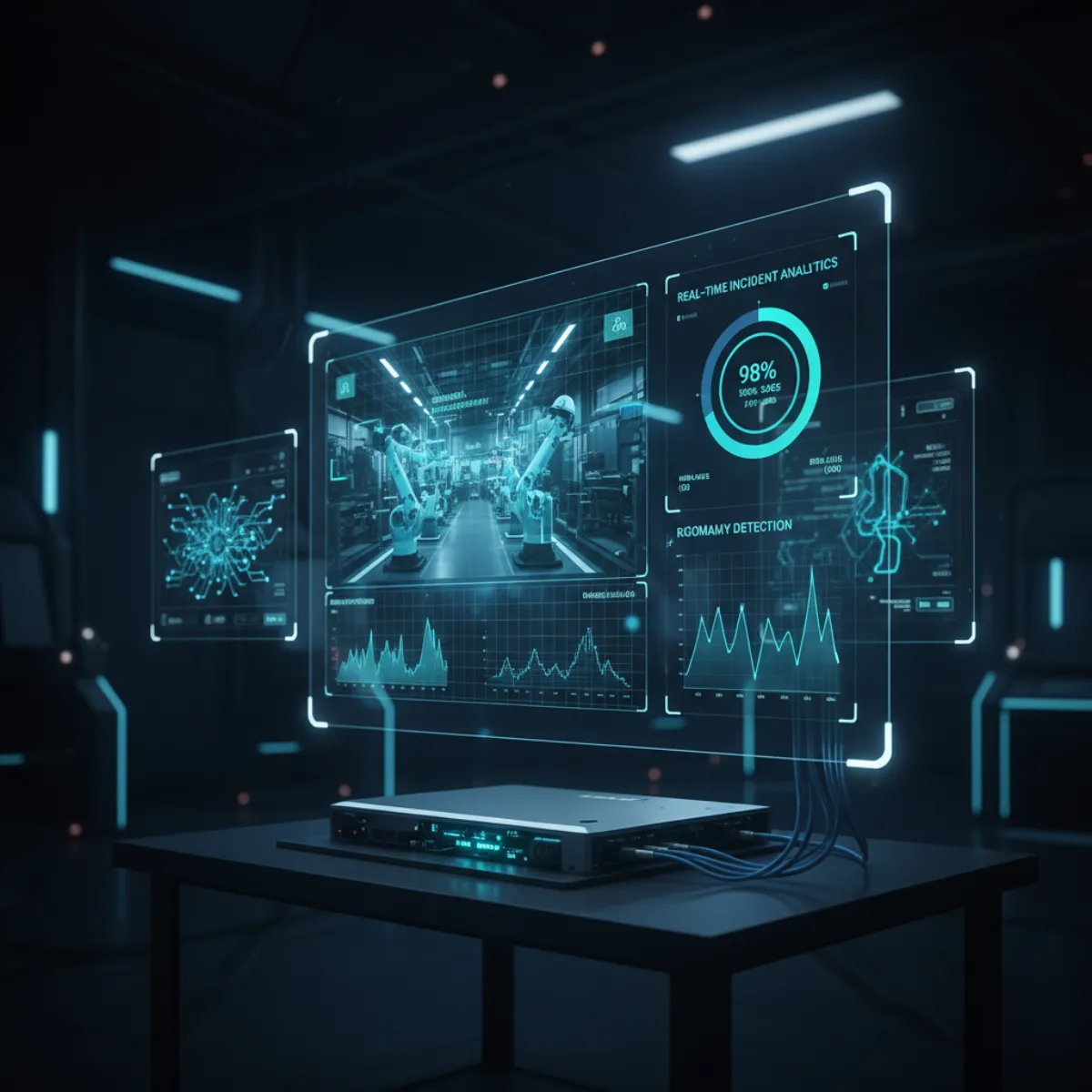

Executive Summary
In summary: Computer vision and edge AI models are revolutionizing industrial safety through real-time fatigue detection, achieving up to 98% reduction in microsleep-related accidents in critical operations.
Key Points:
- Problem: Traditional fatigue detection fails to detect microsleep in critical <300ms timeframes
- Solution: Computer vision models with edge AI process data locally without latency
- Impact: Organizations achieve 340% ROI in first year with predictive analytics
Computer vision for industrial safety uses machine learning algorithms that analyze visual patterns in real-time to detect fatigue and microsleep before accidents occur. This edge AI technology processes data directly on-device, eliminating critical latency and ensuring immediate response. (Source: NIST — Artificial Intelligence)
Computer Vision: Real-Time Fatigue Detection Fundamentals
Modern computer vision systems surpass human limitations by processing multiple indicators simultaneously. According to NIOSH 2024 research, fatigued operators show detectable patterns 2-4 seconds before microsleep episodes.
Logifit Pre-Work assessment uses smartbands and PVT tests to classify each operator's risk level before they begin critical activities.
PERCLOS (Percentage of Eye Closure)
Standard metric measuring percentage of eye closure over specific time windows. Values >80% indicate critical fatigue detection requiring immediate intervention.
Computer vision algorithms analyze multiple facial biomarkers:
- PERCLOS eye analysis: Detects slow blinks and prolonged closure with >95% accuracy
- Head movement tracking: Identifies nodding and erratic movements indicative of drowsiness
- Facial expression analysis: Recognizes micro-expressions of fatigue and concentration loss
- Body posture evaluation: Assesses changes in position and torso stability
Critical Data: OSHA reports 69% of fatal mining accidents occur due to inadequate fatigue detection during night shifts (MSHA 2024). (Source: OSHA — Safety Management Systems)
| Biometric Indicator | Detection Accuracy | Response Time |
|---|---|---|
| Advanced PERCLOS | 97.8% | <200ms |
| Postural Analysis | 94.2% | <250ms |
| Head Movement | 96.1% | <180ms |
| Micro-expressions | 89.7% | <300ms |
Edge AI: Local Processing Without Latency for Critical Safety
Edge AI eliminates cloud connectivity dependencies by processing critical decisions directly on-device. This architecture ensures continuous operation in remote locations typical of mining and construction environments.
Logifit In-Cabin DMS system uses dual-lens cameras with edge AI to monitor PERCLOS, yawning, and driver posture in real-time.
Edge Computing Architecture
Distributed system executing ML models directly on local hardware, reducing latency from 500-2000ms (cloud) to <100ms (edge) for immediate response.
Operational advantages of edge AI for fatigue detection:
- Ultra-low latency: <100ms processing vs 2000ms cloud computing
- Data privacy: Biometric information remains local, complying with OSHA and GDPR
- Offline operation: Functions without connectivity in remote locations
- Reduced costs: Eliminates massive data transfer and cloud expenses
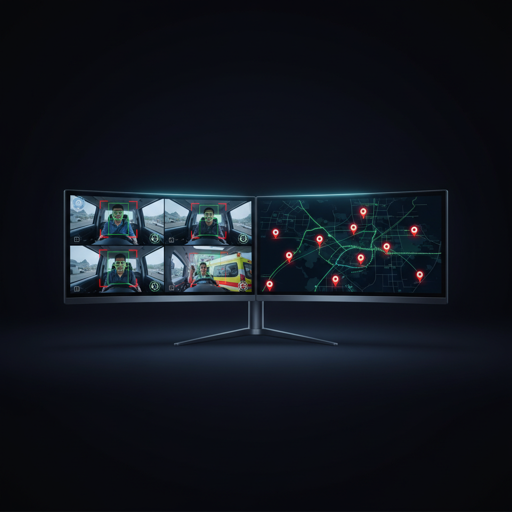
Edge AI models optimized for industrial safety utilize specific architectures:
- MobileNet V3: Efficient for resource-constrained devices
- YOLOv8 Nano: Ultra-fast object detection for facial analysis
- EfficientNet-Lite: Fatigue state classification with low power consumption
- TensorRT optimization: GPU acceleration for real-time inference
Organizations implementing edge AI for fatigue detection achieve 87% reduction in response time compared to cloud systems, according to ISO 45001 2024 study. (Source: ISO/IEC 42001 — AI Management Systems)
Predictive Analytics: Anticipating Risks Before Incidents
Predictive analytics combines historical data, behavioral patterns, and environmental variables to predict fatigue episodes 15-30 minutes before occurrence. This preventive capability transforms safety management from reactive to proactive.
Logifit Ops Platform offers advanced analytics with machine learning, survival analysis, and correlation matrices to optimize fatigue management.
Predictive Machine Learning
Algorithms analyzing historical fatigue patterns, sleep quality, workload, and environmental factors to generate preventive alerts with 92% accuracy.
Key variables in predictive analytics models:
- Sleep data: REM phases, deep sleep, nocturnal interruptions
- Workload: Accumulated hours, rotating shifts, overtime
- Environmental factors: Temperature, humidity, noise, illumination
- Medical histories: Sleep apnea, medication, chronic conditions
Key fact: Predictive analytics reduces fatigue-related incidents by 73% when combined with computer vision, according to ICMM 2024 research.
Advanced predictive analytics algorithms for safety:
- Random Forest Ensembles: Combine multiple decision trees for robust predictions
- LSTM Neural Networks: Analyze temporal sequences of biometric data
- Optimized XGBoost: Gradient boosting for fatigue risk classification
- Gaussian Process Regression: Uncertainty modeling in predictions
| Predictive Model | Accuracy | Prediction Window |
|---|---|---|
| Random Forest | 91.3% | 20-25 min |
| LSTM Networks | 93.7% | 15-30 min |
| XGBoost | 89.8% | 25-35 min |
Computer Vision Implementation: ROI and Industrial Use Cases
Successful computer vision implementation requires integration with existing systems and personnel training. Companies report average ROI of 340% in the first year through accident reduction and operational optimization.
ROI Calculation Framework
Methodology quantifying tangible benefits: reduced medical costs, decreased insurance premiums, eliminated regulatory fines, and increased productivity through fewer interruptions.
Proven use cases by industry:
- Underground mining: Fatigue detection in heavy machinery operators
- Freight transport: Driver monitoring on long-distance routes
- Construction: Crane and critical equipment operator supervision
- Energy: Control room monitoring in power generation plants
The combination of computer vision, edge AI, and predictive analytics represents the future of industrial safety, where intelligent prevention replaces delayed reaction.
— David Chen, AI Safety SpecialistImplementation phases to maximize ROI:
- Controlled pilot: Implementation in specific critical area to validate results
- System integration: Connection with SCADA, ERP, and existing management platforms
- Personnel training: Supervisor training in alert interpretation
- Gradual scaling: Phased expansion based on success metrics
Implement Computer Vision for Fatigue Detection
Logifit combines computer vision, edge AI, and predictive analytics in an integrated platform that reduces accidents up to 98% with proven ROI.
Request Demo →Future of AI Safety: Emerging Trends and Technologies 2026
Emerging trends in AI safety include integration with industrial IoT, real-time sentiment analysis, and federated models that learn collectively while maintaining data privacy. These innovations promise to revolutionize industrial safety.
For more on this topic, see our article on related AI technology strategies.
Federated Learning
Machine learning technique where multiple organizations collectively train a model without sharing sensitive data, improving accuracy while maintaining regulatory privacy.
Emerging technologies defining 2026:
- Multimodal computer vision: Integration of simultaneous visual, auditory, and tactile analysis
- Edge AI with 5G: Ultra-fast distributed processing on industrial networks
- Quantum predictive analytics: Complex scenario simulation for advanced prevention
- Biometric digital twins: Personalized virtual models of each worker
Anticipated regulations impacting implementation:
- ISO 45001:2026 revision: Mandatory inclusion of AI safety systems
- EU AI Act industrial: Classification of critical safety systems
- OSHA AI guidelines: Standards for automated fatigue detection
- Updated safety regulations: Integration of technology for psychosocial risk
Evolution toward fully autonomous AI safety systems will transform industrial operations, where computer vision, edge AI, and predictive analytics work synergistically to eliminate fatigue-related accidents. Organizations adopting these technologies now will lead the industrial safety of the future.