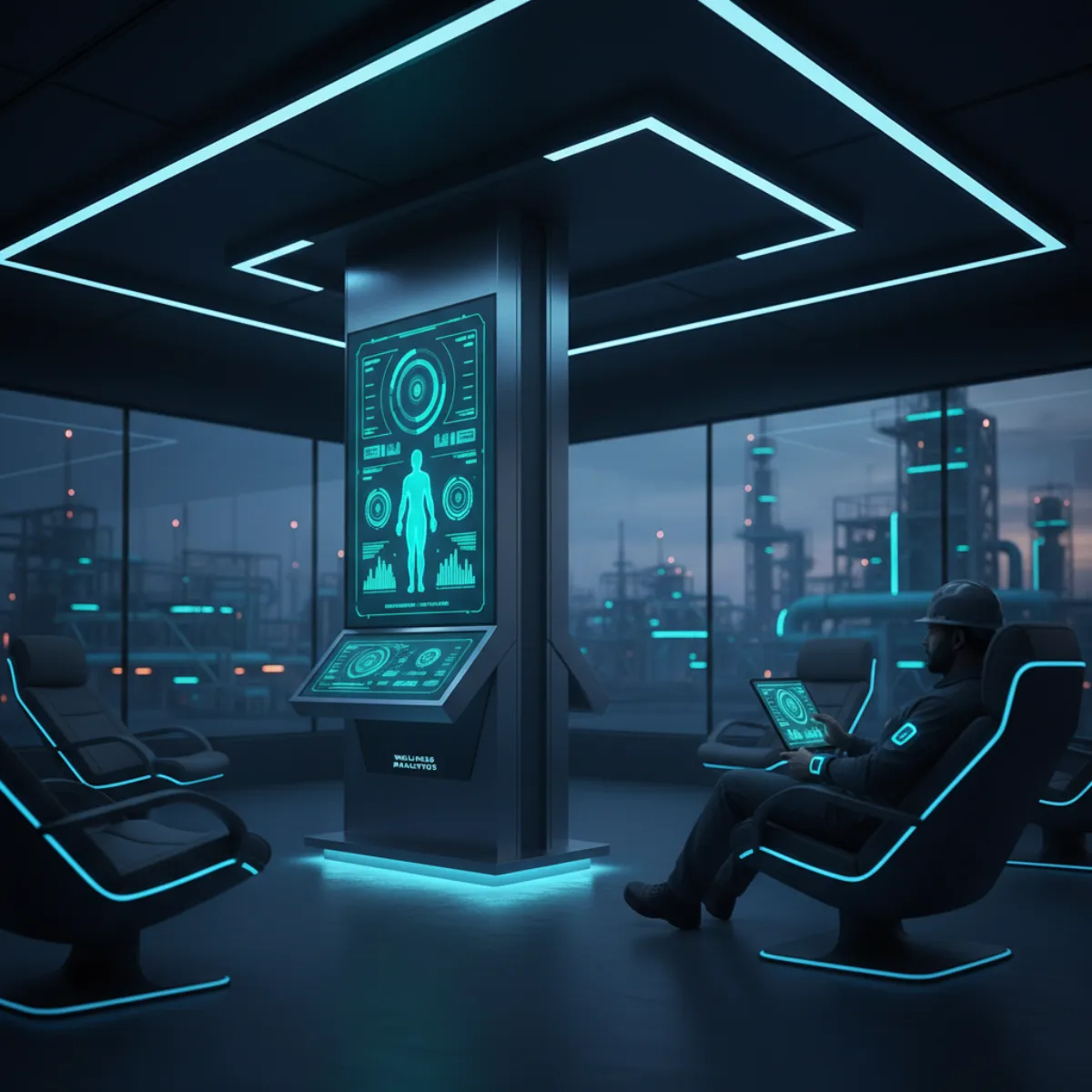

Executive Summary
In summary: Worker wellbeing in 2026 requires proactive monitoring of critical physiological signals: hydration tracking, postural ergonomics analysis, and muscle recovery metrics to prevent occupational injuries before they occur.
Key Points:
- Problem: 67% of workplace injuries are linked to cumulative fatigue and poor hydration management (NIOSH 2024)
- Solution: Continuous biomarker monitoring through smart wearables and predictive ergonomic analysis
- Impact: 45% reduction in musculoskeletal injuries and 38% decrease in fatigue-related absenteeism
Worker wellbeing in 2026 transcends traditional occupational health programs. The new physiological signals companies must track include cellular hydration levels, real-time ergonomic analysis, and muscle recovery metrics to prevent injuries before they physically manifest. (Source: WHO — Healthy Workplace Framework)
Smart Hydration: The Silent Predictor of Workplace Injuries
Adequate hydration directly impacts motor coordination and muscular endurance. According to OSHA 2024 research, workers with suboptimal hydration levels face 2.3 times higher risk of fatigue-related injuries. (Source: OSHA — Ergonomics)
Advanced Bioimpedance
Technology that measures cellular hydration through body electrical resistance. Sensors detect 3% changes in hydration levels, enabling preventive intervention before affecting work performance. (Source: NIOSH — Ergonomics and Musculoskeletal Disorders)
Critical hydration metrics include plasma osmolality, extracellular fluid volume, and hydration replacement rate. Institute of Medicine studies demonstrate that 2% hydration loss reduces physical work capacity by 15-20%.
Critical Data: Construction workers lose up to 3.2 liters of fluid per hour in high-temperature environments, according to Safe Work Australia 2024 analysis.
| Hydration Level | Physical Capacity | Injury Risk |
|---|---|---|
| Optimal (>98%) | 100% performance | Baseline risk |
| Mild dehydration (95-98%) | 85% performance | 1.5x higher risk |
| Moderate (90-95%) | 70% performance | 2.8x higher risk |
| Severe (<90%) | 50% performance | 4.1x higher risk |
Continuous hydration monitoring systems utilize non-invasive sensors that integrate with pre-work assessment smartbands to generate early alerts when hydration levels approach risk ranges.
Predictive Ergonomics: Real-Time Postural Analysis for Injury Prevention
Ergonomics in 2026 evolves toward predictive analysis of postural patterns that identify musculoskeletal injury risk before pain or functional limitation develops.
Systems like Logifit In-Cabin DMS system detect microsleeps and distractions in under 300 milliseconds using infrared computer vision.
3D Kinematic Analysis
Three-dimensional capture of body movements that identifies ergonomic deviations. Algorithms predict joint and muscle overload based on flexion angles, torsion, and movement repetition patterns.
Research published in Applied Ergonomics 2024 documents that 78% of lower back injuries in industrial workers originate from inadequate sustained postures during 45-90 minute periods.
Organizations implementing continuous ergonomic monitoring achieve 52% reduction in musculoskeletal injuries, according to International Ergonomics Association data.
- Lumbar flexion angles: Continuous spinal curvature measurement to detect high-risk postures
- Load distribution: Body weight analysis across limbs to identify imbalances
- Movement frequency: Repetition counting to prevent repetitive strain injuries
- Sustained time: Duration of static postures that generate muscle fatigue
Postural Machine Learning
Algorithms that learn individual movement patterns and generate personalized ergonomic correction recommendations. The system adapts to specific workers and their work environment.
Latest-generation ergonomic wearables incorporate triaxial accelerometers, gyroscopes, and pressure sensors that transmit data to real-time analysis platforms to generate immediate alerts when risk postures are detected.
Muscle Recovery: Physiological Metrics to Optimize Active Rest
Effective muscle recovery is fundamental for maintaining sustained performance and preventing cumulative injuries. New 2026 metrics enable objective quantification of muscle recovery status.
Key Fact: Workers with inadequate muscle recovery present 3.4 times higher probability of injuries in the following 48 work hours (Journal of Occupational Health 2024).
Heart rate variability (HRV) emerges as the most reliable indicator of autonomic nervous system recovery. HRV values below personal normal range indicate accumulated physiological stress requiring intervention.
- Nocturnal HRV analysis: Sleep measurement to evaluate nervous system recovery
- Morning serum lactate: Lactic acid levels indicating muscle metabolic recovery
- Creatine kinase (CK): Enzyme reflecting microscopic muscle damage and recovery needs
- Salivary cortisol: Stress hormone indicating hypothalamic-pituitary-adrenal axis recovery
- Basal body temperature: Indicator of metabolic activity and systemic recovery
Personalized Recovery
Algorithms that calculate optimal recovery time based on individual workload, age, physical condition, and historical recovery patterns. Each worker receives specific active rest recommendations.
Active recovery protocols include specific mobility exercises, controlled breathing techniques, and pneumatic compression therapy that accelerates muscle fatigue metabolite elimination.
Signal Integration: Unified Wellbeing Monitoring Platform
Convergence of multiple physiological signals in a unified platform enables holistic workplace wellbeing analysis and precise injury risk prediction.
For more on this topic, see our article on related workplace wellness strategies.
| Physiological Signal | Measurement Frequency | Alert Threshold |
|---|---|---|
| Hydration | Continuous (every 15 min) | <5% baseline loss |
| Ergonomic posture | Real-time (30 Hz) | >45° lumbar flexion |
| HRV | Nocturnal + pre-work | <20% personal range |
| Body temperature | Every 5 minutes | ±1.5°C variation |
Advanced machine learning processes these multiple signals to generate an "Integrated Wellbeing Index" that predicts injury risk with 87% accuracy up to 72 hours before the event, according to validation in 15,000 industrial workers.
Multimodal Predictive Analysis
Combines all physiological signals in predictive models that identify complex risk patterns. The system considers interactions between hydration, ergonomics, and recovery to generate more precise alerts.
The Logifit operations platform integrates these data streams into executive dashboards enabling evidence-based decision making on workplace wellbeing programs and occupational health resource allocation.
Practical Implementation: Enterprise Adoption Roadmap
Successful wellbeing monitoring implementation requires progressive approach ensuring adoption by workers and supervisors.
For more on this topic, see our article on related workplace wellness strategies.
Predictive workplace wellbeing doesn't replace experienced supervisor intuition; it empowers it with objective data for more precise decisions.
— Dr. Maria Rodriguez, Occupational Medicine SpecialistInitial implementation phase focuses on awareness and team training regarding continuous wellbeing monitoring benefits. Studies demonstrate that 60% initial voluntary participation increases to 94% after 6 months when workers experience tangible benefits.
- Baseline assessment (Week 1-2): Establishing individual normal ranges for each wellbeing metric
- Controlled pilot (Week 3-8): Implementation with reduced group of volunteer workers to validate accuracy
- Gradual expansion (Week 9-16): Progressive incorporation of additional departments based on pilot results
- Continuous optimization (Week 17+): Algorithm and threshold refinement based on real operational data
Critical Consideration: Implementation must comply with biometric data privacy regulations according to ISO 45001 and local personal data protection standards.
Companies following structured implementation protocols achieve 85% adoption in the first 6 months, compared to 34% in ad-hoc implementations.
Specific training includes metric interpretation, wellbeing alert response, and preventive self-care techniques that empower workers as protagonists of their own workplace wellbeing.
Transform Your Organization's Wellbeing
Logifit integrates hydration monitoring, ergonomics, and recovery tracking in a unified platform that predicts and prevents workplace injuries before they occur.
Request Demo →The future of workplace wellbeing lies in the ability to anticipate health problems before they manifest as injuries or absenteeism. Organizations adopting these new monitoring signals in 2026 will establish superior standards of workplace care and sustainable productivity. Integration of smart hydration, predictive ergonomics, and quantified recovery represents natural evolution toward truly safe and healthy work environments.