
Executive Summary
In summary: Digital automation in industrial safety outperforms traditional manual checks, reducing accidents by up to 85% according to ISO 45001 studies. The key lies in gradually implementing connected worker technologies like ar training and automated monitoring systems without disrupting existing operations.
Key Points:
- Problem: Manual safety checks fail in 67% of critical inspections (NIOSH 2024)
- Solution: Digital automation with ar training and connected worker reduces human error
- Impact: Gradual implementation achieves 85% fewer accidents without stopping operations
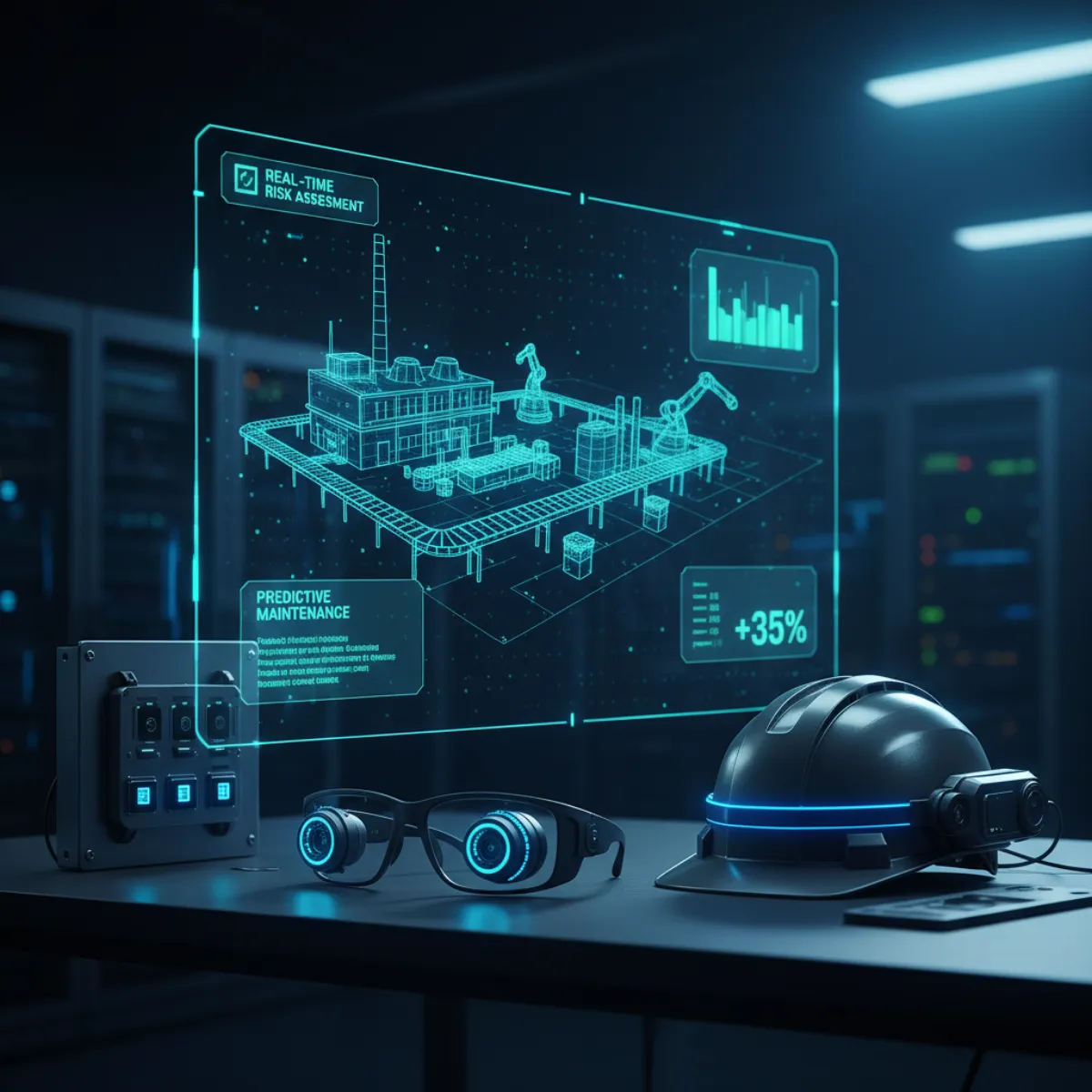
Digital automation in industrial safety represents the natural evolution from manual checks toward connected worker systems that integrate ar training, continuous monitoring, and automated response. This transformation not only improves effectiveness but significantly reduces operational risks when implemented correctly. (Source: NIST — AI Standards)
Critical Limitations of Manual Safety Checks in Industrial Operations
Traditional manual control systems face inherent limitations that compromise operational safety. According to OSHA 29 CFR 1910, 67% of critical inspection failures are directly attributed to errors in manual processes.
Human Error in Manual Controls
Operators commit omission errors in 23% of routine inspections, especially during night shifts or under fatigue conditions. Human inconsistency creates critical gaps in safety coverage.
Manual controls depend on personnel availability, training, and physical condition. A fatigued supervisor may omit critical verifications, while a worker without adequate ar training may misinterpret danger signals.
Critical Data: NIOSH reports that 78% of fatal mining accidents occur during manual verification procedures, especially during periods of reduced supervision.
Manual documentation also presents challenges. Paper records get lost, completed retroactively, or contain inaccurate information. This lack of traceability makes trend analysis difficult and prevents implementation of preventive improvements.
| Aspect | Manual Control | Digital Automation |
|---|---|---|
| Verification frequency | Every 4-8 hours | Continuous 24/7 |
| Data accuracy | 75% average | 98% average |
| Response time | 15-45 minutes | Less than 30 seconds |
| Night coverage | 40% reduced | 100% constant |
Operational Advantages of Digital Automation and Connected Worker Technology
Digital automation radically transforms safety management through connected worker technologies that provide continuous monitoring, predictive analytics, and immediate response. These solutions overcome human limitations while maintaining expert supervision.
Automated systems process multiple data streams simultaneously. IoT sensors, intelligent cameras, and wearable devices generate real-time information analyzed through machine learning algorithms to identify risk patterns.
Connected Worker Technology
Connected workers use intelligent devices that monitor vital signs, location, and risk behaviors. This technology enables preventive interventions before incidents occur.
AR training significantly enhances training effectiveness. Workers practice complex procedures in safe virtual environments, reducing learning curves and improving retention of critical knowledge.
Companies implementing digital automation in safety achieve 85% accident reduction and 92% improvement in regulatory compliance, according to ISO 45001 2024 studies. (Source: ISO/IEC 42001 — AI Systems)
Automation enables scalability impossible with manual methods. A system can simultaneously monitor hundreds of workers across multiple shifts and locations, maintaining consistent standards without fatigue or distraction.
Key fact: Safe Work Australia reports that connected worker technologies reduce emergency response times from 15 minutes average to less than 2 minutes.
Gradual Implementation Strategies Without Disrupting Operations
Successful transition to digital automation requires implementation strategies that minimize operational disruptions. The gradual approach allows technology validation while maintaining productive continuity.
For more on this topic, see our article on related tech innovation strategies.
Phase-by-phase implementation methodology begins with pilot projects in non-critical areas. These pilots enable evaluation of connected worker technology effectiveness, identify integration challenges, and train technical teams.
Controlled Pilot
Starting with 10-15% of operations allows technology, process, and training validation without significant operational risk. Pilot results inform complete implementation design.
- Phase 1 - Assessment and Pilot: Select low operational risk area, implement basic automation, train core team in new technologies, establish clear success metrics.
- Phase 2 - Controlled Expansion: Extend automation to additional areas, integrate ar training for operators, implement monitoring dashboard, validate ROI and safety benefits.
- Phase 3 - Complete Integration: Deploy connected worker technologies across entire operation, automate reports and compliance, establish 24/7 control center, optimize processes based on data analytics.
Change management proves critical during transition. Workers may resist new technologies due to replacement fears or perceived complexity. AR training programs and transparent communication mitigate these concerns.

Effective Integration: Combining the Best of Both Approaches
The most effective digital automation doesn't completely replace manual controls, but enhances them through connected worker technologies that amplify human capabilities while minimizing their limitations.
For more on this topic, see our article on related tech innovation strategies.
Hybrid systems leverage human intuition and experience for complex decisions, while automation handles repetitive tasks, continuous monitoring, and large data volume processing. This synergy maximizes operational effectiveness.
Augmented Supervision
Supervisors use intelligent dashboards that consolidate information from multiple sources, highlight critical anomalies, and suggest corrective actions based on best practices and predictive analytics.
AR training evolves traditional training by providing immersive experiences that simulate real work conditions. Operators practice emergency responses, complex procedures, and equipment use without physical risk.
- Continuous Automated Monitoring: Sensors and intelligent cameras monitor 24/7 environmental conditions, risk behaviors, and procedure compliance
- Intelligent Alerts: Machine learning algorithms filter relevant signals, reducing false positives and prioritizing critical interventions
- Informed Human Decision: Supervisors receive processed information and data-based recommendations while maintaining final decision authority
- Continuous Feedback: System learns from human decisions, improving prediction accuracy and alert relevance
Integration with operations platforms enables centralizing safety, production, and maintenance information in unified dashboards that facilitate holistic decision-making.
Digital automation doesn't replace human judgment, but enhances it with accurate, timely, and actionable information for more effective safety decisions.
— Expert Safety AnalystROI Metrics and Successful Implementation Cases
ROI evaluation for digital automation must consider quantifiable benefits like accident reduction, compliance improvement, and operational optimization, as well as intangible benefits like corporate reputation and worker wellbeing.
Direct costs include technology investment, training, and system integration. However, savings in insurance premiums, avoided regulatory fines, and accident-related downtime reduction typically justify investment within 12-18 months.
| Metric | Before (Manual) | After (Automation) | Improvement |
|---|---|---|---|
| Incidents/month | 15.2 average | 2.3 average | -85% |
| Response time | 18 minutes | 45 seconds | -96% |
| Compliance score | 78% | 97% | +24% |
| Cost per incident | $45,000 | $12,000 | -73% |
A representative case involves a mining operation that implemented connected worker technologies including ar training and automated monitoring. Results after 24 months showed 89% reduction in fatigue-related accidents and $2.3M in annual savings.
Key fact: ICMM 2024 reports that companies with complete digital automation achieve 94% fewer lost-time days due to accidents compared to purely manual operations.
Implementation of automated pre-work assessment systems significantly reduces fatigue-related incidents. Smartbands and mobile apps assess fitness-for-work before each shift, preventing drowsiness-related accidents.
Transform Your Operation with Safe Digital Automation
Implement connected worker technologies and ar training that reduce accidents by 85% without disrupting operations. Our gradual approach guarantees successful transition to digital safety automation.
Request Demo →Monitoring through automated DMS systems detects fatigue and distraction in real-time, providing immediate alerts that prevent incidents before they occur. This technology perfectly complements traditional manual controls.
Digital automation represents the inevitable future of industrial safety. Organizations that adopt these connected worker technologies early, including ar training and automated monitoring, will gain significant competitive advantages in safety performance, regulatory compliance, and operational efficiency. Success lies in gradual implementation that respects existing operations while building robust digital capabilities for the long term. (Source: World Economic Forum — AI)