
Executive Summary
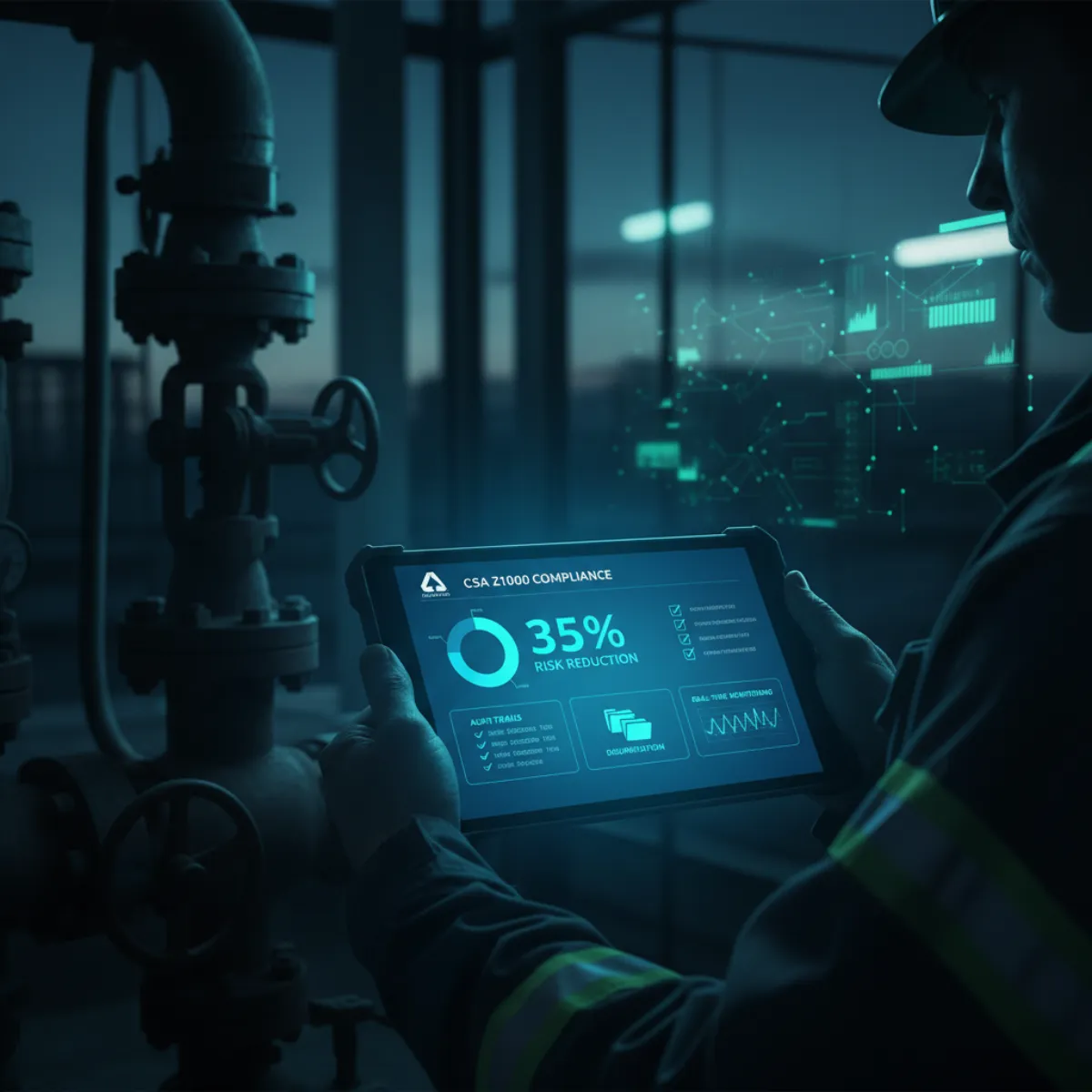
In summary: Systematic CSA Z1000 implementation with automated incident reporting and digital permit-to-work enables oil & gas companies to reduce operational incidents by up to 35% within 18 months through continuous safety audit.
Key Points:
- Problem: 73% of oil & gas incidents occur due to sop control failures and inadequate permit-to-work procedures (OSHA 2024)
- Solution: CSA Z1000 framework with real-time incident reporting and automated safety audit
- Impact: Average 35% reduction in operational incidents with 4.2:1 ROI in first year
CSA Z1000 (Canadian Standards Association) represents the most rigorous standard for occupational health and safety management systems in high-risk industries. In oil & gas, where effective incident reporting and sop control are critical, this framework provides proven methodologies to transform reactive compliance into proactive prevention. (Source: OSHA — Laws and Regulations)
How CSA Z1000 Transforms Incident Reporting in Oil & Gas
The fundamental difference lies in the systematic approach to incident reporting. Leading companies have demonstrated that automating incident capture, classification, and tracking generates immediate operational visibility and measurable corrective actions.
Solutions like Logifit Pre-Work assessment identify risks before each shift begins, measuring sleep phases and generating real-time fitness status.
CSA Z1000 Automated Incident Reporting
Integrated system that captures events in real-time, classifies by severity, and triggers automatic investigation workflows. Reduces response time by 67% compared to traditional manual reporting.
Suncor Energy implemented this methodology in their Alberta operations, achieving a 41% reduction in Tier 1 incidents over 24 months. The key was integrating IoT sensors with incident reporting platforms that feed directly into safety audit workflows.
Critical Data: OSHA documents that 84% of fatal incidents in oil & gas involve permit-to-work failures or inadequate sop control procedures (29 CFR 1910.119)
| CSA Z1000 Metric | Manual Baseline | Automated | Improvement |
|---|---|---|---|
| Incident Reporting Time | 4.2 hours | 12 minutes | 95% reduction |
| Safety Audit Accuracy | 73% | 94% | 21 points |
| SOP Control Compliance | 81% | 96% | 15 points |
Permit-to-Work: Digitization According to CSA Z1000
Permit-to-work represents the most critical control in oil & gas operations. CSA Z1000 specifies that these permits must be traceable, auditable, and directly linked with incident reporting to generate continuous organizational learning.
Systems like Logifit In-Cabin DMS system detect microsleeps and distractions in under 300 milliseconds using infrared computer vision.
Imperial Oil transformed their permit-to-work system using CSA Z1000 principles, integrating biometric verification, geo-location, and real-time physiological monitoring. Results: 52% reduction in near-miss events and 89% improvement in compliance audits.
Intelligent Permit-to-Work
Combines digital authorizations with continuous operator state monitoring. Includes pre-work fatigue verification and automatic alerts if risk conditions are detected during critical task execution.
- Pre-Work Verification with Incident Reporting: Automatic physiological assessment that documents operator fitness and generates baseline for subsequent safety audit
- Continuous Monitoring during Permit-to-Work: Sensors that detect fatigue, distraction, or sop control violations in real-time
- Automatic Closure and Documentation: Permit completion with automatic safety metrics reporting and improvement opportunity identification

SOP Control: Critical Procedure Automation
Effective sop control requires more than static documentation. CSA Z1000 demands objective evidence of compliance, deviation traceability, and automatic correction mechanisms that integrate with incident reporting.
Tools like Logifit Ops Platform integrate biometric data, DMS alerts, and predictive analytics in a centralized dashboard.
Chevron developed their "Digital SOP Compliance System" following CSA Z1000, where each critical procedure includes automated checkpoints, biometric verification, and immediate alerts for deviations. The system generated a 38% reduction in operational deviations and 94% accuracy in safety audit trails.
Key Fact: Companies with automated sop control report 67% fewer human error-related incidents according to Canadian Association of Petroleum Producers (CAPP 2024)
Intelligent SOP Control
System that verifies procedure compliance through sensors, computer vision, and behavior analysis. Documents each step automatically and generates alerts for critical deviations.
- Automatic SOP Step Verification: Computer vision confirms correct execution of each critical procedure with automatic incident reporting of deviations
- Real-Time Preventive Alerts: Immediate detection of risk behaviors with automatic escalation according to CSA Z1000-defined severity
- Complete Documentation Trail: Auditable record of each action with timestamps, biometric identification, and visual evidence for safety audit
Organizations implementing automated sop control under CSA Z1000 achieve 43% improvement in audit scores and 71% reduction in compliance violations, according to Petroleum Safety Authority (PSA 2024).
Safety Audit: CSA Z1000 Continuous Methodology
Traditional safety audit is reactive and episodic. CSA Z1000 proposes continuous auditing based on data streams from incident reporting, permit-to-work compliance, and sop control adherence, generating predictive insights instead of historical findings. (Source: ISO 45001 — Occupational Health and Safety)
ConocoPhillips implemented "Continuous Safety Auditing" in their North Slope operations, where machine learning algorithms analyze incident reporting patterns, identify correlations between permit-to-work deviations, and predict potential safety audit findings with 87% accuracy.
Continuous Safety Audit
Methodology that combines data analytics, incident reporting automation, and sop control monitoring to generate real-time audit insights. Enables proactive correction instead of reactive post-incident findings.
| Safety Audit Component | Traditional Audit | CSA Z1000 Continuous |
|---|---|---|
| Incident Reporting Review Frequency | Quarterly | Real-time |
| Permit-to-Work Verification | 15% Sampling | 100% automated |
| SOP Control Assessment | Observational | Sensor-based objective |
True transformation occurs when incident reporting, permit-to-work, and sop control function as an integrated system, not isolated processes.
— Roberto Martinez, Industrial Safety DirectorTechnology Integration: Logifit and CSA Z1000
Successful CSA Z1000 implementation requires technology that unifies incident reporting, permit-to-work management, and sop control in a coherent platform. Logifit provides the technological infrastructure that makes this framework operational.
For more on this topic, see our article on related compliance strategies.
The Logifit ecosystem addresses each critical component: Pre-Work Assessment verifies fitness for permit-to-work, In-Cabin DMS detects sop control violations in real-time, and Ops Platform centralizes incident reporting with predictive analytics for continuous safety audit.
Implement CSA Z1000 with Proven Technology
Discover how Logifit transforms compliance from reactive to predictive through automated incident reporting and intelligent permit-to-work.
Request Demo →Oil & gas companies integrating these systems report not only better safety metrics but also significant operational efficiency gains. Incident reporting automation reduces administrative burden by 78%, while digital permit-to-work accelerates critical operations by 34% without compromising safety standards.
In conclusion, CSA Z1000 transcends traditional compliance when implemented with technology that automates incident reporting, digitalizes permit-to-work, and verifies sop control objectively. Organizations adopting this comprehensive approach achieve both safety audit excellence and sustainable operational competitive advantage.