
Executive Summary
In summary: Scientific management of circadian rhythm and sleep debt can reduce fatigue-related accidents by up to 85% in shift work operations. SUNAFIL is intensifying inspections under NOM-035 and DS 024, requiring evidence-based preventive fatigue management controls.
Key Points:
- Problem: 43% of fatal accidents occur between 2-6 AM due to circadian rhythm misalignment (NIOSH 2024)
- Solution: Fatigue management systems with physiological indicators and pre-shift assessment
- Impact: Organizations with structured FRMS achieve 67% fewer drowsiness-related incidents
Circadian rhythm is the internal biological clock that regulates sleep-wake cycles over 24 hours. In shift work operations, misalignment of this rhythm generates accumulated sleep debt, exponentially increasing fatigue-related accident risk. SUNAFIL is intensifying inspections under regulations like NOM-035 and DS 024-2016-EM, requiring evidence-based fatigue management systems. (Source: NIOSH — Effects of Long Work Hours)
How Circadian Rhythm Affects Safety in Shift Work Operations
Disruption of circadian rhythm in shift workers generates measurable physiological consequences that directly impact operational safety. During 2-6 AM hours, body temperature naturally decreases and melatonin production reaches its peak.
Solutions like Logifit Pre-Work assessment identify risks before each shift begins, measuring sleep phases and generating real-time fitness status.
Circadian Risk Window
Between 2-6 AM and 2-4 PM, circadian rhythm generates two natural alertness valleys. During these periods, reaction time increases 40% and sustained attention capacity decreases significantly.
Night shift work employees face constant struggle against their natural biological programming. Cortisol, the hormone responsible for alertness, reaches minimum levels precisely when vigilance is most critical in industrial operations. (Source: Sleep Foundation — Shift Work Disorder)
Critical Data: 43% of fatal mining accidents occur between 2-6 AM when circadian rhythm is at its lowest point (MSHA 2024)
Prolonged exposure to shift work generates accumulated sleep debt that cannot be completely compensated with daytime sleep. International Commission on Mining and Minerals (ICMM) studies demonstrate that night workers experience:
- Sleep fragmentation: 23% less REM sleep compared to day workers
- Increased latency: 45 additional minutes to fall asleep during daylight
- Reduced efficiency: Only 78% of time in bed represents effective sleep
Sleep Debt: The Invisible Factor in Industrial Accidents
Sleep debt represents the cumulative difference between required sleep hours and hours actually obtained. Unlike acute fatigue, sleep debt develops gradually and its effects are insidious but devastating for safety.
Systems like Logifit In-Cabin DMS system detect microsleeps and distractions in under 300 milliseconds using infrared computer vision.
Sleep Debt Calculation
Sleep Debt = (Sleep Need × Days) - Total Sleep Obtained. A worker needing 8 hours but sleeping 6 for 5 days accumulates 10 hours of debt.
NIOSH research establishes that sleep debt exceeding 6 hours generates cognitive impairment equivalent to 0.05% blood alcohol content. In critical operations like underground mining or hazardous material transport, this impairment level is unacceptable.
| Sleep Debt Hours | Reaction Time | Accident Risk |
|---|---|---|
| 2-4 hours | +15% slower | 1.3x normal |
| 4-6 hours | +25% slower | 2.1x normal |
| 6+ hours | +40% slower | 3.8x normal |
Workers with sleep debt exceeding 6 hours show 280% higher probability of suffering lost-time accidents, according to Safe Work Australia 2024 data.
Sleep debt does not recover linearly. After a week of sleep restriction, minimum 3 nights of complete sleep are required to fully restore cognitive function and normal reaction times.
Key Fact: Only 34% of shift work employees achieve the 7-9 hours of sleep recommended per day (National Sleep Survey, Mexico 2024)
Evidence-Based Fatigue Management Strategies
An effective fatigue management system must address both circadian factors and accumulated sleep debt through integrated proactive and reactive controls. Successful implementation requires aligned technology, policies, and organizational culture.
Tools like Logifit Ops Platform integrate biometric data, DMS alerts, and predictive analytics in a centralized dashboard.
Layered Management Approach
Effective fatigue management operates in 4 layers: pre-shift assessment, continuous monitoring, immediate intervention, and predictive analysis for continuous system optimization.
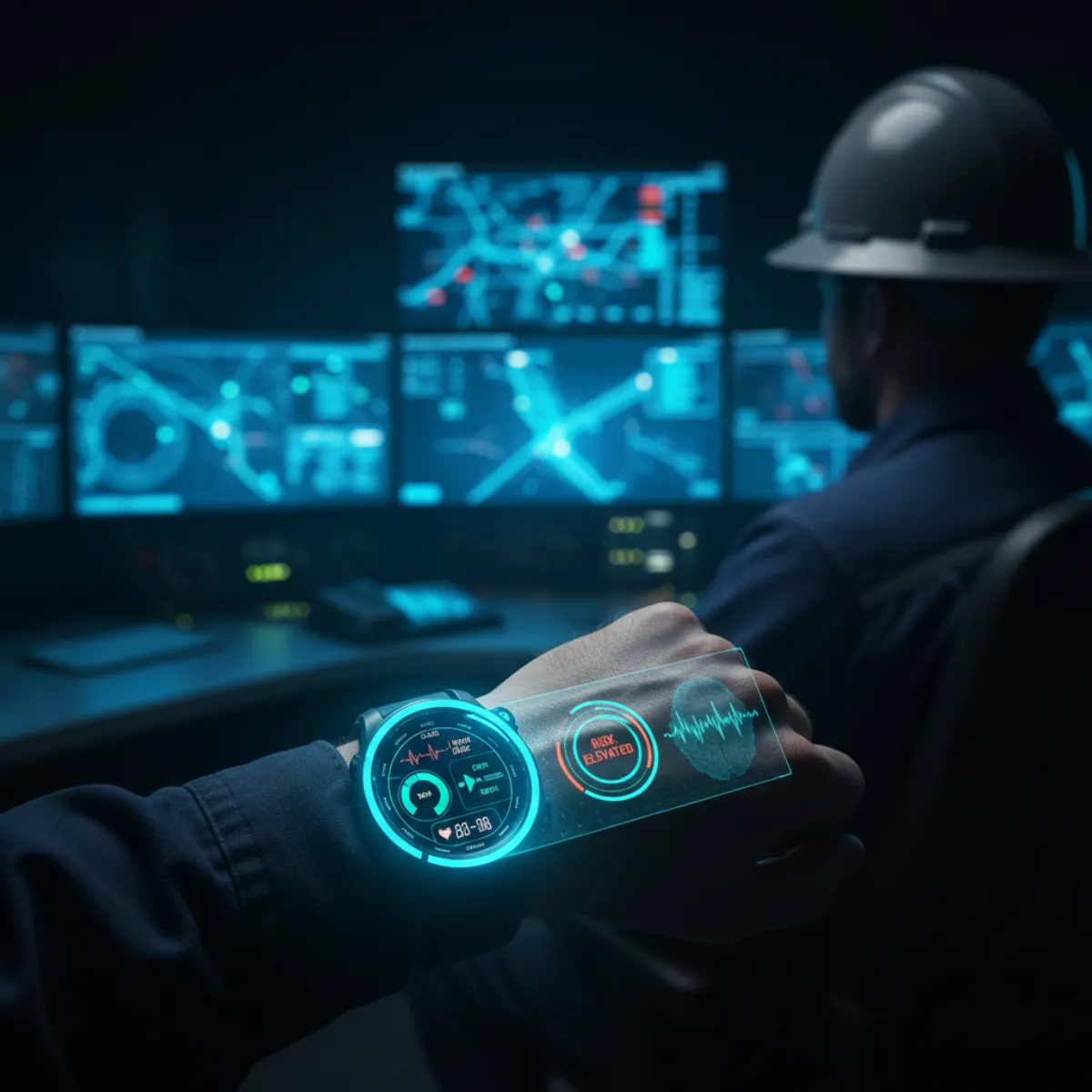
Pre-shift assessment through wearables like smartbands enables identification of workers with critical sleep debt before high-risk activity initiation. Devices like Logifit Band 9 measure REM and deep sleep phases to generate objective fitness-for-work indicators.
- Objective sleep assessment: Quality and duration measurement via actigraphy and heart rate variability
- Standardized cognitive testing: PVT (Psychomotor Vigilance Test) to measure baseline reaction time
- Dynamic risk classification: Algorithms considering sleep history, scheduled shift, and environmental factors
- Adaptive task assignment: Automatic restriction of critical activities for high-risk workers

Regulatory Compliance: NOM-035 and LATAM Regulations
SUNAFIL and Latin American regulatory authorities are requiring documented fatigue management controls as part of occupational safety compliance. NOM-035-STPS establishes specific requirements for psychosocial risk management, including shift work fatigue.
SUNAFIL inspections under DS 024-2016-EM require objective evidence that mining organizations implement preventive fatigue controls. Documentation must include:
SUNAFIL Documentation Requirements
Fatigue risk matrix by position, pre-shift evaluation records, intervention protocols, and effectiveness metrics with verifiable historical trends.
- Critical position identification: Formal analysis of roles with high risk from deficient fatigue management
- Evaluation procedures: Standardized protocols for pre-shift assessment with FIT/UNFIT criteria
- Intervention registry: Documentation of corrective actions when critical sleep debt is detected
- Performance metrics: Safety KPIs correlated with fatigue management program effectiveness
In Colombia, Decree 1072 and Resolution 0312 establish the Occupational Health and Safety Management System (SG-SST) with specific emphasis on shift work risks. Organizations must demonstrate technical controls, not just administrative ones. (Source: WHO — Occupational Health)
Fatigue management has shifted from a recommendation to a legal obligation with significant economic sanctions for non-compliance
— Dr. Sarah Jenkins, Industrial Safety SpecialistPractical Implementation: From Science to Field Controls
The transition from scientific knowledge about circadian rhythm and sleep debt toward effective operational controls requires a systematic approach considering LATAM budgetary and operational realities.
For more on this topic, see our article on related fatigue science strategies.
Implement Scientific Fatigue Management
Logifit Pre-Work Assessment combines smartbands, cognitive evaluation, and supervision dashboards for preventive fatigue controls under LATAM regulations.
Request Demo →Successful fatigue management implementation requires integration of wearable technology, information systems, and operational processes. The approach should be gradual but consistent:
| Phase | Duration | Key Components |
|---|---|---|
| Pilot | 30 days | 20 devices, critical operators |
| Scale-up | 60 days | All shifts, HRIS integration |
| Optimization | Ongoing | Predictive ML, algorithm refinement |
Implementation costs in LATAM must consider economies of scale and flexible financing options. A basic fatigue management installation for 200 operators represents initial investment less than the cost of a single serious accident.
Key Fact: Average ROI of FRMS systems is 4.2:1 in the first year, considering accident and absenteeism reduction (ICMM Economic Impact Study 2024)
Scientific management of circadian rhythm and sleep debt through preventive controls represents the natural evolution of industrial safety. Organizations implementing evidence-based fatigue management not only comply with emerging LATAM regulations but establish sustainable competitive advantages through safer and more efficient operations.
SUNAFIL will continue intensifying inspections and sanctions for non-compliance in fatigue risk management. Proactive implementation of scientific controls is both a regulatory obligation and operational improvement opportunity that reduces costs, improves productivity, and most importantly, preserves human lives in the workplace.