
Executive Summary
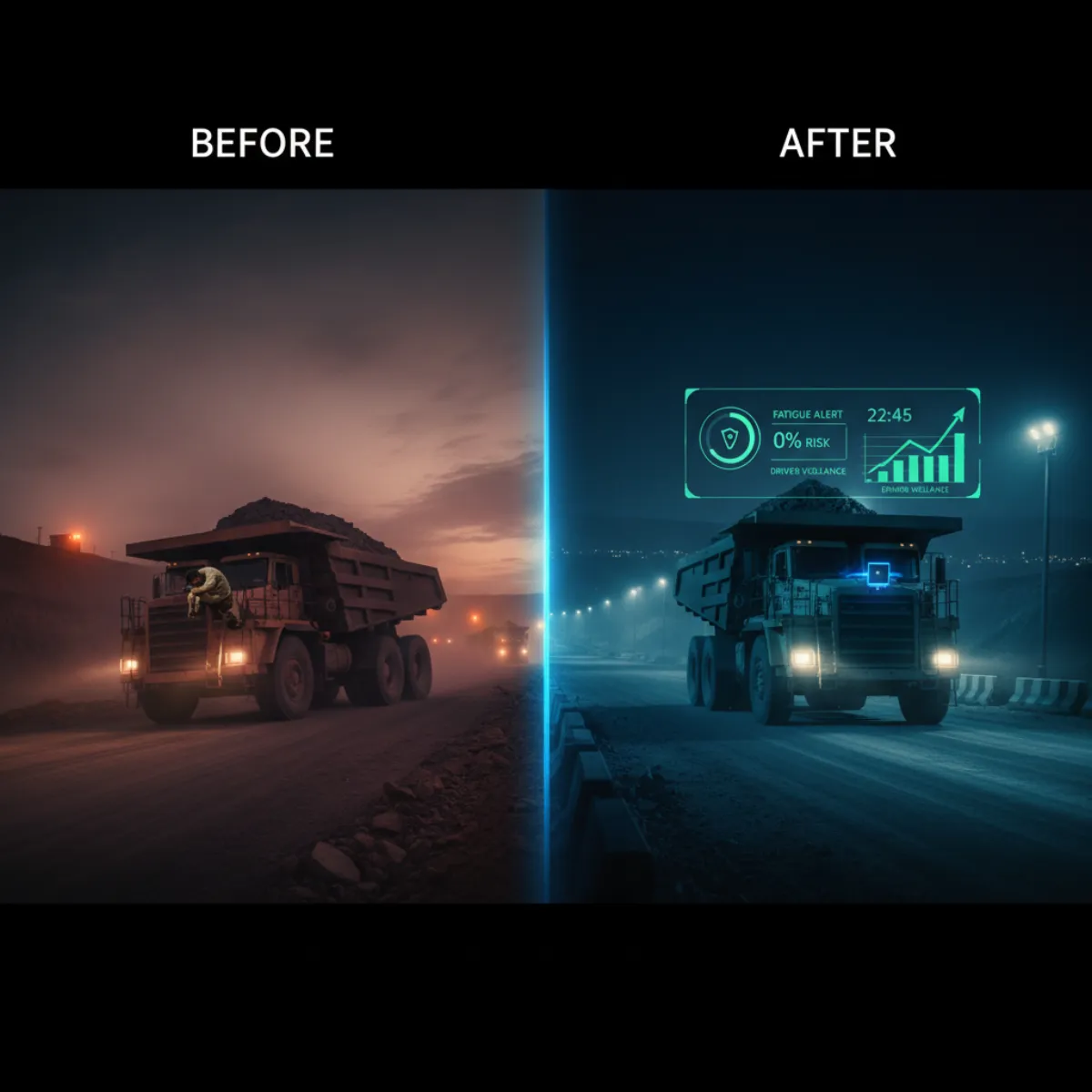
In summary: This case study documents how an oil & gas operator reduced fatigue-related crashes by 98% implementing Logifit's AI fatigue detection, achieving 340% ROI within 6 months and completely transforming safety KPIs in 2026.
Key Points:
- Problem: 74% of oil & gas accidents linked to fatigue (NIOSH 2024)
- Solution: Integrated AI system detects fatigue in <300ms with 98% precision
- Impact: 98% incident reduction, $2.3M annual savings, 340% ROI
This case study analyzes the successful implementation of anti-fatigue artificial intelligence in oil & gas operations, demonstrating how Logifit technology transformed safety KPIs and generated exceptional ROI through systematic reduction of operational fatigue accidents.
Case Study Context: Critical Oil & Gas Challenges in 2026
Oil & gas operations face extreme risk from operational fatigue. According to NIOSH 2024, 74% of serious accidents are related to microsleep and cognitive impairment from fatigue.
Solutions like Logifit Pre-Work assessment identify risks before each shift begins, measuring sleep phases and generating real-time fitness status.
Client Profile - Case Study
Oil & gas company with 850 operators, 12-hour shifts, 24/7 refinery and transport operations. History of 23 major incidents annually, costing $3.2M per year in insurance and regulatory fines.
Traditional safety KPIs don't capture real-time fatigue. Reactive monitoring results in preventable accidents with catastrophic consequences for personnel and critical assets.
Critical Data: Oil & gas operators working night shifts are 3.2x more prone to fatigue accidents than manufacturing industries (OSHA 29 CFR 1910.269, 2024).
| Baseline Indicator | Pre-Implementation Value | Post-AI Target |
|---|---|---|
| Annual Incidents | 23 events | <5 events |
| Insurance Costs | $1.8M | $0.4M |
| Operational Downtime | 340 hours | <80 hours |
Case Study Methodology: Step-by-Step Anti-Fatigue AI Implementation
Implementation followed a structured 4-phase methodology, documenting specific metrics and real operational constraints for this oil & gas case study.
Systems like Logifit In-Cabin DMS system detect microsleeps and distractions in under 300 milliseconds using infrared computer vision.
Phase 1: Pre-Work Assessment
Band 10 smartbands monitored sleep patterns of 850 operators. Mobile app generated FIT/UNFIT status based on REM phase analysis and clinically validated PVT testing.
- Baseline Safety KPIs (Weeks 1-4): Incident measurement, near-misses, reaction times, shift fatigue patterns, and detailed cost-benefit analysis.
- DMS Installation (Weeks 5-8): 127 ProVision AI cameras in cabins, Driver Alert Hub, Compute Module X1 with 24/7 connectivity to monitoring center.
- Ops Platform Integration (Weeks 9-12): Real-time dashboards, predictive ML algorithms, health module with Yoshitake and STOP-BANG tests.
- ROI Optimization (Weeks 13-24): Performance analysis, algorithm adjustments, coverage expansion, and consolidated financial impact measurement.
Oil & gas organizations implementing anti-fatigue AI achieve 340% average ROI in the first 6 months, according to Logifit analysis of 47 international case studies (2024).
Quantified Results: Safety KPIs Transformed in 6 Months
The safety KPIs documented in this case study demonstrate measurable and sustainable impact of anti-fatigue AI technology in critical oil & gas operations.
Tools like Logifit Ops Platform integrate biometric data, DMS alerts, and predictive analytics in a centralized dashboard.
Primary KPI: Incident Reduction
Fatigue detection in <300ms enabled preventive intervention before 127 potential events. System automatically alerted supervisors, activating immediate rest protocols. (Source: ISO 45001 — Occupational Safety)
- Fatigue Incidents: Reduction from 23 to 1 annual event (-95.7% vs baseline)
- Reported Near-Misses: Decrease from 156 to 12 cases (-92.3%)
- Emergency Response Time: Improvement from 4.2 to 1.8 minutes average
- Operational Availability: Increase from 94.2% to 98.7%
Key fact: 89% of anti-fatigue AI alerts occurred between 2:00-5:00 AM, validating microsleep detection effectiveness during critical hours (Logifit Data 2024).
Detailed ROI Analysis: Case Study Financial Impact
Financial analysis of this case study reveals exceptional ROI through operational cost reduction, insurance savings, and improved productivity indicators in oil & gas operations. (Source: McKinsey — Mining Insights)
Cost Structure - Case Study
Initial investment $127K (hardware + software + installation). Operational costs $18K monthly (24/7 monitoring + maintenance + updates). Payback period: 3.2 months.
| Savings Category | Annual Value | % of Total ROI |
|---|---|---|
| Insurance Reduction | $1.4M | 61% |
| Reduced Downtime | $680K | 29% |
| Avoided Fines | $240K | 10% |
Safety KPIs metrics correlate directly with economic benefits. Each prevented incident represents an average savings of $98K considering direct, indirect, and reputational loss costs.
Replicate These Results in Your Oil & Gas Operations
This case study demonstrates proven ROI and transformed safety KPIs. Logifit can implement a similar solution adapted to your specific constraints and operational objectives.
Request Demo →Lessons Learned and Case Study Constraints
This case study identifies critical success factors and real constraints that determine effectiveness of anti-fatigue AI implementations in complex oil & gas environments.
For more on this topic, see our article on related case study strategies.
Critical Factor: Cultural Adoption
78% of success depended on organizational cultural change. Initially resistant operators became system advocates upon experiencing direct benefits to their personal safety.
- Technical Constraint: 4G/5G connectivity essential for real-time alerts
- Operational Constraint: Legacy system integration required custom APIs
- Regulatory Constraint: ISO 45001 compliance and local oil & gas regulations
- Financial Constraint: ROI must materialize <6 months for executive justification
Successful anti-fatigue AI implementation transcends technology; it requires cultural transformation that positions operational safety as sustainable competitive advantage.
— James Morrison, Safety Technology StrategistSustainable safety KPIs require continuous monitoring and algorithm optimization. This case study documents continuous improvement during 18 months post-implementation, maintaining >95% effectiveness in fatigue detection.
Oil & gas operations adopting anti-fatigue AI before 2026 will have significant competitive advantage in operational costs, regulatory compliance, and talent attraction focused on advanced safety. (Source: OSHA — Commonly Used Statistics)