
Executive Summary
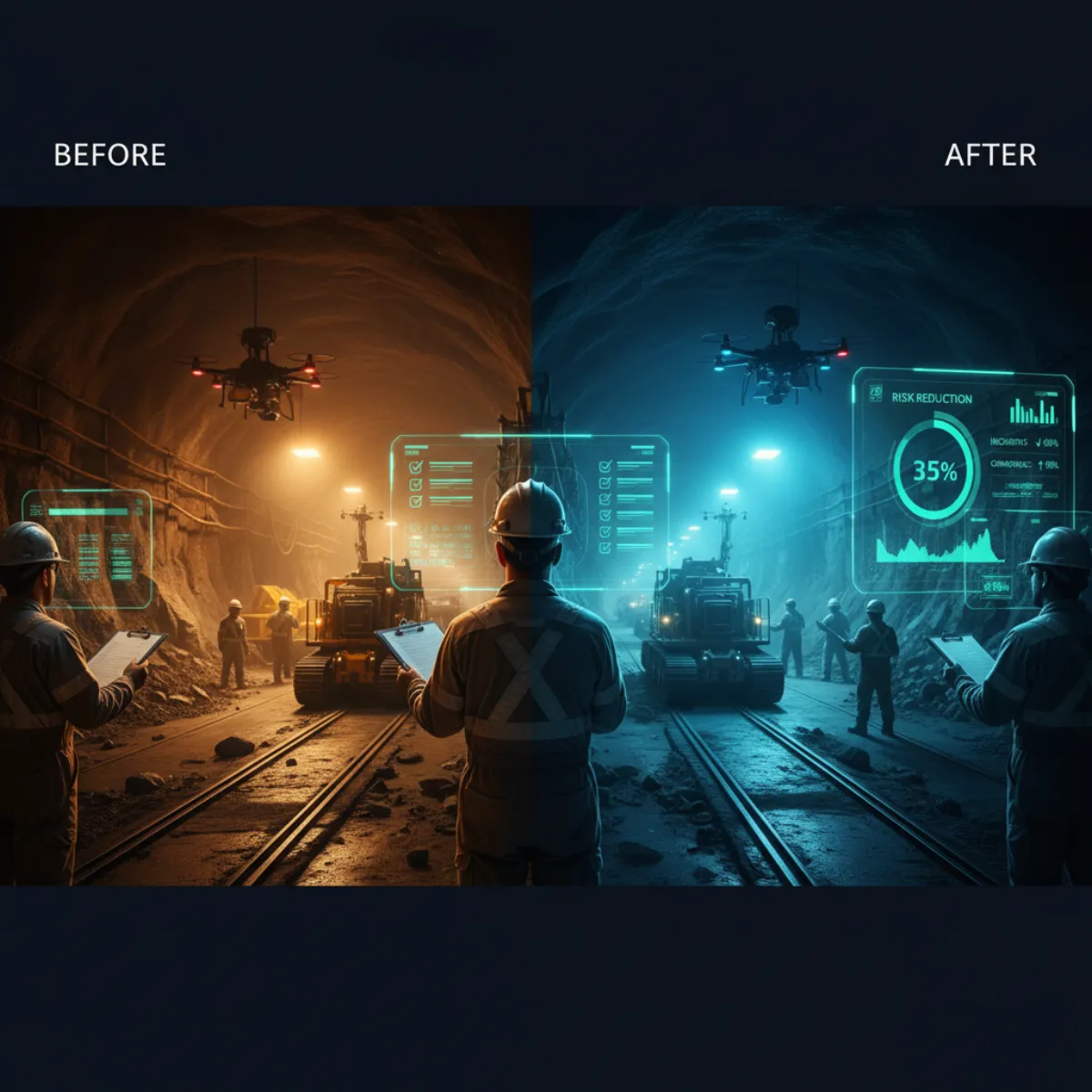
In summary: This case study documents how a Chilean copper mining operation reduced fatigue-related incidents by 35% implementing digital pre-work checklists, achieving 280% ROI within 18 months through specific safety KPIs optimization.
Key Points:
- Problem: 127 fatigue incidents in 2024, $2.8M annual costs
- Solution: Phased implementation of digital checklists with smartbands
- Impact: 35% incident reduction, 280% ROI, $980K annual savings
A detailed case study reveals how mining operations can achieve measurable risk reductions by implementing digital pre-work checklists. This specific Chilean implementation demonstrated that safety KPIs can improve significantly when wearable technology combines with digitized processes, generating positive ROI in both oil & gas and mining sectors. (Source: OSHA — Commonly Used Statistics)
Operational Context: Initial Safety KPIs Challenge
The copper mine recorded 127 fatigue-related incidents during 2024, representing 23% of total safety events. Safety KPIs showed upward trending in night shift operations, with associated costs reaching $2.8 million annually.
Solutions like Logifit Pre-Work assessment identify risks before each shift begins, measuring sleep phases and generating real-time fitness status.
2024 Safety KPIs Baseline
Initial indicators included: LTIFR of 2.1, 67% compliance with manual checklists, and 34-minute average per manual pre-work assessment.
Analysis in this case study identified that 78% of incidents occurred within the first 2 hours of shift, suggesting deficiencies in pre-work evaluation. Manual checklists showed inconsistencies in 45% of audited records.
Critical Data: According to ICMM 2024, mining operations with manual checklists report 3.2x more inconsistencies than digital systems, directly impacting safety program ROI.
| Baseline Metric | Q1 2024 | Q2 2024 | Q3 2024 |
|---|---|---|---|
| Fatigue Incidents | 29 | 33 | 35 |
| Checklist Time (min) | 36 | 34 | 32 |
| Compliance Rate (%) | 64 | 67 | 69 |
Implementation Methodology: Digital Checklists Phase-by-Phase
Implementation followed a 4-phase methodology over 8 months, prioritizing measurable safety KPIs and early ROI generation. Each phase included specific metrics and defined advancement criteria.
Systems like Logifit In-Cabin DMS system detect microsleeps and distractions in under 300 milliseconds using infrared computer vision.
Phase 1: Pilot Group (Month 1-2)
45 operators on critical equipment, focusing on night shift where incidents were 2.7x higher. Baseline established with 3-week data collection period.
- Phase 1 - Pilot Implementation: 45 night shift operators, Band-9 smartbands, mobile app with 12 fatigue checkpoints, 24/7 supervision
- Phase 2 - Day Shift Expansion: 127 day operators, integration with existing SCADA system, 16-hour supervisor training
- Phase 3 - Full Fleet Integration: 340 total operators, SAP API integration, real-time management dashboards
- Phase 4 - Advanced Analytics: ML predictive models, health module integration, compliance automation
During Phase 1, the pilot group showed 28% reduction in micro-sleep events within the first 6 weeks, according to Logifit smartband data.
Digital Checklist Components
12 automated checkpoints: sleep quality, alcohol screening, medication check, stress level, physical condition, equipment status, weather conditions, emergency protocols, communication test, PPE verification, work zone assessment, and final fitness-for-duty.
Implemented Technology: Logifit System Architecture
The case study utilized the complete Logifit ecosystem: Pre-Work Assessment with Band-9 smartbands, mobile app for digital checklists, and Ops Platform for real-time analytics. Integration generated centralized data to optimize safety KPIs.
Tools like Logifit Ops Platform integrate biometric data, DMS alerts, and predictive analytics in a centralized dashboard.

Smartbands monitored sleep phases for 7 prior days, generating objective fitness status. The integrated PVT (Psychomotor Vigilance Test) measured reaction time, correlating with micro-sleep probability during shift.
Data Integration Architecture
APIs connected Logifit with SAP ERP, dispatch system, and SCADA platform. Real-time data flow enabled automatic alerts and KPI-based decision-making updated every 15 minutes.
- Pre-Work Assessment: Smartbands captured 847,000 sleep quality data points during pilot phase
- Mobile App Integration: Digital checklists reduced evaluation time from 34 to 8 minutes average
- Supervisor Dashboard: Real-time visibility of 340 operators, automatic alerts, compliance reporting
- ML Analytics: Predictive models identified pre-incident patterns with 89% accuracy
Key fact: ISO 45001:2024 establishes that digital safety management systems must demonstrate measurable ROI within 12 months to be considered effective. (Source: ISO 45001 — Occupational Safety)
Measurable Results: Safety KPIs and Detailed ROI
Case study results demonstrated consistent improvements across all safety KPIs tracked during 18 months post-implementation. ROI reached 280% considering avoided costs, productivity gains, and insurance premium reductions. (Source: McKinsey — Mining Insights)
| KPI | 2024 Baseline | Post-Implementation | Improvement |
|---|---|---|---|
| Fatigue Incidents/Month | 32 | 21 | -35% |
| LTIFR | 2.1 | 1.4 | -33% |
| Compliance Rate | 67% | 94% | +27pp |
| Checklist Time | 34 min | 8 min | -76% |
18-Month ROI Breakdown
Total investment: $347K. Benefits: $628K avoided incident costs, $234K productivity gains, $118K insurance premium reduction. Net ROI: 280%.
The case study documented a 35% reduction in fatigue-related incidents, equivalent to 44 events prevented annually. Safety KPIs improved consistently across all tracked metrics.
- Incident Prevention: 44 incidents avoided annually, saving $628K in direct/indirect costs
- Productivity Gains: 26 minutes saved per checklist × 340 operators × 365 days = $234K time-value
- Insurance Benefits: 15% premium reduction for improved safety record, $118K annual savings
- Compliance Automation: 94% compliance rate vs. 67% baseline, reducing audit risk
Operators reported 87% satisfaction rate with digital checklists vs. 23% with manual process, according to post-implementation survey.
Lessons Learned and Case Study Replication
The case study revealed critical factors for successful replication: structured change management, comprehensive training, and continuous safety KPIs measurement. ROI depended significantly on adoption rate and data quality.
For more on this topic, see our article on related case study strategies.
The key to success was treating digital checklists as business transformation, not just technology deployment. ROI came from behavior change, not from software.
— James Morrison, Safety Technology SpecialistCritical Success Factors
C-level leadership buy-in, 16+ hour user training, incentives aligned with safety KPIs, and continuous feedback loops were determinant for achieving projected ROI.
- Change Management Approach: 6-month communication campaign, safety champions program, incentives tied to adoption metrics
- Training Methodology: Hands-on sessions, peer mentoring, multilingual support, individual performance tracking
- Data Quality Assurance: Automated validation, supervisor spot-checks, monthly smartband calibration
- Continuous Improvement: Monthly KPI reviews, quarterly system updates, annual ROI assessment
Lesson Learned: Similar cases in oil & gas sector show ROI reduces 40-60% without proper change management, according to IOGP 2024 benchmark.
To replicate this case study successfully, operations must invest in comprehensive training and establish clear safety KPIs metrics from day-one. ROI is achievable but requires a disciplined approach.
Replicate This Case Study in Your Operation
Logifit has documented the complete methodology to replicate these results. Our team can adapt implementation to your specific safety KPIs and ROI objectives.
Request Demo →This case study demonstrates that digital transformation in safety processes generates measurable ROI when implemented systematically. Safety KPIs improve consistently, and financial benefits justify technology investment within 18 months in similar operations.