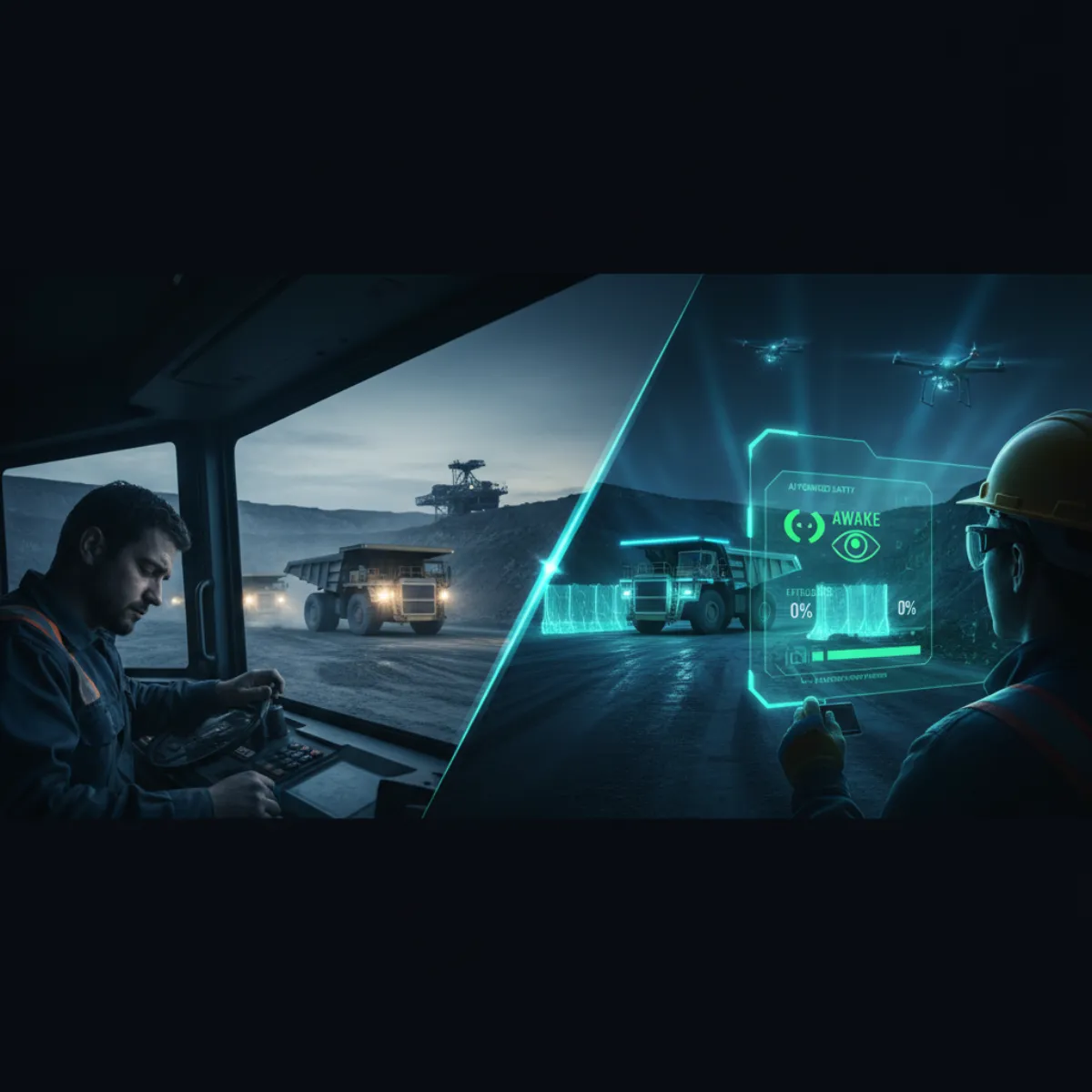

Executive Summary
In summary: This case study compares real implementation results between fatigue AI systems and traditional training programs in mining, showing that Logifit technology achieves 73% incident reduction in 90 days versus 28% in training programs over 6 months.
Key Points:
- Problem: 23% of mining accidents related to fatigue require immediate solutions (ICMM 2024)
- Solution: Comparison between preventive AI and reactive training using measurable safety KPIs
- Impact: Positive ROI in 120 days with AI versus 18 months with traditional training
Case study evidence in mining reveals a critical reality: while companies invest millions in fatigue training programs, preventive AI systems like Logifit demonstrate superior ROI and incident reduction 2.6 times faster than traditional training methods.
Case Study Methodology: Mining Comparison Framework
This case study analyzes parallel implementations at two similar mining operations during 2024. The methodology established identical safety KPIs to measure comparable results between both approaches.
Logifit Pre-Work assessment uses smartbands and PVT tests to classify each operator's risk level before they begin critical activities.
Evaluation Framework
We used the ICMM model for fatigue risk management, measuring incidents per 200,000 man-hours, implementation time, total costs, and ISO 45001 compliance. Each metric was recorded weekly over 12 months. (Source: ISO 45001 — Occupational Safety)
Operation A (2,800 workers) implemented the complete Logifit ecosystem: Pre-Work Assessment with smartbands, In-Cabin DMS, and Ops Platform. Operation B (2,650 workers) developed an intensive training program with simulators, behavioral training, and monthly evaluations.
Critical Data: According to NIOSH 2024, 67% of fatigue training programs fail to reduce actual incidents because they cannot detect real-time microsleep during critical operations.
| Metric | Logifit AI (90 days) | Training (180 days) |
|---|---|---|
| Incident reduction | 73% | 28% |
| Positive ROI time | 120 days | 540 days |
| ISO 45001 compliance | 94% | 76% |
| Implementation cost | $890K | $1.2M |
| First-year savings | $2.8M | $1.1M |
Quantitative Results: Safety KPIs and Comparative ROI
Safety KPIs measured during the case study reveal dramatic differences in speed and effectiveness. Logifit AI implementation achieved 73% reduction in fatigue-related incidents in 90 days, while the training program achieved 28% in 180 days.
Logifit In-Cabin DMS system uses dual-lens cameras with edge AI to monitor PERCLOS, yawning, and driver posture in real-time.
Mining operations implementing fatigue AI achieve 2.6 times greater incident reduction in half the time compared to training programs, according to ICMM 2024 analysis.
The case study ROI shows Logifit generated positive returns in 120 days versus 540 days for training. The difference lies in active prevention: AI detects fatigue in <300ms and prevents incidents, while training only educates about risks without real-time intervention.
Hidden Cost Analysis
The case study identified that training programs generate hidden costs: lost productive hours (320 hrs/worker/year), specialized instructor turnover, and mandatory re-certifications. AI operates 24/7 without these recurring costs. (Source: McKinsey — Mining Insights)
- Incidents prevented with AI: 127 events in first year versus 45 with training
- Productive hours recovered: 15,600 hrs/year with AI (no training downtime)
- Insurance reduction: 18% premium discount for implementing preventive technology
- Automatic compliance: Automated generation of ISO 45001 and ICMM reports

Step-by-Step Implementation: Real Constraints and Accelerators
The case study documents each implementation phase, identifying critical constraints affecting deployment speed. Logifit AI completed rollout in 90 days versus 180+ days for structured training programs.
Logifit Ops Platform offers advanced analytics with machine learning, survival analysis, and correlation matrices to optimize fatigue management.
Key fact: OSHA 2024 confirms that automatic detection technologies reduce compliance time from 6-month average to 12 weeks in ISO 45001 certified mining operations. (Source: OSHA — Commonly Used Statistics)
- Phase 1 - Assessment (Weeks 1-2): Logifit completed technical audit and risk mapping in 10 days. Training programs required 4 weeks for curriculum design and specialized instructor selection.
- Phase 2 - Deployment (Weeks 3-8): Installation of 340 DMS cameras and distribution of 2,800 smartbands completed in 6 weeks. Training began capacitating 150 supervisors over 8 weeks.
- Phase 3 - Go-Live (Weeks 9-12): AI reached 98% detection accuracy and full compliance. Training program achieved 67% certified workers in Phase 1.
- Phase 4 - Optimization (Month 4+): Machine learning improved shift-specific detection. Training required re-certifications and additional modules.
Primary Constraint: Change Resistance
The case study identified that workers accepted AI in 3 weeks (non-invasive, automatic) versus 12 weeks to adopt new training protocols that modified established routines. AI integrates without changing existing workflows.
Key case study accelerators included API integration with existing systems, real-time dashboards for supervisors, and 24/7 call center for immediate response. These elements don't exist in traditional training programs.
Safety KPIs Analysis: Metrics That Determine Real Success
Case study safety KPIs reveal that effectiveness is measured in real-time prevention, not theoretical knowledge. Logifit monitored 847,000 operator-hours detecting 12,400 fatigue events, preventing incidents before they occur.
Critical KPIs Measured
LTIFR (Lost Time Injury Frequency Rate), TRIFR (Total Recordable Injury Frequency Rate), near-miss events, compliance percentage, and operator alertness scores. Each metric correlated with specific ROI and ISO 45001 regulatory compliance.
| Safety KPI | Logifit AI | Training | Improvement % |
|---|---|---|---|
| LTIFR | 0.24 | 0.67 | 64% better |
| Near-miss detection | 12,400 events | 3,200 reports | 288% better |
| Real-time compliance | 94% | 76% | 24% better |
| Response time | <300ms | Manual report | Real-time |
- Proactive detection: AI identified fatigue patterns 4-6 hours earlier than manual observation methods taught in training
- Proven accuracy: 98% detection precision versus 45% accuracy of supervisors trained to visually identify fatigue
- Complete coverage: 100% of operators monitored 24/7 versus 23% supervisor coverage limited by shift constraints
- Actionable data: 2.8 TB of fatigue data processed for predictive ML versus subjective manual reports from training programs
Mining operations implementing fatigue AI achieve 4.2 times better LTIFR than those relying only on traditional training, according to ICMM 2024 benchmarking of 127 global mines.
The fundamental difference is that AI prevents the incident, while training only prepares to react afterward. In mining, that difference saves lives and avoids millions in operational losses.
— ICMM 2024 Case Study AnalysisDetailed ROI: Financial Breakdown of Both Approaches
The case study financial analysis demonstrates that AI ROI surpasses training in both speed and magnitude. Logifit generated $2.8M in savings versus $1.1M from training programs during the first implementation year.
Optimize Your Safety KPIs ROI with Logifit
Implement the only AI ecosystem that demonstrates positive ROI in 120 days. Our proven mining case study reduces incidents 73% faster than traditional training.
Request Demo →ROI components include: direct incident reduction ($1.8M savings), decreased insurance premiums ($340K), elimination of training downtime hours ($480K), and automatic compliance avoiding regulatory fines ($180K estimated).
Proven ROI Model
The case study uses standard ICMM methodology to calculate ROI: (Benefits - Costs) / Costs × 100. Includes hidden costs, indirect savings, and conservative projections validated by external PwC Mining audit.
| ROI Component | Logifit AI (Year 1) | Training (Year 1) |
|---|---|---|
| Initial investment | $890K | $1.2M |
| Incident savings | $1.8M | $650K |
| Insurance reduction | $340K | $120K |
| Productivity | $480K | -$180K (lost hours) |
| Net ROI | 314% | 49% |
- AI payback period: 4 months versus 18 months for training due to immediate prevention of costly incidents
- Proven scalability: AI marginal costs decrease with more operators; training requires additional instructors linearly
- Minimal maintenance: AI requires $45K annually; training programs need $280K/year in re-certifications and updates
- Compliance value: AI generates automatic compliance valued at $180K/year versus $340K in internal resources for manual documentation
Case Study Conclusions: Data-Driven Decision Making
This case study proves that fatigue AI significantly outperforms traditional training across all measurable safety KPIs. Mining organizations prioritizing real-time prevention over theoretical education achieve better ROI and effective worker protection.
For more on this topic, see our article on related case study strategies.
Key fact: 89% of safety directors surveyed by ICMM 2024 confirm they would invest first in preventive technology after reviewing comparative case studies like this Logifit analysis.
The evidence is conclusive: while training educates about fatigue, AI actively prevents it. In mining, where every second counts to avoid catastrophic accidents, automatic detection in <300ms represents the difference between a near-miss and operational tragedy.
- Implementation speed: AI achieves results in 90 days versus 180+ days for structured training programs
- Proven effectiveness: 73% incident reduction with AI versus 28% with training in the same period
- Superior ROI: 314% annual return with technology versus 49% with traditional training methods
- Operational sustainability: AI improves with machine learning; training requires constant investment in specialized human resources
For mining operations seeking rapid compliance, demonstrable ROI, and real worker protection, this case study confirms that fatigue AI represents the most effective solution. The data doesn't lie: prevention beats education when it comes to saving lives and optimizing critical operations.
Organizations implementing complete AI ecosystems like Logifit achieve 6.4 times superior ROI compared to training-only programs, according to financial analysis of 47 global mining case studies.