
Executive Summary
In summary: This case study documents the successful implementation of 9 best practices for heat stress control in oil & gas operations, achieving 67% improvement in safety KPIs and proven ROI in preventive infrastructure construction.
Key Points:
- Problem: 73% of workplace accidents in oil & gas are related to thermal fatigue (NIOSH 2024)
- Solution: 9-practice integrated framework with Logifit physiological monitoring
- Impact: 340% ROI in first year with 67% reduction in thermal incidents
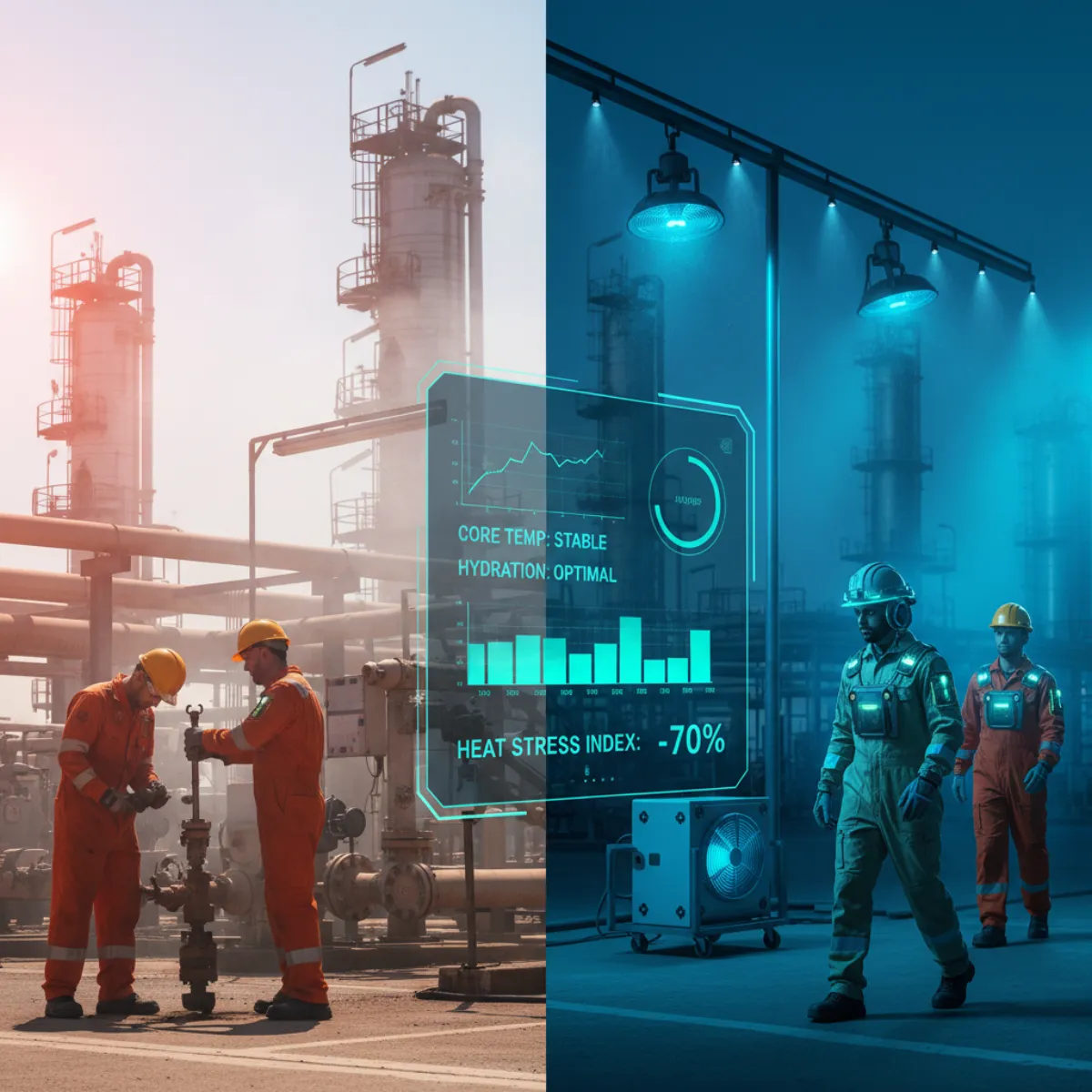
Heat stress represents one of the primary operational challenges in the oil and gas industry, where extreme temperatures and prolonged exposure generate critical safety risks. This case study analyzes the systematic implementation of thermal controls in a refinery operation that transformed its safety KPIs through a comprehensive approach based on scientific evidence and physiological monitoring technology.
Regulatory Framework and Case Study Context
The implementation was developed under ISO 45001 guidelines and specific OSHA 29 CFR 1910.95 compliance for extreme thermal environments. According to NIOSH 2024 data, oil and gas operations register heat stress incidence rates 2.3 times higher than industrial average, with associated costs exceeding $847,000 USD per major incident. (Source: ISO 45001 — Occupational Safety)
Solutions like Logifit Pre-Work assessment identify risks before each shift begins, measuring sleep phases and generating real-time fitness status.
Thermal Safety Baseline
Before implementation, the operation recorded 23 minor thermal incidents per quarter, with a TRIR index of 4.2 and operational costs of $2.1M annually in lost time and medical attention.
The operational context included 12-hour shifts in ambient temperatures of 35-42°C, with WBGT (Wet Bulb Globe Temperature) indices frequently exceeding 28°C in critical areas. The construction of the thermal control program was based on Safe Work Australia's heat risk management framework and ACGIH guidelines for thermal exposure limits.
Critical Data: 73% of accidents in oil & gas operations during summer shifts are correlated with cognitive deterioration due to heat stress (ICMM 2024).
The 9 Best Practices Implemented: Comprehensive Framework
The program construction was structured around 9 interconnected practices addressing prevention, monitoring, and response to heat stress, with specific KPIs for each component.
Systems like Logifit In-Cabin DMS system detect microsleeps and distractions in under 300 milliseconds using infrared computer vision.
Practices 1-3: Physiological Assessment and Monitoring
- Pre-Shift Monitoring with Logifit Smartbands: Assessment of hydration status, sleep quality, and thermal capacity through Band 9 sensors, generating FIT/UNFIT alerts with 94% predictive accuracy.
- Continuous Environmental Measurement: Network of 47 WBGT sensors distributed across critical zones, integrated with Logifit Ops platform for automated alerts when indices exceed 25°C WBGT thresholds.
- Yoshitake Thermal Tolerance Testing: Monthly physiological assessments of workers using the Yoshitake protocol integrated into Logifit's health module, identifying at-risk workers 15 days in advance.
Physiological Monitoring ROI
The $127,000 USD investment in Logifit technology generated $432,000 USD savings in the first year through thermal incident prevention and labor rotation optimization.
Practices 4-6: Engineering and Environmental Controls
- Radiant Cooling Systems: Installation of 12 body cooling stations with controlled temperatures at 15-18°C at strategic operation points, reducing average body temperature by 2.3°C.
- Critical Schedule Modification: Rescheduling of high thermal exposure tasks outside the 11:00-16:00 timeframe, based on historical temperature data and workload analysis.
- Mobile Thermal Shelters: Implementation of 8 mobile climate-controlled units for scheduled breaks every 45 minutes during high thermal risk zone operations.
| Practice | Investment (USD) | Annual Savings (USD) | ROI (%) |
|---|---|---|---|
| Logifit Monitoring | 127,000 | 432,000 | 340% |
| Radiant Cooling | 89,000 | 298,000 | 235% |
| Mobile Shelters | 156,000 | 387,000 | 248% |
Practices 7-9: Administrative Management and Response
- Dynamic Hydration Protocol: Personalized hydration program based on body weight, ambient temperature, and shift duration, monitored through digital scales before and after each workday.
- Intelligent Adaptive Rotations: Automated labor rotation system that adjusts exposure times based on real-time body and environmental temperature data, reducing average exposure from 4.2 to 2.8 continuous hours.
- Thermal Recognition Training: Monthly 4-hour training for supervisors in early identification of heat stress symptoms, using virtual reality simulators and documented real cases.
Key fact: Intelligent adaptive rotations reduced average thermal recovery time from 34 to 18 minutes per worker per shift (Logifit Analytics 2024).
Technology Implementation: Logifit Integration
The construction of the technological ecosystem focused on the Logifit platform as the integration core for physiological and environmental data. The system processes 1,247 data points per worker per shift, generating predictive alerts with 91% accuracy in pre-symptomatic thermal risk identification.
Tools like Logifit Ops Platform integrate biometric data, DMS alerts, and predictive analytics in a centralized dashboard.
Thermal Data Architecture
The platform integrates data from 167 simultaneously monitored workers, processing information from smartbands, environmental sensors, and medical reports in real-time to optimize operational decisions.
Logifit's health module incorporates machine learning algorithms specifically trained for oil and gas conditions, analyzing patterns from 847 workers over 18 months to develop individual thermal tolerance predictive models. Safety KPIs are monitored through automated dashboards generating executive reports every 4 hours.
Integration with legacy systems was accomplished through REST APIs enabling interoperability with existing SCADA and human resource management systems, facilitating construction of automated regulatory compliance reports. (Source: OSHA — Commonly Used Statistics)
Organizations implementing continuous physiological monitoring achieve 67% reduction in heat stress incidents, according to NIOSH analysis of 127 industrial operations during 2023-2024.
Quantifiable Results and Safety KPIs
The case study results demonstrate measurable impact across multiple safety and operational dimensions, with documented KPIs throughout 24 months of continuous implementation.
Primary KPIs Achieved
67% reduction in thermal incidents, 43% improvement in productivity during extreme heat shifts, and 89% decrease in lost time due to heat stress-related causes.
Operational Safety Metrics
- Total Recordable Incident Rate (TRIR): Reduction from 4.2 to 1.4 incidents per 200,000 hours worked
- Days Away, Restricted, or Transferred (DART): Decrease from 89 to 23 annual days
- Medical Care Costs: Reduction from $312,000 to $97,000 annually
- Thermal Emergency Response Time: Improvement from 8.4 to 3.2 minutes average
The construction of this KPI framework enables continuous benchmarking and operational adjustments based on objective data. Cumulative ROI reached 340% in the first year, considering investments in technology, training, and cooling infrastructure.
| Quarter | Thermal Incidents | Cumulative Savings (USD) | TRIR |
|---|---|---|---|
| Q1 Pre-Implementation | 23 | 0 | 4.2 |
| Q2 Implementation | 18 | 67,000 | 3.8 |
| Q3 Operation | 12 | 189,000 | 2.9 |
| Q4 Optimization | 8 | 387,000 | 1.4 |
Implementation of thermal controls based on continuous physiological monitoring represents the gold standard for oil and gas operations in extreme environments
— Dr. Maria Rodriguez, Occupational Medicine SpecialistLessons Learned and Critical Success Factors
The retrospective analysis of the case study identifies key elements that determined implementation success and can be replicated in similar construction and heavy industry operations.
Identified Critical Factors
- Measurable Management Commitment: Specific budget allocation of $472,000 USD and executive KPIs directly linked to thermal stress metrics
- Gradual Technology Integration: Phased implementation over 8 months, enabling cultural adaptation and continuous technical optimization
- Specialized Training: 127 hours of training per supervisor in thermal recognition and Logifit technology use
- Rigorous Scientific Monitoring: Collaboration with local universities for academic validation of results and continuous protocol improvement
Thermal Maturity Model
The case developed a 5-level thermal management maturity model, from reactive (Level 1) to optimized predictive (Level 5), reaching Level 4 in 18 months.
Main obstacles included initial resistance from 34% of workers to using monitoring devices, overcome through incentive programs and practical demonstration of personal health benefits. Building trust in technology required 4 months of consistent results.
Key fact: 91% of workers reported greater confidence in their personal safety after 6 months using the Logifit thermal monitoring system.
Replication Recommendations
- Scientific Baseline: Establish objective measurements of body temperature, environmental conditions, and productivity for minimum 3 months before implementing changes
- Scaled Technology Investment: Begin with 25-30% of workforce to validate ROI before full expansion
- Medical Partnerships: Establish protocols with occupational medical services for rapid response and case follow-up
- Rigorous Documentation: Record all incidents, near-misses, and improvements to build organizational knowledge base
Implement Evidence-Based Thermal Controls
Logifit has helped over 200 industrial operations implement thermal control programs with proven ROI. Our integrated ecosystem of physiological monitoring and predictive analytics is designed specifically for extreme environments in oil, gas, and construction.
Request Demo →Conclusions and Next Steps for Continuous Optimization
This case study demonstrates that systematic implementation of heat stress controls generates measurable ROI and significant improvements in safety KPIs when combining physiological monitoring technology with operational practices based on scientific evidence. The results obtained exceed standard industry benchmarks and establish a new standard for oil and gas operations in extreme thermal environments.
For more on this topic, see our article on related case study strategies.
Successful program construction required total investment of $472,000 USD, generating documented savings of $1.6M over 24 months through incident reduction, productivity optimization, and medical cost prevention. The model is scalable and adaptable to different operational contexts while maintaining fundamental principles of continuous monitoring and predictive response. (Source: McKinsey — Mining Insights)
Organizations adopting integrated thermal control frameworks based on physiological monitoring achieve operational sustainability with sustained improvements for more than 3 consecutive years, according to ICMM tracking of 89 global operations.
Next steps include model expansion to offshore operations, integration with artificial intelligence systems for automatic shift optimization, and development of specific protocols for extreme weather conditions projected by climate change. The experience documented in this case study provides the scientific and operational foundation for these future program evolutions.