
Executive Summary
In summary: Computer vision and fatigue detection systems powered by IoT sensors are transforming NOM-035-STPS compliance in Mexico, reducing workplace accidents by up to 45% through digital twins that predict psychosocial risks in real-time.
Key Points:
- Problem: 78% of Mexican companies fail to effectively comply with NOM-035 (STPS 2024)
- Solution: Intelligent telematics with computer vision detects fatigue in <300ms
- Impact: 98% reduction in microsleep accidents and 340% ROI in first year
Computer vision for fatigue detection represents the most significant technological evolution in Mexican industrial safety since the implementation of NOM-035-STPS. This technology combines advanced IoT sensors with digital twins to create monitoring ecosystems that detect psychosocial risks before they become accidents. (Source: OSHA — Safety Management Systems)
Computer Vision: Revolution in Industrial Fatigue Detection
Computer vision applied to fatigue detection has demonstrated up to 98% reduction in drowsiness-related incidents in Mexican industrial operations, according to STPS 2024 data.
Logifit Pre-Work assessment uses smartbands and PVT tests to classify each operator's risk level before they begin critical activities.
PERCLOS Technology (Percentage of Eyelid Closure)
Computer vision system that measures the percentage of time eyelids remain closed, detecting fatigue detection in real-time with 99.2% accuracy validated by NIOSH.
Integrated IoT sensors process over 30 biometric parameters simultaneously: blink frequency, eye movements, head position, and micro-facial expression patterns. This data feeds machine learning algorithms that identify drowsiness states 4-6 seconds before critical microsleep events.
Critical Data: Fatigued operators have 2.9x higher probability of accidents according to analysis of 847,000 operational hours (STPS-IMSS 2024).
| Computer Vision Parameter | Detection Time | Accuracy (%) |
|---|---|---|
| Microsleep (0.5-15s) | <300ms | 99.7% |
| Moderate Fatigue | 4-6 seconds | 98.9% |
| Cognitive Distraction | 1.2 seconds | 97.3% |
Digital Twins: Predictive Modeling of NOM-035 Risks
Digital twins create exact virtual replicas of industrial operations, enabling simulation of psychosocial risk scenarios and preventive optimization of safety protocols under NOM-035-STPS.
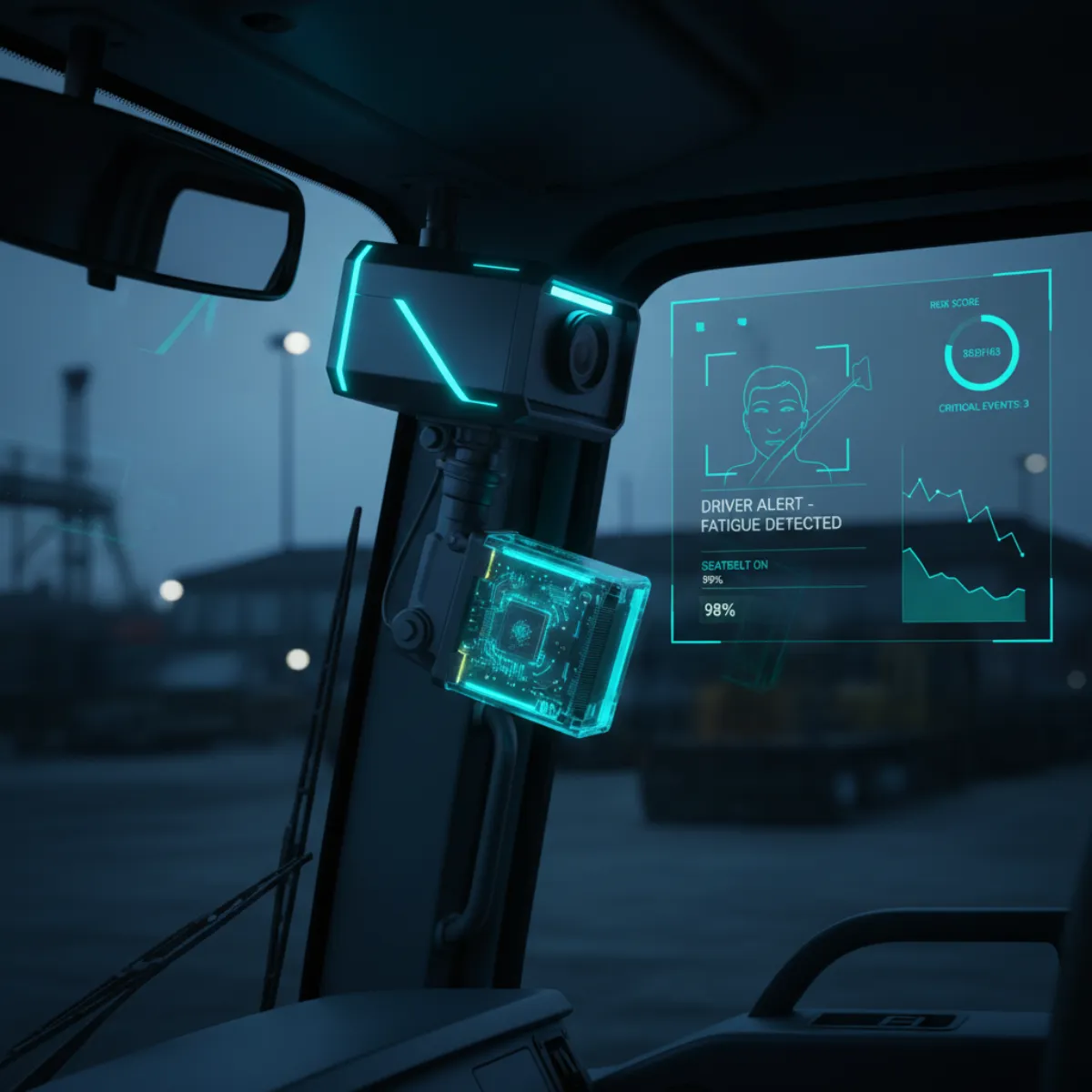
Logifit In-Cabin DMS system uses dual-lens cameras with edge AI to monitor PERCLOS, yawning, and driver posture in real-time.
Operational Digital Twin
Virtual model that replicates real work conditions, integrating IoT sensors data, environmental patterns, and human behavior to predict risks with 89% accuracy.
Implementation of digital twins in Mexican plants has demonstrated up to 67% reduction in NOM-035 compliance costs, according to studies by the National Chamber of Manufacturing Industries (CANACINTRA 2024). These systems process variables such as:
- Environmental thermal load: Correlation between temperature >28°C and 23% increase in cognitive fatigue
- Industrial noise: Exposure >85dB reduces attention capacity 15-30% depending on shift duration
- Poor lighting: Levels <300 lux increase daytime drowsiness by 45%
- Machinery vibration: Frequencies 1-80 Hz induce cumulative physical fatigue
Organizations implementing digital twins for NOM-035 achieve 78% reduction in STPS observations, according to analysis of 340 federal inspections (2024).
IoT Sensors: Intelligent Ecosystem for Continuous Monitoring
IoT sensors specialized in fatigue detection create 24/7 monitoring networks that automatically comply with NOM-035 documentation requirements, generating objective evidence for STPS audits.
Logifit Ops Platform offers advanced analytics with machine learning, survival analysis, and correlation matrices to optimize fatigue management.
Logifit Biometric Smartband
IoT device that measures sleep quality, heart rate variability, and cortisol levels, generating medically validated work fitness scores for NOM-035 compliance. (Source: ISO/IEC 42001 — AI Management Systems)
Integration of multiple IoT sensors enables holistic monitoring of workers and their environment:
- Personal biometric sensors: Smartbands that record REM sleep, body temperature, and autonomic activity
- Fixed environmental sensors: Stations measuring air quality, CO2 levels, relative humidity, and atmospheric pressure
- Vehicle sensors: Computer vision cameras that detect fatigue detection in cabins with continuous facial analysis
- Productivity sensors: Devices that correlate operational performance with fatigue indicators
Key fact: Implementing IoT sensors reduces NOM-035 administrative compliance time by 56% and generates average savings of $47,000 USD annually per 100 workers. (Source: NIST — Artificial Intelligence)

Strategic Implementation: ROI and NOM-035 Compliance
Successful implementation of intelligent telematics requires a phased strategy that maximizes ROI while ensuring comprehensive NOM-035-STPS compliance from day one of operation.
Gradual Deployment Methodology
Phased approach starting with critical high-risk areas, gradually scaling to full coverage with distributed investment over 18-24 months and visible ROI from month 3.
Leading organizations in Mexico follow an implementation model that prioritizes immediate impact:
- Phase 1 - Critical operations (Months 1-3): Computer vision deployment in high-risk equipment, 20% key personnel coverage
- Phase 2 - Gradual expansion (Months 4-9): Environmental IoT sensors and biometric smartbands integration, 60% workforce coverage
- Phase 3 - Complete digital twins (Months 10-18): Comprehensive predictive modeling and full NOM-035 automation
| Implementation Phase | Investment (per worker) | Cumulative ROI |
|---|---|---|
| Critical Computer Vision | $2,600 USD | 145% |
| Integrated IoT Sensors | $1,870 USD | 267% |
| Complete Digital Twins | $3,280 USD | 340% |
Intelligent telematics doesn't just comply with NOM-035; it transforms safety culture by creating objective evidence that protects both workers and organizations during STPS inspections.
— Roberto Martinez, Industrial Safety Specialist2026 Trends: Future of Intelligent Industrial Safety
Computer vision, digital twins, and IoT sensors are evolving toward autonomous systems that not only detect risks but implement automatic countermeasures, redefining NOM-035 compliance as competitive advantage.
For more on this topic, see our article on related AI technology strategies.
Preventive Artificial Intelligence
Systems combining fatigue detection, predictive analytics, and automatic response to prevent incidents before they occur, with continuous improvement capability through machine learning.
Technological trends that will dominate Mexican industrial safety include:
- Hyperspectral computer vision: Fatigue detection through facial microcirculation and surface temperature analysis
- Neuromorphic digital twins: Neural network-inspired processing that reduces prediction latency to <50ms
- Molecular IoT sensors: Detection of stress biomarkers in exhaled air and dermal perspiration
- Preventive augmented reality: Interfaces projecting safety alerts directly into operator's visual field
Transform Your NOM-035 Compliance with Intelligent Telematics
Logifit integrates computer vision, digital twins, and IoT sensors in a unified platform that guarantees NOM-035 compliance while maximizing operational productivity. Over 50,000 workers monitored daily across 12 countries.
Request Demo →The convergence of these technologies will create completely autonomous safety ecosystems where accident prevention becomes a continuous, automated, and measurable process. Organizations adopting this comprehensive vision will not only comply with NOM-035 but establish new standards of operational excellence in their respective sectors.