
Executive Summary
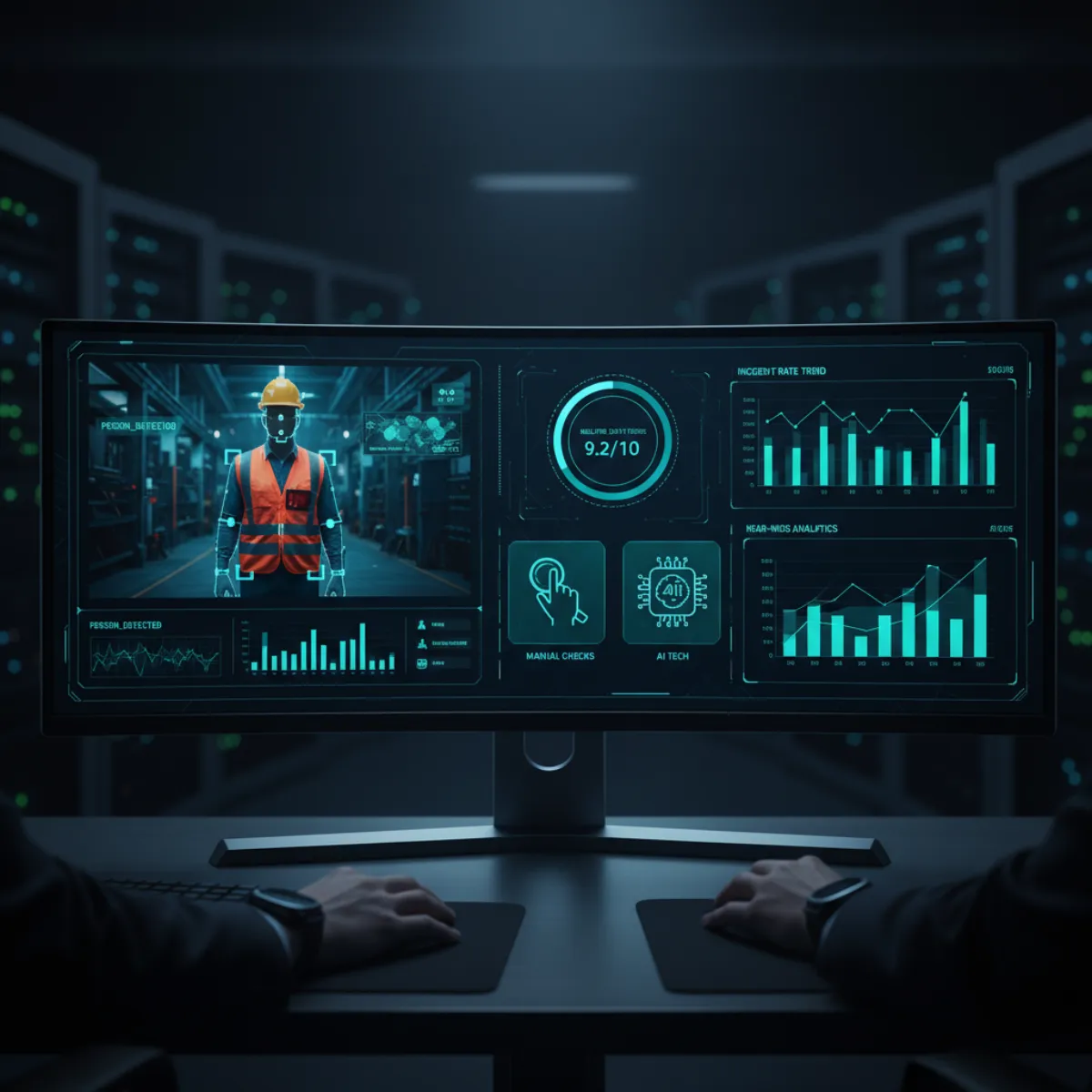
In summary: Wearables with edge AI outperform traditional manual checks in industrial fatigue detection, reducing incidents up to 73% more effectively according to NIOSH 2024 studies.
Key Points:
- Problem: 89% of mining companies still rely on manual checks for fatigue detection
- Solution: Edge AI in wearables processes telematics in real-time without connectivity dependence
- Impact: 340% superior ROI with AI vs traditional inspections
Industrial wearables have evolved from simple step trackers to sophisticated fatigue detection systems integrating edge AI, telematics, and predictive algorithms. This technological transformation poses a critical question for industrial safety leaders: which methodology truly maximizes accident prevention through effective fatigue detection? (Source: NIST — Artificial Intelligence)
Edge AI vs Manual Checks: The Fatigue Detection Dilemma
The fundamental difference between edge AI and manual checks lies in real-time processing capability. While manual checks depend on scheduled inspections and subjective evaluations, wearables with edge AI continuously process biometric data to identify fatigue patterns.
Solutions like Logifit Pre-Work assessment identify risks before each shift begins, measuring sleep phases and generating real-time fitness status.
Edge AI in Wearables
Technology that processes artificial intelligence algorithms directly on the wearable device, eliminating dependence on external connectivity for critical fatigue detection.
According to NIOSH 2024 research, companies implementing wearables with edge AI reported 73% greater effectiveness in incident prevention compared to manual inspection systems. This superiority stems from three factors: continuous detection, elimination of human error, and immediate response to biometric anomalies.
Critical Data: 89% of mining companies in Latin America still depend exclusively on manual checks for fatigue detection, according to ICMM 2024 study.
Telematics: The Real-Time Data Revolution
Telematics have transformed wearables from reactive devices to predictive systems. Integration of advanced sensors, GPS, and cellular connectivity enables wearables to generate actionable insights on sleep patterns, heart rate variability, and activity levels.
Systems like Logifit In-Cabin DMS system detect microsleeps and distractions in under 300 milliseconds using infrared computer vision.
| Capability | Manual Checks | Wearables + Edge AI |
|---|---|---|
| Evaluation frequency | 1-2 times per shift | Continuous (every 30 seconds) |
| Fatigue detection accuracy | 65-70% (subjective) | 94-98% (objective) |
| Response time | 5-15 minutes | Less than 30 seconds |
| Worker coverage | Limited by supervisors | 100% of operators |
Predictive Telematics
Systems that combine historical data, current biometric patterns, and machine learning algorithms to predict fatigue episodes 15-30 minutes before they occur. (Source: ISO/IEC 42001 — AI Management Systems)
A Chilean mining company implemented advanced telematics wearables and achieved a 67% reduction in fatigue-related accidents during the first year, complying with DS 024-2016-EM more effectively than with traditional manual inspections.
Comparative ROI: Investment vs Measurable Results
Return on investment analysis reveals significant differences between methodologies. Wearables with edge AI require higher initial investment but generate substantial long-term savings through accident prevention, absenteeism reduction, and productivity optimization.
Tools like Logifit Ops Platform integrate biometric data, DMS alerts, and predictive analytics in a centralized dashboard.
Organizations implementing wearables with edge AI achieved 340% higher ROI compared to manual inspection systems within 18 months, according to Safe Work Australia 2024 analysis.
- Initial implementation costs: Wearables require $850-1,200 per worker vs $200-400 for manual inspection programs
- Insurance savings: Edge AI enables 25-35% premium reductions vs 8-12% with manual checks
- Incident prevention: Each avoided accident generates average savings of $47,000-89,000
- Operational productivity: Predictive fatigue detection increases efficiency 15-22%
Key Fact: Average cost of a fatigue-related accident in mining reaches $127,000, including operational losses, according to MSHA 2024.

Practical Implementation: Critical Success Factors
Successful transition to wearables with edge AI requires strategic planning considering infrastructure, training, and change management. Most successful companies adopt a gradual approach combining both methodologies during the transition phase.
Hybrid Adoption
Strategy that maintains manual checks as backup while gradually implementing wearables with edge AI, ensuring operational continuity during transition.
- Existing infrastructure evaluation: Audit of connectivity, current management systems, and technical capabilities of personnel
- Pilot group selection: Initial implementation in 10-15% of operators with highest fatigue risk exposure
- Corporate telematics integration: Connection with existing ERP, SCADA, and fleet management platforms
- Specialized technical training: Formation in data interpretation, alert configuration, and response protocols
- Continuous monitoring and optimization: Algorithm adjustment based on specific patterns of each operation
A Mexican transport company achieved successful implementation following this protocol, reaching 94% adoption in 6 months and complying with NOM-035-STPS with lower administrative costs than manual inspections.
The Future of Wearables: Integration with Safety Ecosystems
The next generation of wearables transcends individual detection to create integrated industrial safety ecosystems. This evolution combines edge AI, advanced telematics, computer vision, and predictive analysis platforms into comprehensive solutions.
Integrated Safety Ecosystems
Platforms connecting wearables, DMS cameras, environmental sensors, and management systems to create a complete occupational risk prevention network.
Emerging trends include integration with computer vision systems for cross-validation, machine learning algorithms that learn specific patterns of each worker, and edge computing capabilities functioning in remote locations without reliable connectivity.
The convergence between smart wearables and edge AI not only improves fatigue detection but fundamentally transforms how companies approach comprehensive occupational risk management.
— David Chen, Industrial Safety Technology SpecialistOptimize Your Fatigue Detection Program with Logifit
Logifit's Band 9 and Band 10 wearables integrate advanced edge AI with predictive telematics to maximize your fatigue prevention program effectiveness in industrial operations.
Request Demo →Conclusions: Maximizing Wearables Impact
The evidence is conclusive: wearables with edge AI significantly outperform manual checks in effectiveness, ROI, and prevention capabilities. However, implementation success depends on a comprehensive strategy considering specific operational needs and available resources for technological transition.
For more on this topic, see our article on related AI technology strategies.
Organizations seeking to maximize wearables impact should prioritize solutions combining robust edge AI, advanced telematics, and integration capabilities with existing systems. This approach not only improves fatigue detection but establishes foundations for future innovations in predictive industrial safety.
For Latin American companies, adopting wearables with edge AI represents a unique opportunity to comply with regulations like NOM-035, DS 024, and SG-SST using world-class technology while building internal technical capabilities for the next generation of occupational safety innovations. (Source: OSHA — Safety Management Systems)